Brancaleoni Valentina, Nava Isabella, Delbini Paola, Duca Lorena, Motta Irene
Fondazione IRCCS Ca' Granda Ospedale Maggiore Policlinico, UOC General Medicine, Milan, Italy.
Department of Clinical Sciences and Community Health, University of Milan, Milan, Italy.
Mediterr J Hematol Infect Dis. 2020 Nov 1;12(1):e2020075. doi: 10.4084/MJHID.2020.075. eCollection 2020.
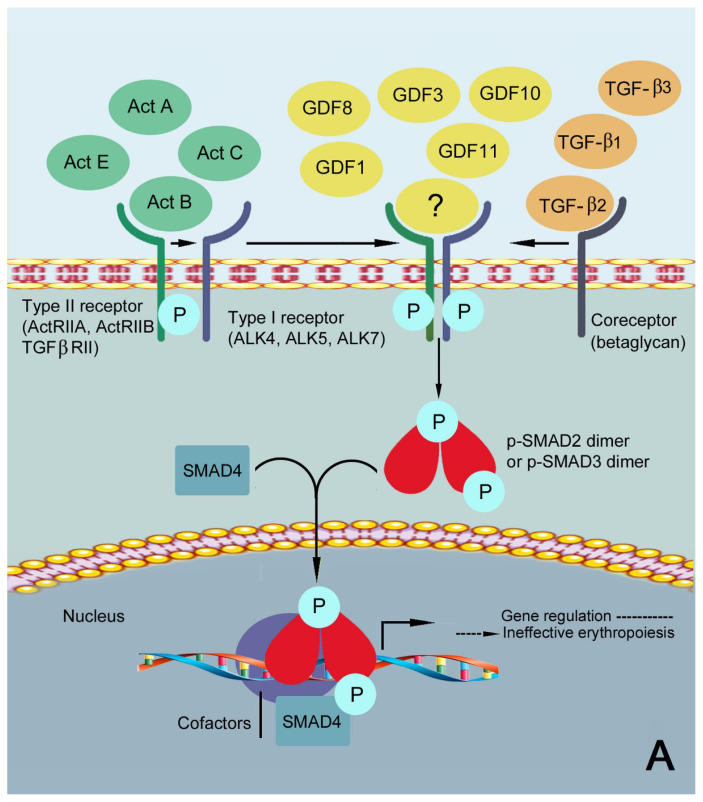
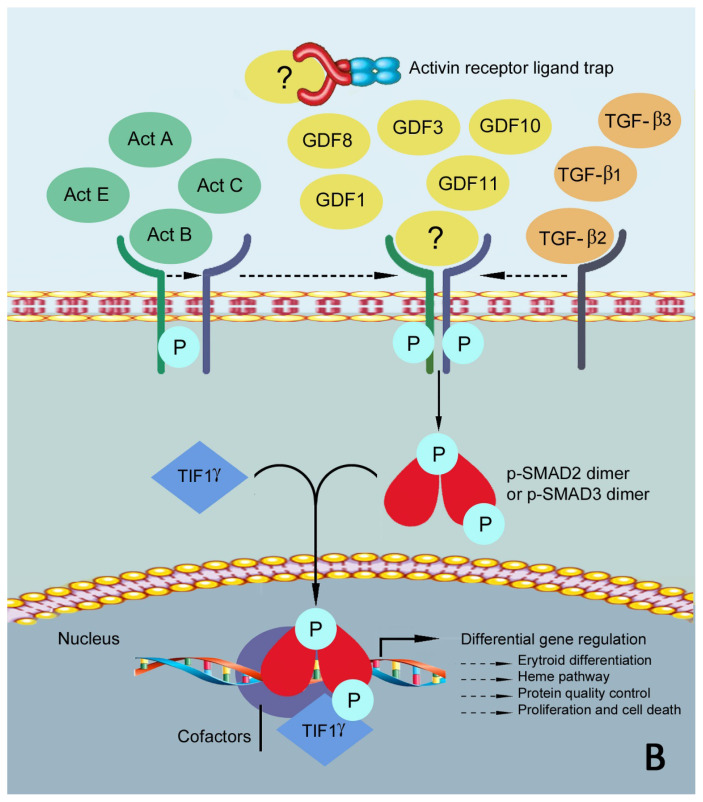
β-thalassemia is a hereditary disorder caused by defective production of β-globin chains of hemoglobin (Hb) that leads to an increased α/β globins ratio with subsequent free α-globins. Alpha globin excess causes oxidative stress, red blood cells membrane damage, premature death of late-stage erythroid precursors, resulting in ineffective erythropoiesis. The transforming growth factor β (TGF-β) superfamily signaling acts on biological processes, such as cell quiescence, apoptosis, proliferation, differentiation, and migration, and plays an essential role in regulating the hematopoiesis. This pathway can lose its physiologic regulation in pathologic conditions, leading to anemia and ineffective erythropoiesis. Activin receptor-ligand trap molecules such as Sotatercept and Luspatercept downregulate the TGF-β pathway, thus inhibiting the Smad2/3 cascade and alleviating anemia in patients with β-thalassemia and myelodysplastic syndromes. In this review, we describe the TGF-β pathway, as well as the molecular and biological basis of activin receptors ligand traps, focusing on their role in various β-thalassemia experimental models. The most recent results from clinical trials on sotatercept and luspatercept will also be reviewed.
β地中海贫血是一种遗传性疾病,由血红蛋白(Hb)的β珠蛋白链生成缺陷引起,导致α/β珠蛋白比例增加,随后出现游离α珠蛋白。α珠蛋白过量会导致氧化应激、红细胞膜损伤、晚期红系前体细胞过早死亡,从而导致无效造血。转化生长因子β(TGF-β)超家族信号作用于细胞静止、凋亡、增殖、分化和迁移等生物学过程,在调节造血过程中起重要作用。该途径在病理条件下可能失去生理调节,导致贫血和无效造血。索他西普和罗沙司他等激活素受体-配体陷阱分子可下调TGF-β途径,从而抑制Smad2/3级联反应,减轻β地中海贫血和骨髓增生异常综合征患者的贫血症状。在这篇综述中,我们描述了TGF-β途径以及激活素受体配体陷阱的分子和生物学基础,重点关注它们在各种β地中海贫血实验模型中的作用。还将综述索他西普和罗沙司他临床试验的最新结果。