Pérez-Botella Eduardo, Martínez-Franco Raquel, González-Camuñas Nuria, Cantín Ángel, Palomino Miguel, Moliner Manuel, Valencia Susana, Rey Fernando
Instituto de Tecnología Química, Universitat Politècnica de València-Consejo Superior de Investigaciones Científicas, Valencia, Spain.
Institut Français du Pétrole (IFP) Energies Nouvelles, Lyon, France.
Front Chem. 2020 Oct 28;8:588712. doi: 10.3389/fchem.2020.588712. eCollection 2020.
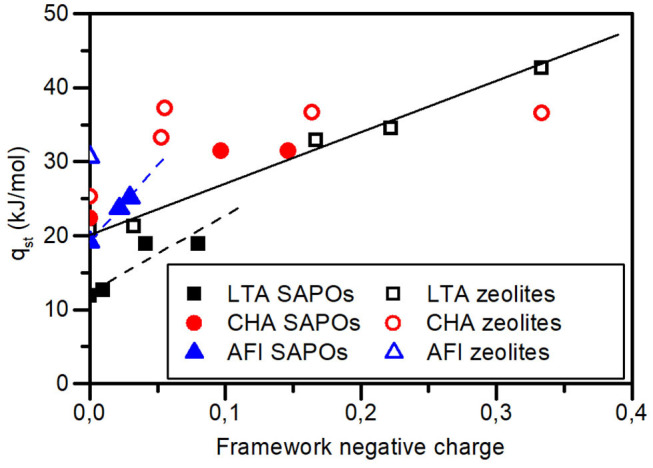
The capture of CO from post-combustion streams or from other mixtures, such as natural gas, is an effective way of reducing CO emissions, which contribute to the greenhouse effect in the atmosphere. One of the developing technologies for this purpose is physisorption on selective solid adsorbents. The ideal adsorbents are selective toward CO, have a large adsorption capacity at atmospheric pressure and are easily regenerated, resulting in high working capacity. Therefore, adsorbents combining molecular sieving properties and low heats of adsorption of CO are of clear interest as they will provide high selectivities and regenerabilities in CO separation process. Here we report that some aluminophosphate (AlPO) and silicoaluminophosphate (SAPO) materials with LTA, CHA and AFI structures present lower heats of adsorption of CO (13-25 kJ/mol) than their structurally analogous zeolites at comparable framework charges. In some cases, their heats of adsorption are even lower than those of pure silica composition (20-25 kJ/mol). This could mean a great improvement in the regeneration process compared to the most frequently used zeolitic adsorbents for this application while maintaining most of their adsorption capacity, if materials with the right stability and pore size and topology are found.
从燃烧后气流或其他混合物(如天然气)中捕获一氧化碳(CO)是减少CO排放的有效方法,CO排放会导致大气中的温室效应。为此目的,一种正在发展的技术是在选择性固体吸附剂上进行物理吸附。理想的吸附剂对CO具有选择性,在大气压下具有大的吸附容量且易于再生,从而具有高的工作容量。因此,兼具分子筛性能和低CO吸附热的吸附剂显然备受关注,因为它们将在CO分离过程中提供高选择性和可再生性。在此我们报告,一些具有LTA、CHA和AFI结构的铝磷酸盐(AlPO)和硅铝磷酸盐(SAPO)材料在可比的骨架电荷下,其CO吸附热(13 - 25 kJ/mol)低于其结构类似的沸石。在某些情况下,它们的吸附热甚至低于纯硅组成的材料(20 - 25 kJ/mol)。如果找到具有合适稳定性、孔径和拓扑结构的材料,与该应用中最常用的沸石吸附剂相比,这可能意味着再生过程有很大改进,同时保持其大部分吸附容量。