Nałęcz Katarzyna A
Laboratory of Transport Through Biomembranes, Nencki Institute of Experimental Biology, Warsaw, Poland.
Front Cell Dev Biol. 2020 Oct 21;8:594464. doi: 10.3389/fcell.2020.594464. eCollection 2020.
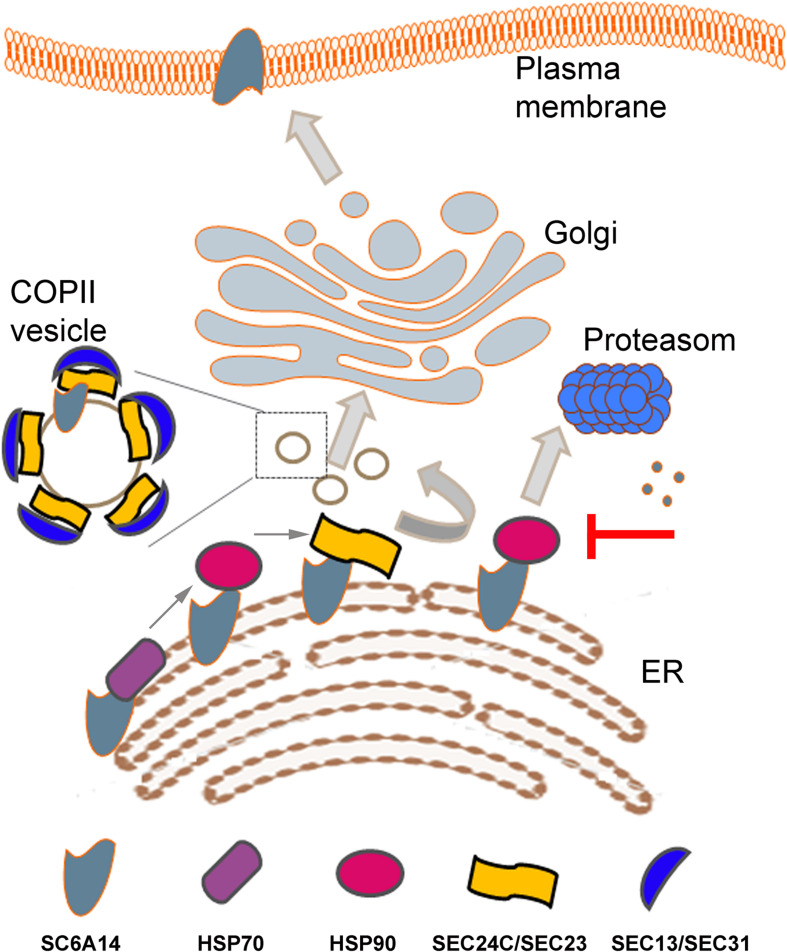
Cancer cells are characterized by quick growth and proliferation, demanding constant supply of various nutrients. Several plasma membrane transporters delivering such compounds are upregulated in cancer. Solute carrier family 6 member 14 (SLC6A14), known as amino acid transporter B (ATB) transports all amino acids with exception of the acidic ones: aspartate and glutamate. Its malfunctioning is correlated with several pathological states and it is upregulated in solid tumors. The high expression of is prognostic and unfavorable in pancreatic cancer, while in breast cancer it is expressed in estrogen receptor positive cells. As many plasma membrane transporters it resides in endoplasmic reticulum (ER) membrane after translation before further trafficking through Golgi to the cell surface. Transporter exit from ER is strictly controlled. The proper folding of SLC6A14 was shown to be controlled from the cytoplasmic side by heat shock proteins, further exit from ER and formation of coatomer II (COPII) coated vesicles depends on specific interaction with COPII cargo-recognizing subunit SEC24C, phosphorylated by kinase AKT. Inhibition of heat shock proteins, known to be upregulated in cancer, directs SLC6A14 to degradation. Targeting proteins regulating SLC6A14 trafficking is proposed as an additional pharmacological treatment of cancer.
癌细胞的特征是快速生长和增殖,需要持续供应各种营养物质。几种负责转运这些化合物的质膜转运蛋白在癌症中上调。溶质载体家族6成员14(SLC6A14),即氨基酸转运体B(ATB),可转运除酸性氨基酸天冬氨酸和谷氨酸之外的所有氨基酸。其功能失调与多种病理状态相关,并且在实体瘤中上调。在胰腺癌中,其高表达具有预后不良的意义,而在乳腺癌中,它在雌激素受体阳性细胞中表达。与许多质膜转运蛋白一样,它在翻译后定位于内质网(ER)膜,然后通过高尔基体进一步转运到细胞表面。转运蛋白从内质网的输出受到严格控制。已表明SLC6A14的正确折叠由细胞质一侧的热休克蛋白控制,从内质网的进一步输出以及II型被膜小泡(COPII)的形成取决于与被激酶AKT磷酸化的COPII货物识别亚基SEC24C的特异性相互作用。已知在癌症中上调的热休克蛋白的抑制会导致SLC6A14降解。靶向调节SLC6A14转运的蛋白质被提议作为癌症的一种额外药物治疗方法。