College of Basic Medicine, Chengdu University of Traditional Chinese Medicine, Chengdu 610075, Sichuan, China.
Institute of Acupuncture and Homeostasis Regulation, Chengdu University of Traditional Chinese Medicine, Chengdu 610075, Sichuan, China.
Aging (Albany NY). 2020 Nov 16;12(22):22538-22549. doi: 10.18632/aging.103663.
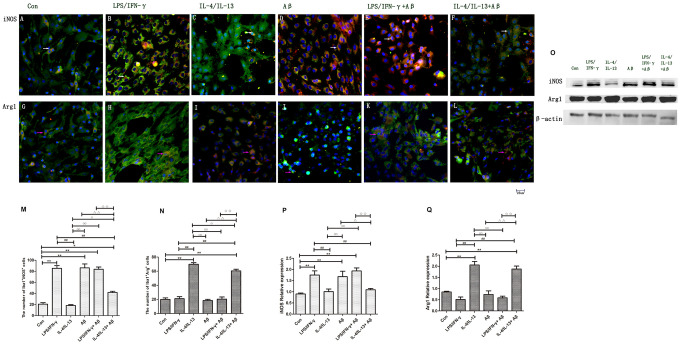
The immunological responses are a key pathological factor in Alzheimer's disease (AD). We hypothesized that microglial polarization alters microglia-astrocyte immune interactions in AD. M1 and M2 microglia were isolated from primary rat microglia and were confirmed to secrete pro-inflammatory and anti-inflammatory factors, respectively. Primary rat astrocytes were co-cultured with M1 or M2 microglial medium. M1 microglial medium increased astrocyte production of pro-inflammatory factors (interleukin [IL]-1β, tumor necrosis factor α and IL-6), while M2 microglial medium enhanced astrocyte production of anti-inflammatory factors (IL-4 and IL-10). To analyze the crosstalk between microglia and astrocytes after microglial polarization specifically in AD, we co-cultured astrocytes with medium from microglia treated with amyloid-β (Aβ) alone or in combination with other inflammatory substances. Aβ alone and Aβ combined with lipopolysaccharide/interferon-γ induced pro-inflammatory activity in M1 microglia and astrocytes, whereas IL-4/IL-13 inhibited Aβ-induced pro-inflammatory activity. Nuclear factor κB p65 was upregulated in M1 microglia and pro-inflammatory astrocytes, while Stat6 was upregulated in M2 microglia and anti-inflammatory astrocytes. These results provide direct evidence that microglial polarization governs communication between microglia and astrocytes, and that AD debris alters this crosstalk.
免疫反应是阿尔茨海默病(AD)的一个关键病理因素。我们假设小胶质细胞极化改变了 AD 中小胶质细胞-星形胶质细胞的免疫相互作用。从原代大鼠小胶质细胞中分离出 M1 和 M2 小胶质细胞,并证实它们分别分泌促炎和抗炎因子。将原代大鼠星形胶质细胞与 M1 或 M2 小胶质细胞培养基共培养。M1 小胶质细胞培养基增加了星形胶质细胞促炎因子(白细胞介素 [IL]-1β、肿瘤坏死因子 α 和 IL-6)的产生,而 M2 小胶质细胞培养基增强了星形胶质细胞抗炎因子(IL-4 和 IL-10)的产生。为了分析 AD 中小胶质细胞极化后小胶质细胞和星形胶质细胞之间的串扰,我们将星形胶质细胞与小胶质细胞经淀粉样蛋白-β(Aβ)单独或与其他炎症物质联合处理后的培养基共培养。Aβ 单独和 Aβ 联合脂多糖/干扰素-γ诱导 M1 小胶质细胞和星形胶质细胞的促炎活性,而 IL-4/IL-13 抑制 Aβ 诱导的促炎活性。M1 小胶质细胞和促炎星形胶质细胞中核因子 κB p65 上调,而 M2 小胶质细胞和抗炎星形胶质细胞中 Stat6 上调。这些结果提供了直接证据,表明小胶质细胞极化控制着小胶质细胞和星形胶质细胞之间的通讯,而 AD 碎片改变了这种串扰。