Department of Cardiovascular Disease, Jiangmen Central Hospital of Sun Yat-sen University, Jiangmen, Guangdong.
Department of Hypertension and Vascular Disease, The First Affiliated Hospital of Sun Yat-sen University, Guangzhou.
J Hypertens. 2021 May 1;39(5):970-978. doi: 10.1097/HJH.0000000000002715.
Angiogenic T cells (Tang cells), a recently discovered T-cell subset, have been reported involved in the repair of endothelial injury. The purpose of this study was to explore the correlation of immunologic senescence and pro-inflammatory capacity of Tang cells with endothelial dysfunction in hypertensive patients.
Immunological characteristics of Tang cells (CD3+CD31+CXCR4+) from hypertensive patients with or without endothelial dysfunction were elucidated by surface immunophenotyping and intracellular cytokine staining. Endothelial function was measured by flow-mediated dilation (FMD).
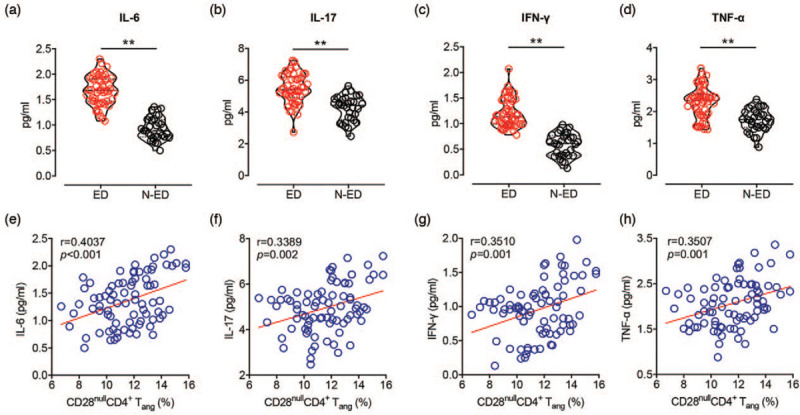
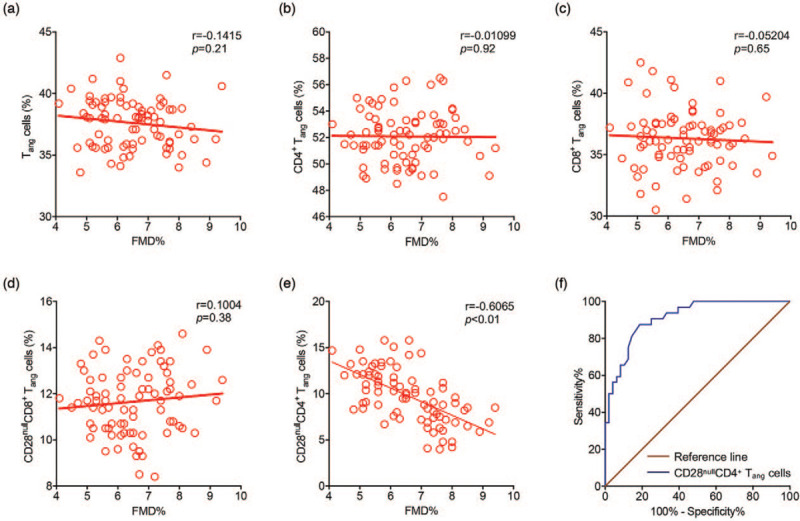
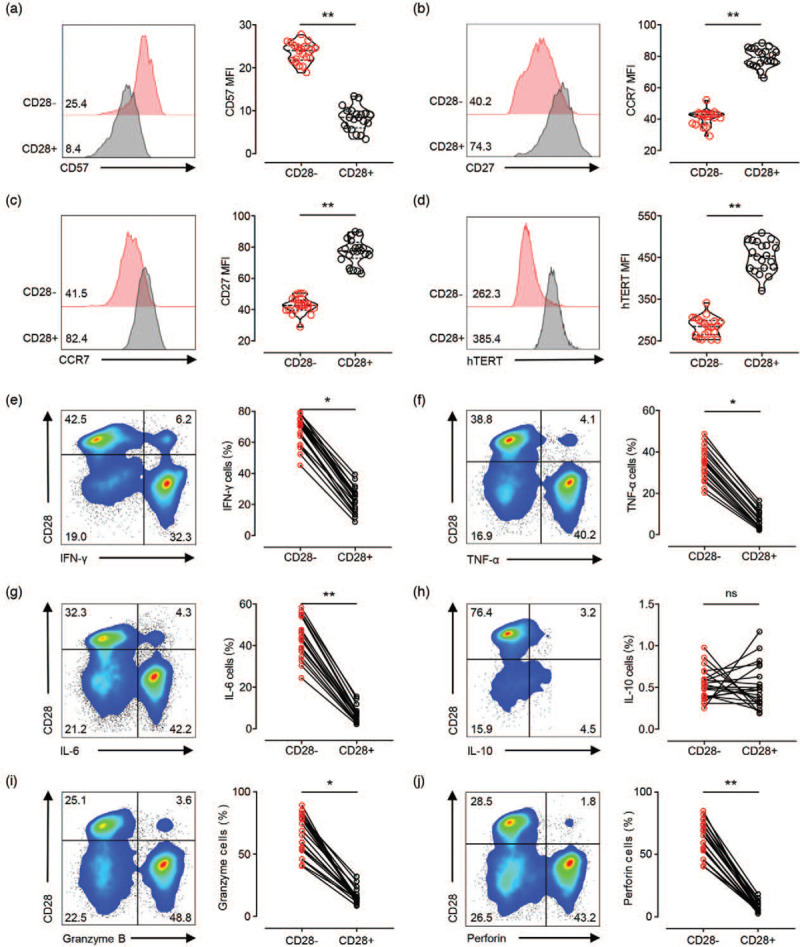
The frequency of CD28null subset in CD4+ Tang cells was notably elevated in hypertensive patients with endothelial dysfunction, which was negatively associated with FMD. The high frequency of CD28nullCD4+ Tang cells was an independent risk factor of endothelial dysfunction with good diagnostic performance in ROC curve analysis. Immunophenotyping revealed that this specific subset of Tang cells exhibited senescent profile and has low hTERT expression. CD28nullCD4+ Tang cells produced high levels of inflammatory cytokines, IL-6, IFN-γ and TNF-α, and significantly correlated with the systemic inflammation in hypertensive patients with endothelial dysfunction.
Collectively, our findings demonstrate for the first time that CD28null subset in CD4+ Tang cells with senescent and pro-inflammatory phenotype is dependently correlated with impaired FMD and systemic inflammation, which might contribute to the immunopathologic mechanism of endothelial dysfunction. Identification of a pathogenic CD4+ Tang-cell subset lacking CD28 may offer opportunities for the evaluation and management of endothelial dysfunction in hypertension.
新近发现的 T 细胞亚群——血管生成 T 细胞(Tang 细胞)被报道参与内皮损伤修复。本研究旨在探讨高血压患者中 Tang 细胞的免疫衰老和促炎能力与内皮功能障碍的相关性。
通过表面免疫表型和细胞内细胞因子染色阐明伴有或不伴有内皮功能障碍的高血压患者中 Tang 细胞(CD3+CD31+CXCR4+)的免疫学特征。采用血流介导的舒张功能(FMD)来测量内皮功能。
高血压伴内皮功能障碍患者的 CD4+Tang 细胞中 CD28null 亚群的频率明显升高,与 FMD 呈负相关。CD28nullCD4+Tang 细胞的高频率是内皮功能障碍的独立危险因素,ROC 曲线分析具有良好的诊断性能。免疫表型分析表明,这种特定的 Tang 细胞亚群具有衰老表型和低 hTERT 表达。CD28nullCD4+Tang 细胞产生高水平的炎症细胞因子 IL-6、IFN-γ 和 TNF-α,与高血压伴内皮功能障碍患者的全身炎症显著相关。
总之,我们的研究结果首次表明,CD4+Tang 细胞中具有衰老和促炎表型的 CD28null 亚群与 FMD 受损和全身炎症密切相关,这可能有助于内皮功能障碍的免疫病理机制。鉴定缺乏 CD28 的致病性 CD4+Tang 细胞亚群可能为高血压患者内皮功能障碍的评估和管理提供机会。