Alotaibi Tareq F, Thackray Alice E, Roberts Matthew J, Alanazi Turki M, Bishop Nicolette C, Wadley Alex J, King James A, O'Donnell Emma, Steiner Michael C, Singh Sally J, Stensel David J
School of Sport, Exercise and Health Sciences, National Centre for Sport and Exercise Medicine, Loughborough University, Loughborough, UNITED KINGDOM.
Med Sci Sports Exerc. 2021 May 1;53(5):1021-1032. doi: 10.1249/MSS.0000000000002560.
Cigarette smoking is an independent risk factor for coronary heart disease and is associated with impaired postprandial metabolism. Acute exercise reduces postprandial lipemia and improves other coronary heart disease risk markers in nonsmokers. Less is known about responses in cigarette smokers.
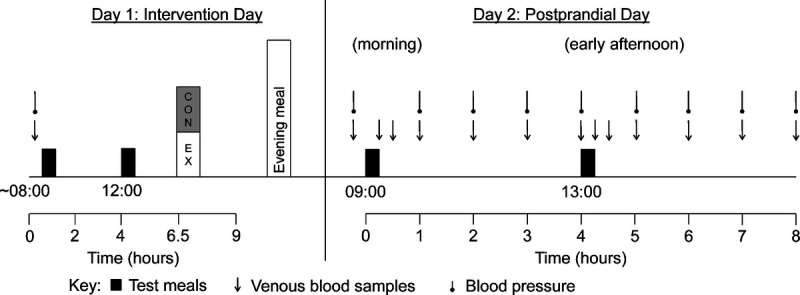
Twelve male cigarette smokers (mean ± SD; age = 23 ± 4 yr, body mass index = 24.9 ± 3.0 kg·m-2) and 12 male nonsmokers (age = 24 ± 4 yr, body mass index = 24.1 ± 2.0 kg·m-2) completed two, 2-d conditions (control and exercise) in a randomized crossover design. On day 1, participants rested for 9 h (0800-1700) in both conditions except a 60-min treadmill run (65% ± 7% peak oxygen uptake, 2.87 ± 0.54 MJ) was completed between 6.5 and 7.5 h (1430-1530) in the exercise condition. On day 2 of both conditions, participants rested and consumed two high-fat meals over 8 h (0900-1700) during which 13 venous blood samples and nine resting arterial blood pressure measurements were collected.
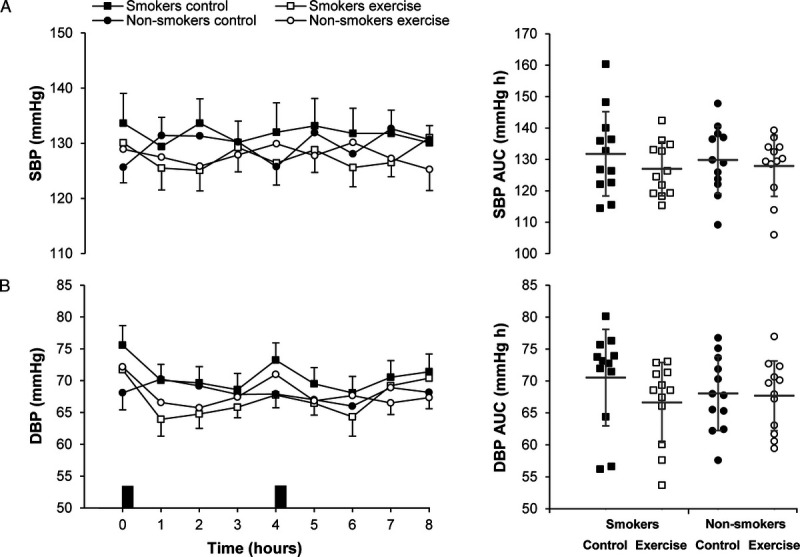
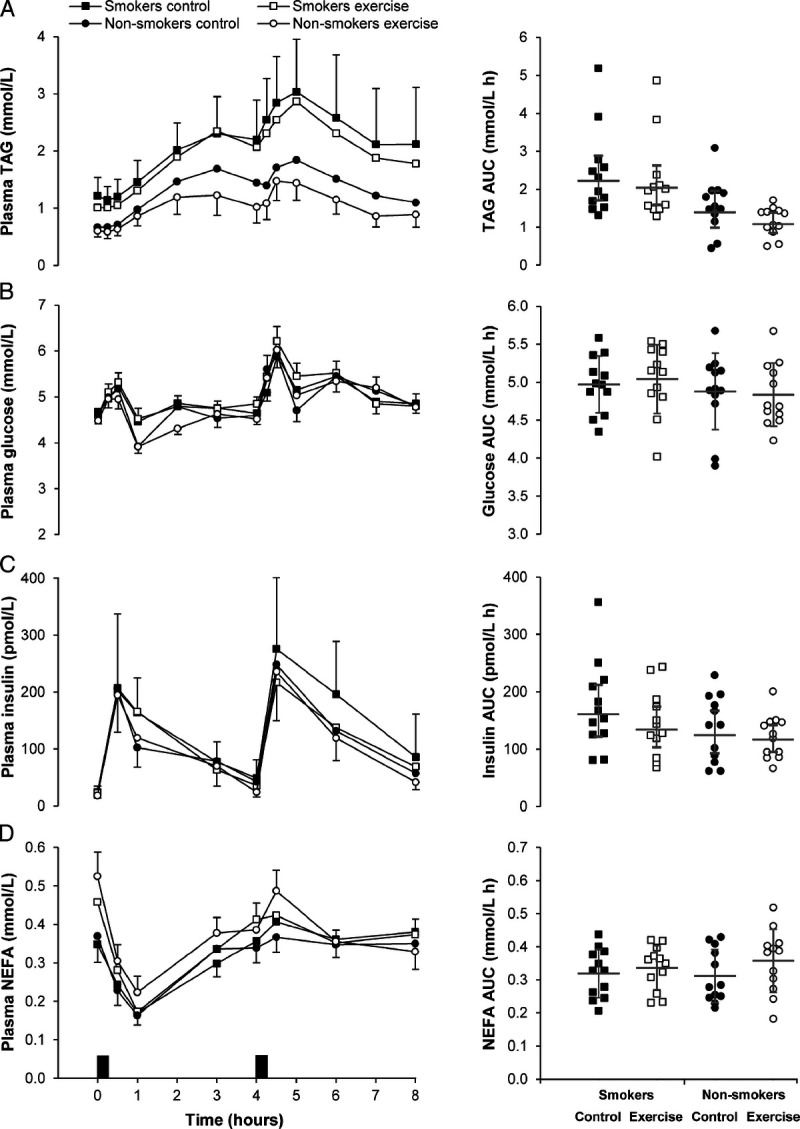
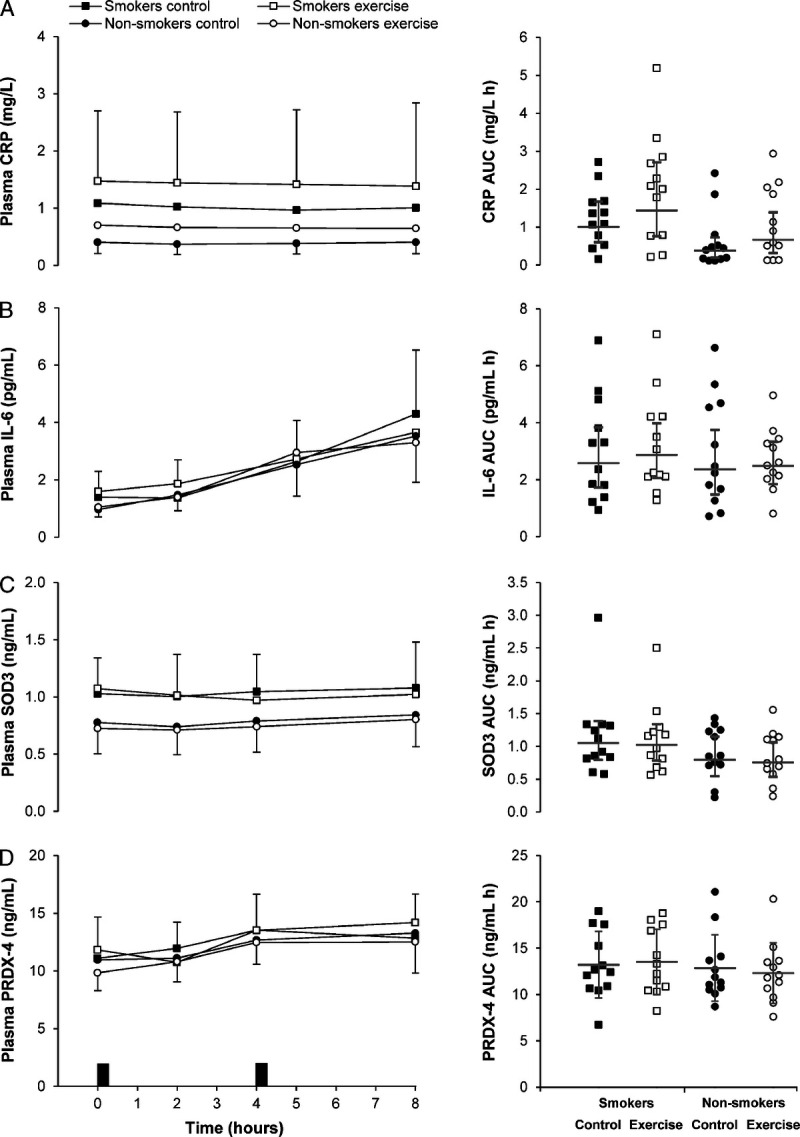
Smokers exhibited higher postprandial triacylglycerol and C-reactive protein than nonsmokers (main effect group effect size [Cohen's d] ≥ 0.94, P ≤ 0.034). Previous day running reduced postprandial triacylglycerol, insulin, and systolic and diastolic blood pressure (main effect condition d ≥ 0.28, P ≤ 0.044) and elevated postprandial nonesterified fatty acid and C-reactive protein (main effect condition d ≥ 0.41, P ≤ 0.044). Group-condition interactions were not apparent for any outcome across the total postprandial period (0-8 h; all P ≥ 0.089), but the exercise-induced reduction in postprandial triacylglycerol in the early postprandial period (0-4 h) was greater in nonsmokers than smokers (-21%, d = 0.43, vs -5%, d = 0.16, respectively; group-condition interaction P = 0.061).
Acute moderate-intensity running reduced postprandial triacylglycerol, insulin, and resting arterial blood pressure the day after exercise in male cigarette smokers and nonsmokers. These findings highlight the ability of acute exercise to augment the postprandial metabolic health of cigarette smokers and nonsmokers.
吸烟是冠心病的独立危险因素,且与餐后代谢受损有关。急性运动可降低非吸烟者的餐后血脂,并改善其他冠心病风险指标。而吸烟者对此的反应了解较少。
12名男性吸烟者(均值±标准差;年龄=23±4岁,体重指数=24.9±3.0kg·m-2)和12名男性非吸烟者(年龄=24±4岁,体重指数=24.1±2.0kg·m-2)采用随机交叉设计完成两种为期2天的情况(对照和运动)。第1天,在两种情况下参与者均休息9小时(08:00-17:00),但在运动情况下,在6.5至7.5小时(14:30-15:30)之间完成一次60分钟的跑步机跑步(峰值摄氧量的65%±7%,2.87±0.54兆焦)。在两种情况的第2天,参与者休息并在8小时(09:00-17:00)内食用两顿高脂肪餐,在此期间采集13份静脉血样本并测量9次静息动脉血压。
吸烟者的餐后甘油三酯和C反应蛋白高于非吸烟者(主要效应组效应量[科恩d值]≥0.94,P≤0.034)。前一天跑步降低了餐后甘油三酯、胰岛素、收缩压和舒张压(主要效应情况d≥0.28,P≤0.044),并提高了餐后非酯化脂肪酸和C反应蛋白(主要效应情况d≥0.41,P≤0.044)。在整个餐后期间(0-8小时),任何结果的组-情况交互作用均不明显(所有P≥0.089),但在餐后早期(0-4小时),运动引起的餐后甘油三酯降低在非吸烟者中比吸烟者更大(分别为-21%,d=0.43,对比-5%,d=0.16;组-情况交互作用P=0.061)。
急性中等强度跑步在运动后的第二天降低了男性吸烟者和非吸烟者的餐后甘油三酯、胰岛素和静息动脉血压。这些发现突出了急性运动增强吸烟者和非吸烟者餐后代谢健康的能力。