Department of Neurology (AGH), Perelman School of Medicine, University of Pennsylvania, Philadelphia, Pennsylvania; Department of Neurology and Ophthalmology & Visual Sciences (LBDL, TD), University of Michigan, Ann Arbor, Michigan; and Department of Ophthalmology and Neurology & Neurological Sciences (HEM), Stanford University, Palo Alto, California.
J Neuroophthalmol. 2020 Dec;40(4):514-519. doi: 10.1097/WNO.0000000000000971.
Administrative health claims data have been used for research in neuro-ophthalmology, but the validity of International Classification of Diseases (ICD) codes for identifying neuro-ophthalmic conditions is unclear.
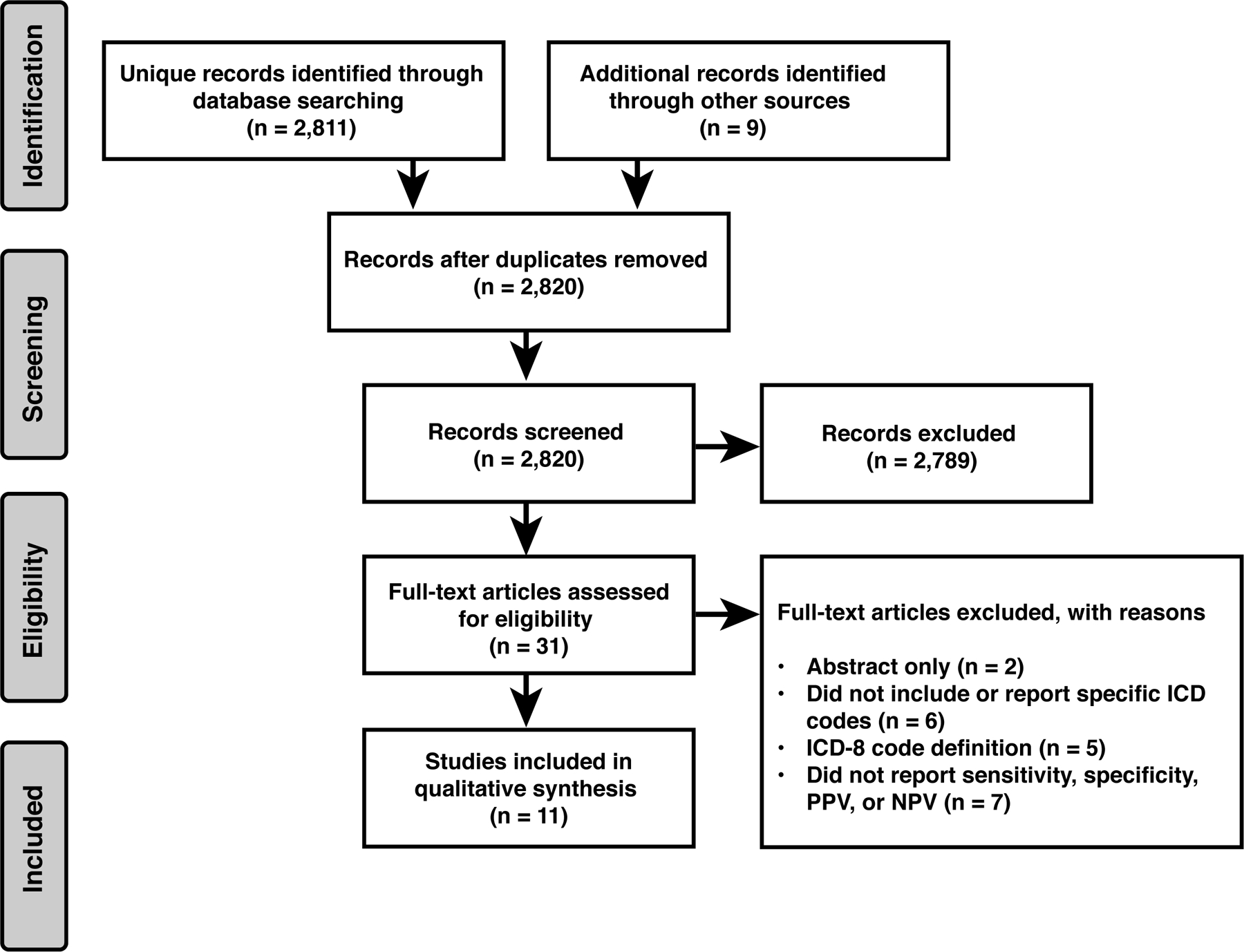
We performed a systematic literature review to assess the validity of administrative claims data for identifying patients with neuro-ophthalmic disorders. Two reviewers independently reviewed all eligible full-length articles and used a standardized abstraction form to identify ICD code-based definitions for 9 neuro-ophthalmic conditions and their sensitivity, specificity, positive predictive value (PPV), and negative predictive value (NPV). A quality assessment of eligible studies was also performed.
Eleven articles that met criteria for inclusion are as follows: 3 studies of idiopathic intracranial hypertension (PPV 54%-91% and NPV 74%-85%), 2 studies of giant cell arteritis (sensitivity 30%-96% and PPV 94%), 3 studies of optic neuritis (sensitivity 76%-99%, specificity 83%-100%, PPV 25%-100%, and NPV 98%-100%), 1 study of neuromyelitis optica (sensitivity 60%, specificity 100%, PPV 43%-100%, and NPV 98%-100%), 1 study of ocular motor cranial neuropathies (PPV 98%-99%), and 2 studies of myasthenia gravis (sensitivity 53%-97%, specificity 99%-100%, PPV 5%-90%, and NPV 100%). No studies met eligibility criteria for nonarteritic ischemic optic neuropathy, thyroid eye disease, and blepharospasm. Approximately 45.5% provided only one measure of diagnostic accuracy. Complete information about the validation cohorts, inclusion/exclusion criteria, data collection methods, and expertise of those reviewing charts for diagnostic accuracy was missing in 90.9%, 72.7%, 81.8%, and 36.4% of studies, respectively.
Few studies have reported the validity of ICD codes for neuro-ophthalmic conditions. The range of diagnostic accuracy for some disorders and study quality varied widely. This should be taken into consideration when interpreting studies of neuro-ophthalmic conditions using administrative claims data.
行政健康索赔数据已被用于神经眼科研究,但国际疾病分类(ICD)代码用于识别神经眼科疾病的有效性尚不清楚。
我们进行了系统的文献综述,以评估行政索赔数据识别神经眼科疾病患者的有效性。两名审查员独立审查了所有符合条件的全文文章,并使用标准化的抽象表格,根据 ICD 代码确定了 9 种神经眼科疾病的定义及其敏感性、特异性、阳性预测值(PPV)和阴性预测值(NPV)。还对合格研究进行了质量评估。
符合纳入标准的 11 篇文章如下:3 项特发性颅内高压研究(PPV 54%-91%和 NPV 74%-85%),2 项巨细胞动脉炎研究(敏感性 30%-96%和 PPV 94%),3 项视神经炎研究(敏感性 76%-99%,特异性 83%-100%,PPV 25%-100%和 NPV 98%-100%),1 项视神经脊髓炎研究(敏感性 60%,特异性 100%,PPV 43%-100%和 NPV 98%-100%),1 项眼运动颅神经病变研究(PPV 98%-99%),2 项重症肌无力研究(敏感性 53%-97%,特异性 99%-100%,PPV 5%-90%和 NPV 100%)。没有研究符合非动脉炎性缺血性视神经病变、甲状腺眼病和眼睑痉挛的入选标准。大约 45.5%的研究仅提供了一种诊断准确性衡量标准。在分别有 90.9%、72.7%、81.8%和 36.4%的研究中,验证队列的完整信息、纳入/排除标准、数据收集方法以及评估图表以确定诊断准确性的专业知识均缺失。
很少有研究报告了 ICD 代码用于神经眼科疾病的有效性。一些疾病的诊断准确性范围和研究质量差异很大。在使用行政索赔数据解释神经眼科疾病的研究时,应考虑到这一点。