Laboratory of Malaria and Vector Research, National Institute of Allergy and Infectious Diseases, National Institutes of Health, Rockville, MD, 20892, USA.
Laboratory of Malaria and Vector Research, National Institute of Allergy and Infectious Diseases, National Institutes of Health, Rockville, MD, 20892, USA.
Int J Parasitol Drugs Drug Resist. 2020 Dec;14:208-217. doi: 10.1016/j.ijpddr.2020.10.009. Epub 2020 Oct 27.
Lumefantrine and mefloquine are used worldwide in artemisinin-based combination therapy (ACT) of malaria. Better understanding of drug susceptibility and resistance is needed and can be obtained from studies of genetic crosses.
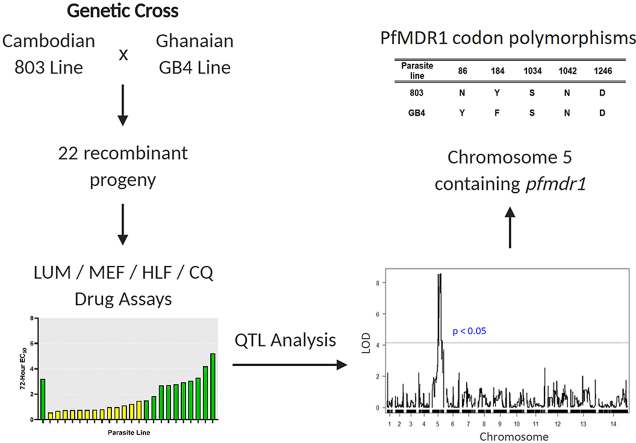
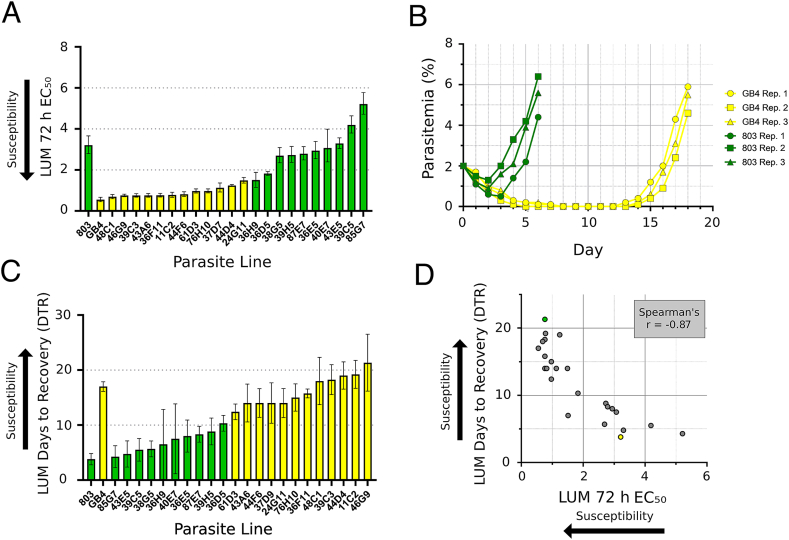
Drug response phenotypes of a cross between Plasmodium falciparum lines 803 (Cambodia) and GB4 (Ghana) were obtained as half-maximal effective concentrations (ECs) and days to recovery (DTR) after 24 h exposure to 500 nM lumefantrine. ECs of mefloquine, halofantrine, chloroquine, and dihydroartemisinin were also determined. Quantitative trait loci (QTL) analysis and statistical tests with candidate genes were used to identify polymorphisms associated with response phenotypes.
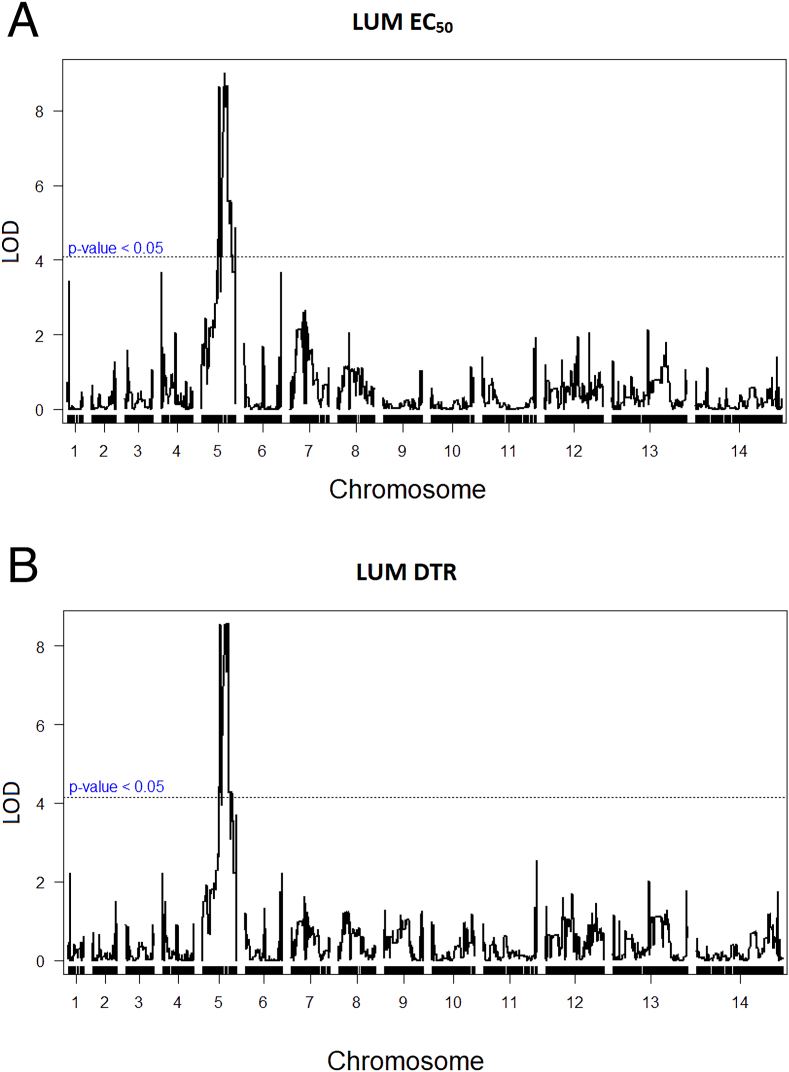
Lumefantrine ECs averaged 5.8-fold higher for the 803 than GB4 parent, and DTR results were 3-5 and 16-18 days, respectively. In 803 × GB4 progeny, outcomes of these two lumefantrine assays showed strong inverse correlation; these phenotypes also correlated strongly with mefloquine and halofantrine ECs. By QTL analysis, lumefantrine and mefloquine phenotypes mapped to a chromosome 5 region containing codon polymorphisms N86Y and Y184F in the P. falciparum multidrug resistance 1 protein (PfMDR1). Statistical tests of candidate genes identified correlations between inheritance of PfK13 Kelch protein polymorphism C580Y (and possibly K189T) and lumefantrine and mefloquine susceptibilities. Correlations were detected between lumefantrine and chloroquine ECs and polymorphisms N326S and I356T in the CVIET-type P. falciparum chloroquine resistance transporter (PfCRT) common to 803 and GB4.
Correlations in this study suggest common mechanisms of action in lumefantrine, mefloquine, and halofantrine responses. PfK13 as well as PfMDR1 and PfCRT polymorphisms may affect access and/or action of these arylaminoalcohol drugs at locations of hemoglobin digestion and heme metabolism. In endemic regions, pressure from use of lumefantrine or mefloquine in ACTs may drive selection of PfK13 polymorphisms along with versions of PfMDR1 and PfCRT associated with lower susceptibility to these drugs.
青蒿素复方疗法(ACT)在全球范围内使用了青蒿琥酯和甲氟喹。需要更好地了解药物敏感性和耐药性,而这可以通过遗传杂交研究获得。
通过在暴露于 500nM 青蒿琥酯 24 小时后获得 803(柬埔寨)和 GB4(加纳)两种疟原虫系之间的杂交的半最大有效浓度(EC)和恢复天数(DTR)来获得药物反应表型。还确定了甲氟喹、卤泛群、氯喹和双氢青蒿素的 EC。使用数量性状基因座(QTL)分析和候选基因的统计检验来鉴定与反应表型相关的多态性。
803 亲本的青蒿琥酯 EC 平均比 GB4 亲本高 5.8 倍,DTR 结果分别为 3-5 天和 16-18 天。在 803×GB4 后代中,这两种青蒿琥酯检测的结果显示出强烈的反比关系;这些表型也与甲氟喹和卤泛群的 EC 强烈相关。通过 QTL 分析,青蒿琥酯和甲氟喹表型定位在包含疟原虫多药耐药蛋白 1(PfMDR1)中的 N86Y 和 Y184F 密码子多态性的 5 号染色体区域。候选基因的统计检验表明,PfK13 Kelch 蛋白多态性 C580Y(可能还有 K189T)的遗传与青蒿琥酯和甲氟喹的敏感性之间存在相关性。在 803 和 GB4 共有的 CVIET 型疟原虫氯喹耐药转运蛋白(PfCRT)中检测到青蒿琥酯与氯喹 EC 之间以及 N326S 和 I356T 多态性之间的相关性。
本研究中的相关性表明青蒿琥酯、甲氟喹和卤泛群反应的作用机制相似。PfK13 以及 PfMDR1 和 PfCRT 多态性可能会影响这些芳基氨基醇类药物在血红蛋白消化和血红素代谢部位的进入和/或作用。在流行地区,由于青蒿琥酯或甲氟喹在 ACT 中的使用,可能会选择与这些药物敏感性较低相关的 PfK13 多态性以及 PfMDR1 和 PfCRT 版本。