Geriatric Unit, Department of Palliative Medicine, Poznan University of Medical Sciences, 61-245 Poznan, Poland.
Department of Biology and Environmental Protection, Poznan University of Medical Sciences, 60-806 Poznan, Poland.
Int J Environ Res Public Health. 2020 Nov 12;17(22):8362. doi: 10.3390/ijerph17228362.
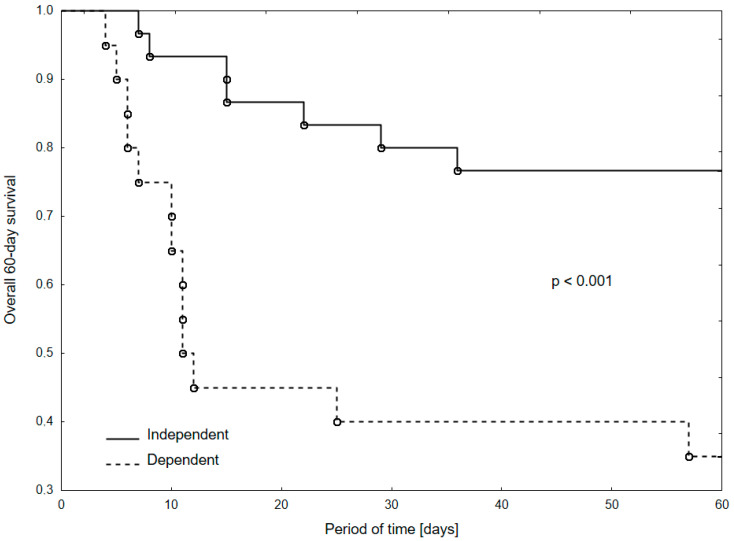
The older population is one of the most vulnerable to experience adverse outcomes of COVID-19. Exploring different clinical features that may act as detrimental to this population's survival is pivotal for recognizing the highest risk individuals for poor outcome. We thus aimed to characterize the clinical differences between 60-day survivors and non-survivors, as well as analyze variables influencing survival in the first older adults hospitalized in Poznan, Poland, with COVID-19. Symptoms, comorbidities, complications, laboratory results, and functional capacity regarding the first 50 older patients (≥60 years) hospitalized due to COVID-19 were retrospectively studied. Functional status before admission (dependent/independent) was determined based on medical history. The 60-day survivors ( = 30/50) and non-survivors ( = 20/50) were compared across clinical parameters. The patients had a mean age of 74.8 ± 9.4 years. Overall, 20/50 patients died during hospitalization, with no further fatal outcomes reported during the 60-day period. The non-survivors were on average older (78.3 ± 9.7 years), more commonly experienced concurrent heart disease (75%), and displayed functional dependence (65%) ( < 0.05). When assessing the variables influencing survival (age, heart disease, and functional dependence), using a multivariate proportional hazards regression, functional dependence (requiring assistance in core activities of daily living) was the main factor affecting 60-day survival (HR, 3.34; 95% CI: 1.29-8.63; = 0.01). In our study, functional dependence was the most important prognostic factor associated with mortality. Elderly with COVID-19 who required assistance in core activities of daily living prior to hospitalization had a three times increased risk to experience mortality, as compared to those with complete independence. Exploring geriatric approaches, such as assessment of functional capacity, may assist in constructing comprehensive survival prognosis in the elderly COVID-19 population.
老年人群体是感染 COVID-19 后最容易出现不良后果的人群之一。探索可能对这一人群的生存造成不利影响的不同临床特征,对于识别预后不良的高危个体至关重要。因此,我们旨在描述波兰波兹南首次因 COVID-19 住院的老年患者(≥60 岁)中 60 天幸存者与非幸存者之间的临床差异,并分析影响其生存的变量。回顾性研究了 50 名因 COVID-19 首次住院的老年患者(≥60 岁)的症状、合并症、并发症、实验室结果和功能能力。入院前的功能状态(依赖/独立)根据病史确定。将 60 天幸存者(n=30/50)和非幸存者(n=20/50)的临床参数进行比较。患者的平均年龄为 74.8±9.4 岁。总体而言,50 名患者中有 20 名在住院期间死亡,在 60 天期间没有进一步的死亡。非幸存者的年龄平均较大(78.3±9.7 岁),更常见合并心脏病(75%),并表现出功能依赖(65%)(<0.05)。当评估影响生存的变量(年龄、心脏病和功能依赖)时,使用多变量比例风险回归,功能依赖(日常生活活动的核心活动需要帮助)是影响 60 天生存的主要因素(HR,3.34;95%CI:1.29-8.63;=0.01)。在我们的研究中,功能依赖是与死亡率相关的最重要的预后因素。与完全独立的患者相比,住院前日常生活活动核心活动需要帮助的 COVID-19 老年患者死亡风险增加了三倍。探索老年方法,如功能能力评估,可能有助于构建老年 COVID-19 人群的综合生存预后。