Department of Surgery, University of Wisconsin Hospitals and Clinics, 600 Highland Ave, Madison, WI, USA 53792.
Division of Pediatric Anesthesiology, Department of Anesthesiology, University of Wisconsin School of Medicine and Public Health, 600 Highland Avenue, Madison, WI, USA 53792.
J Pediatr Surg. 2021 Oct;56(10):1841-1845. doi: 10.1016/j.jpedsurg.2020.10.009. Epub 2020 Oct 19.
Minimally invasive repair of pectus excavatum (Nuss procedure) is associated with significant pain, and efforts to control pain impact resource utilization. Bilateral thoracic intercostal nerve cryoablation has been proposed as a novel technique to improve post-operative pain control, though the impact on hospital cost is unknown.
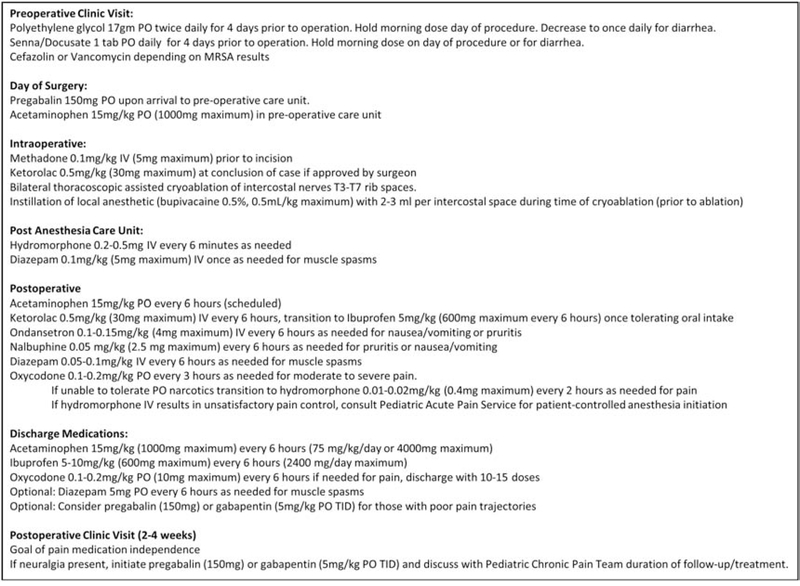
We conducted a retrospective study of patients undergoing a Nuss procedure from 2016 to 2019. Patients who received cryoablation were compared to those that received traditional pain control (patient-controlled analgesia or epidural). Outcome variables included postoperative opioid usage (milligram morphine equivalents, MME), length of stay (LOS), and hospital cost.
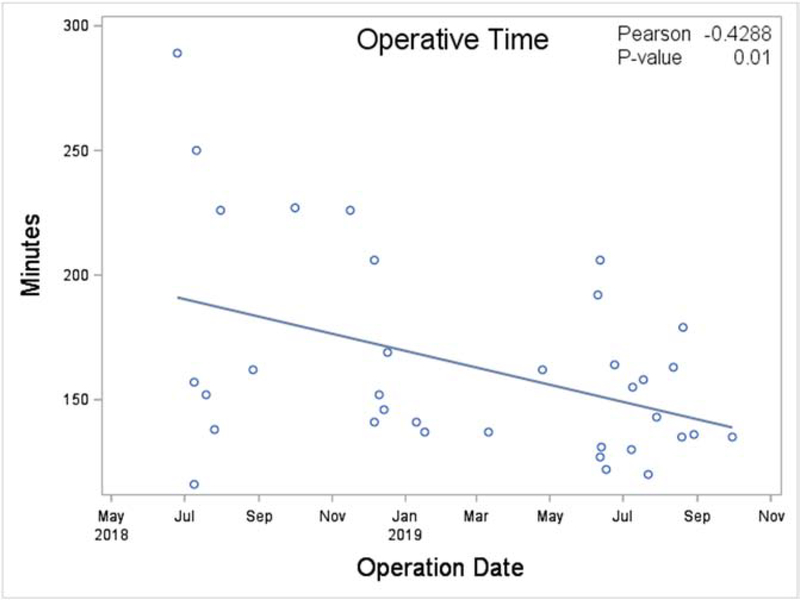
Thirty-five of 73 patients studied (48%) received intercostal nerve cryoablation. LOS (1.0 vs 4.0 days, p < 0.01) and total hospital cost ($21,924 versus $23,694, p = 0.04) were decreased in the cryoablation cohort, despite longer operative time (152 vs 74 min, p < 0.01). Cryoablation was associated with decreased opioid usage (15.0 versus 148.6 MME, p < 0.01) during the 24 h following surgery and this persisted over the entire postoperative period, including discharge opioid prescription (112.5 vs 300.0 MME, p < 0.01).
Bilateral intercostal nerve cryoablation is associated with decreased postoperative opioid usage and decreased resource utilization in pediatric patients undergoing a minimally invasive Nuss procedure for pectus excavatum.
Retrospective comparative study, level III.
微创漏斗胸修复术(Nuss 手术)相关的疼痛较为明显,而减轻疼痛的努力会影响资源利用。双侧胸肋间神经冷冻消融术已被提议作为一种改善术后疼痛控制的新方法,但对医院成本的影响尚不清楚。
我们对 2016 年至 2019 年期间接受 Nuss 手术的患者进行了回顾性研究。比较了接受冷冻消融术和接受传统疼痛控制(患者自控镇痛或硬膜外)的患者。观察指标包括术后阿片类药物使用量(吗啡等效毫克数,MME)、住院时间(LOS)和医院成本。
35 例(48%)患者接受了肋间神经冷冻消融术。冷冻消融组的 LOS(1.0 天与 4.0 天,p<0.01)和总住院费用(21924 美元与 23694 美元,p=0.04)降低,尽管手术时间延长(152 分钟与 74 分钟,p<0.01)。冷冻消融组术后 24 小时内阿片类药物使用量(15.0 毫克与 148.6 毫克 MME,p<0.01)和整个术后期间(包括出院阿片类药物处方,112.5 毫克与 300.0 毫克 MME,p<0.01)均减少。
在接受微创 Nuss 手术治疗漏斗胸的小儿患者中,双侧肋间神经冷冻消融术与术后阿片类药物使用量减少和资源利用率降低相关。
回顾性比较研究,III 级。