Molecular Microbial Ecology Group, Institute of Aquatic Ecology, University of Girona, Maria Aurèlia Capmany 40, 17003, Girona, Spain.
LEQUiA, Institute of the Environment, University of Girona, Maria Aurèlia Capmany 69, 17003, Girona, Spain.
Sci Rep. 2020 Nov 16;10(1):19852. doi: 10.1038/s41598-020-76694-y.
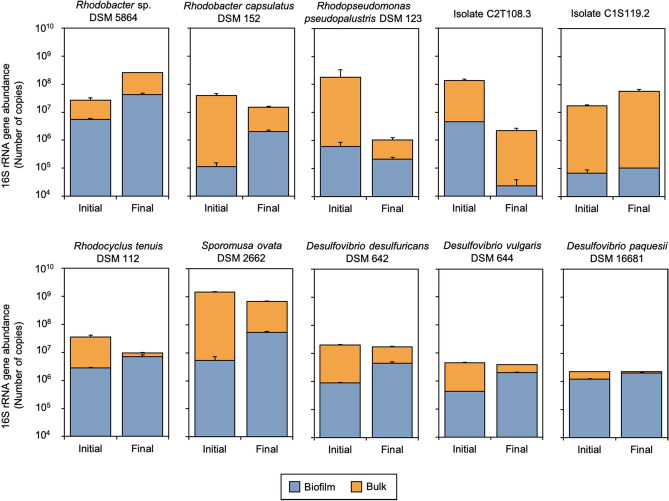
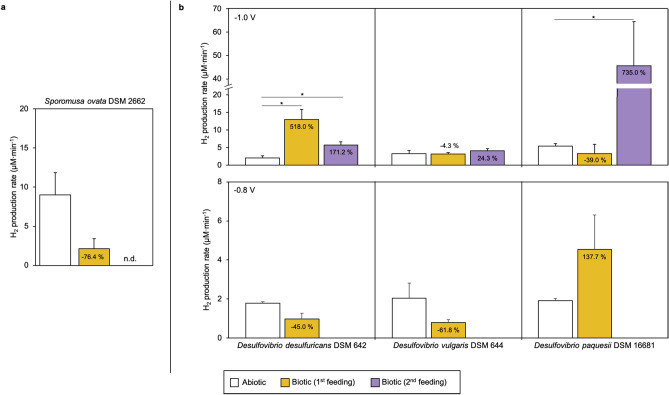
Hydrogen is a key intermediate element in microbial electrosynthesis as a mediator of the reduction of carbon dioxide (CO) into added value compounds. In the present work we aimed at studying the biological production of hydrogen in biocathodes operated at - 1.0 V vs. Ag/AgCl, using a highly comparable technology and CO as carbon feedstock. Ten bacterial strains were chosen from genera Rhodobacter, Rhodopseudomonas, Rhodocyclus, Desulfovibrio and Sporomusa, all described as hydrogen producing candidates. Monospecific biofilms were formed on carbon cloth cathodes and hydrogen evolution was constantly monitored using a microsensor. Eight over ten bacteria strains showed electroactivity and H production rates increased significantly (two to eightfold) compared to abiotic conditions for two of them (Desulfovibrio paquesii and Desulfovibrio desulfuricans). D. paquesii DSM 16681 exhibited the highest production rate (45.6 ± 18.8 µM min) compared to abiotic conditions (5.5 ± 0.6 µM min), although specific production rates (per 16S rRNA copy) were similar to those obtained for other strains. This study demonstrated that many microorganisms are suspected to participate in net hydrogen production but inherent differences among strains do occur, which are relevant for future developments of resilient biofilm coated cathodes as a stable hydrogen production platform in microbial electrosynthesis.
氢气是微生物电合成中的关键中间元素,作为将二氧化碳(CO)还原为附加值化合物的媒介。在本工作中,我们旨在研究在-1.0 V 相对于 Ag/AgCl 的生物阴极中生物产生氢气,使用高度可比的技术和 CO 作为碳原料。从 Rhodobacter、Rhodopseudomonas、Rhodocyclus、Desulfovibrio 和 Sporomusa 属中选择了十种细菌菌株,这些菌株均被描述为产氢候选物。单种生物膜在碳纤维布阴极上形成,使用微传感器不断监测氢气的产生。十种细菌中有八种表现出电活性,与非生物条件相比,两种细菌(脱硫弧菌和脱硫脱硫弧菌)的 H 产量显著增加(两倍至八倍)。与非生物条件(5.5±0.6 µM min)相比,D. paquesii DSM 16681 的产量最高(45.6±18.8 µM min),尽管特定产率(每 16S rRNA 拷贝)与其他菌株获得的产率相似。这项研究表明,许多微生物可能参与净氢气生产,但菌株之间存在固有差异,这对于微生物电合成中作为稳定氢气生产平台的有弹性的生物膜涂层阴极的未来发展很重要。