Department of Biology, Washington University in St. Louis, St. Louis, MO, 63130, USA.
Department of Mechanical Engineering and Materials Science, Washington University in St. Louis, St. Louis, MO, 63130, USA.
Nat Commun. 2019 Mar 22;10(1):1355. doi: 10.1038/s41467-019-09377-6.
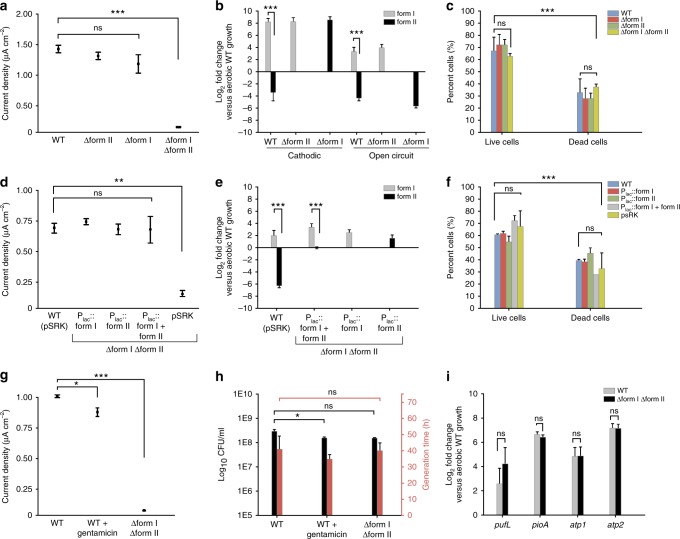
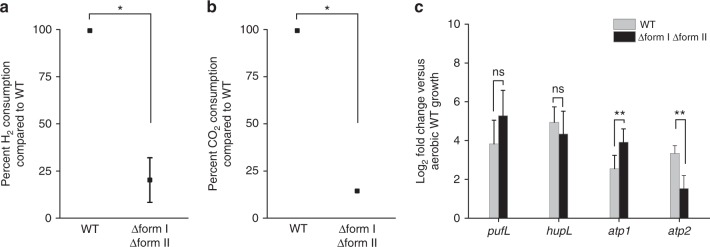
Extracellular electron uptake (EEU) is the ability of microbes to take up electrons from solid-phase conductive substances such as metal oxides. EEU is performed by prevalent phototrophic bacterial genera, but the electron transfer pathways and the physiological electron sinks are poorly understood. Here we show that electrons enter the photosynthetic electron transport chain during EEU in the phototrophic bacterium Rhodopseudomonas palustris TIE-1. Cathodic electron flow is also correlated with a highly reducing intracellular redox environment. We show that reducing equivalents are used for carbon dioxide (CO) fixation, which is the primary electron sink. Deletion of the genes encoding ruBisCO (the CO-fixing enzyme of the Calvin-Benson-Bassham cycle) leads to a 90% reduction in EEU. This work shows that phototrophs can directly use solid-phase conductive substances for electron transfer, energy transduction, and CO fixation.
细胞外电子摄取(EEU)是微生物从金属氧化物等固相导电物质中摄取电子的能力。EEU 由普遍存在的光养细菌属执行,但电子转移途径和生理电子汇仍不清楚。在这里,我们表明在光养细菌沼泽红假单胞菌 TIE-1 的 EEU 过程中,电子进入光合作用电子传递链。阴极电子流也与高度还原的细胞内氧化还原环境相关。我们表明,还原当量用于二氧化碳(CO)固定,这是主要的电子汇。编码 RuBisCO(卡尔文-本森-巴斯汉姆循环的 CO 固定酶)的基因缺失导致 EEU 减少 90%。这项工作表明,光能自养生物可以直接将固相导电物质用于电子转移、能量转导和 CO 固定。