Biomedical Engineering Research Center, Samsung Medical Center, Sungkyunkwan University School of Medicine, Seoul, Korea.
Department of Medical Device Management and Research, SAIHST, Sungkyunkwan University, Seoul, Korea.
Sci Rep. 2020 Nov 16;10(1):19897. doi: 10.1038/s41598-020-76987-2.
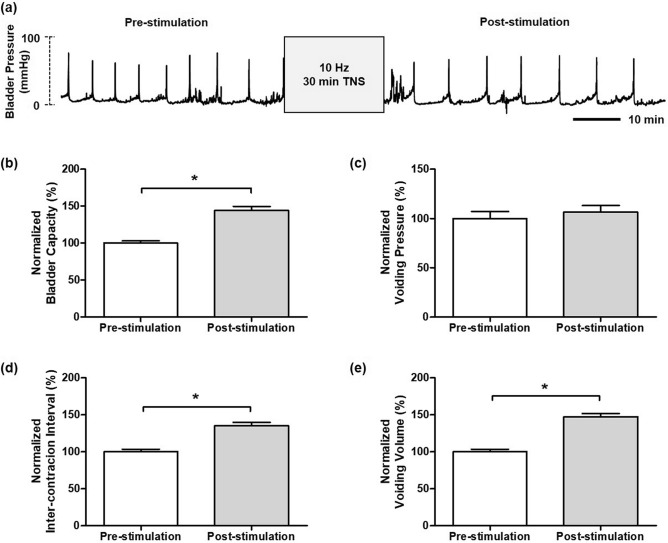
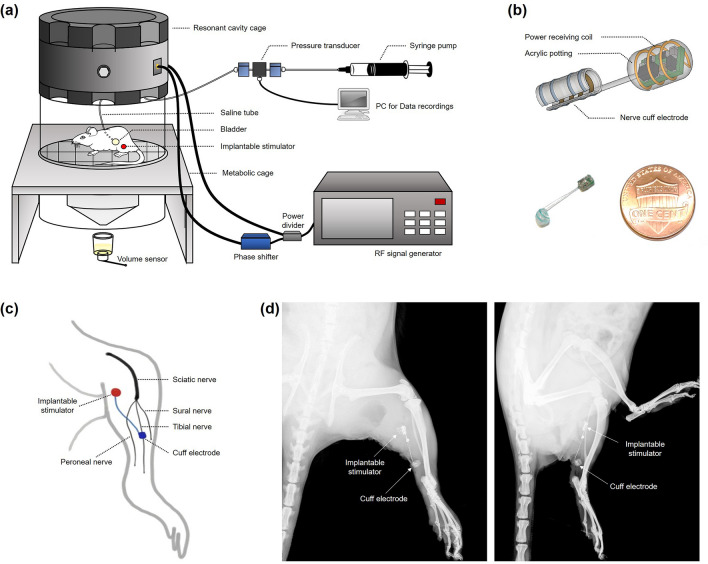
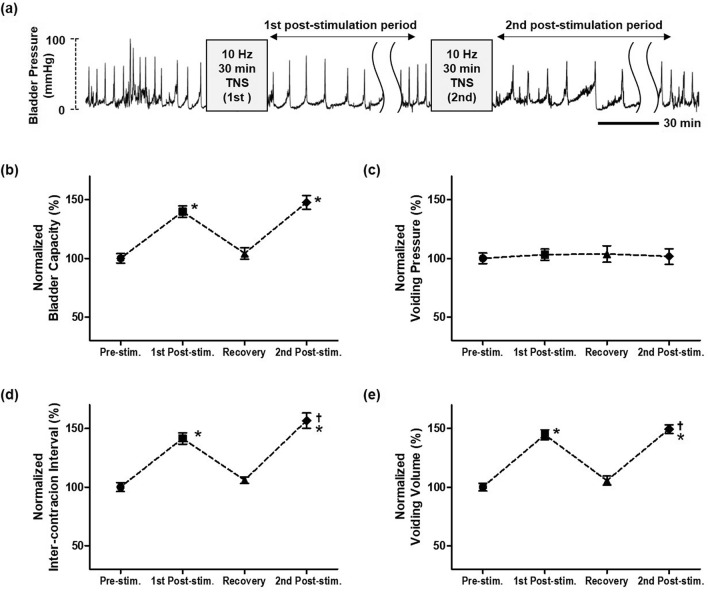
Tibial nerve stimulation (TNS) is one of the neuromodulation methods used to treat an overactive bladder (OAB). However, the treatment mechanism is not accurately understood owing to significant differences in the results obtained from animal and clinical studies. Thus, this study was aimed to confirm the response of bladder activity to the different stimulation frequencies and to observe the duration of prolonged post-stimulation inhibitory effects following TNS. This study used unanesthetized rats to provide a closer approximation of the clinical setting and evaluated the changes in bladder activity in response to 30 min of TNS at different frequencies. Moreover, we observed the long-term changes of post-stimulation inhibitory effects. Our results showed that bladder response was immediately inhibited after 30 min of 10 Hz TNS, whereas it was excited at 50 Hz TNS. We also used the implantable stimulator to observe a change in duration of the prolonged post-stimulation inhibitory effects of the TNS and found large discrepancies in the time that the inhibitory effect lasted after stimulation between individual animals. This study provides important evidence that can be used to understand the neurophysiological mechanisms underlying the bladder inhibitory response induced by TNS as well as the long-lasting prolonged post-stimulation effect.
胫神经刺激(TNS)是用于治疗过度活跃膀胱(OAB)的神经调节方法之一。然而,由于动物和临床研究结果存在显著差异,其治疗机制尚不清楚。因此,本研究旨在确认膀胱活动对不同刺激频率的反应,并观察 TNS 后长时间的刺激性抑制作用持续时间。本研究使用未麻醉大鼠来更接近临床环境,并评估在不同频率下进行 30 分钟 TNS 时膀胱活动的变化。此外,我们观察了刺激性抑制作用的长期变化。我们的结果表明,在 10 Hz TNS 刺激 30 分钟后,膀胱反应立即受到抑制,而在 50 Hz TNS 刺激后,膀胱反应被兴奋。我们还使用植入式刺激器观察 TNS 后长时间刺激性抑制作用的持续时间变化,发现个体动物之间刺激后抑制作用持续的时间存在很大差异。这项研究提供了重要的证据,可以用于理解 TNS 诱导的膀胱抑制反应的神经生理机制以及长时间的刺激性抑制作用。