Clinical Division for Endocrinology and Diabetology, Medical University Graz, Graz, Austria.
Center for Biomarker Research in Medicine (CBMed), Graz, Austria.
Diabetes Obes Metab. 2021 Feb;23(2):589-598. doi: 10.1111/dom.14256. Epub 2020 Dec 4.
To assess predictors of in-hospital mortality in people with prediabetes and diabetes hospitalized for COVID-19 infection and to develop a risk score for identifying those at the greatest risk of a fatal outcome.
A combined prospective and retrospective, multicentre, cohort study was conducted at 10 sites in Austria in 247 people with diabetes or newly diagnosed prediabetes who were hospitalized with COVID-19. The primary outcome was in-hospital mortality and the predictor variables upon admission included clinical data, co-morbidities of diabetes or laboratory data. Logistic regression analyses were performed to identify significant predictors and to develop a risk score for in-hospital mortality.
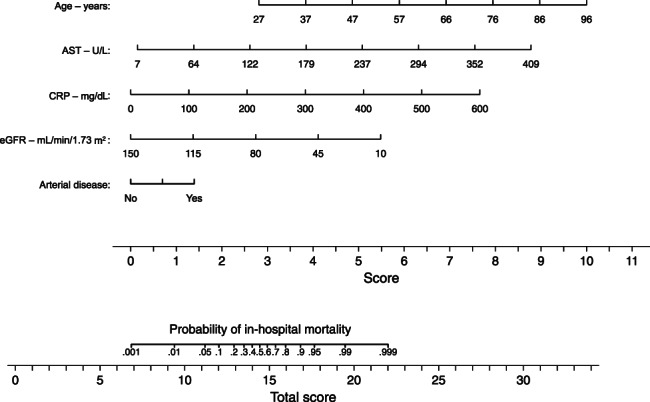
The mean age of people hospitalized (n = 238) for COVID-19 was 71.1 ± 12.9 years, 63.6% were males, 75.6% had type 2 diabetes, 4.6% had type 1 diabetes and 19.8% had prediabetes. The mean duration of hospital stay was 18 ± 16 days, 23.9% required ventilation therapy and 24.4% died in the hospital. The mortality rate in people with diabetes was numerically higher (26.7%) compared with those with prediabetes (14.9%) but without statistical significance (P = .128). A score including age, arterial occlusive disease, C-reactive protein, estimated glomerular filtration rate and aspartate aminotransferase levels at admission predicted in-hospital mortality with a C-statistic of 0.889 (95% CI: 0.837-0.941) and calibration of 1.000 (P = .909).
The in-hospital mortality for COVID-19 was high in people with diabetes but not significantly different to the risk in people with prediabetes. A risk score using five routinely available patient variables showed excellent predictive performance for assessing in-hospital mortality.
评估因 COVID-19 感染住院的糖尿病前期和糖尿病患者的院内死亡率预测因素,并制定一种风险评分来识别那些发生致命结局风险最大的患者。
在奥地利 10 个地点的 10 个中心进行了一项前瞻性和回顾性的联合队列研究,纳入了 247 名因 COVID-19 住院的糖尿病或新诊断的糖尿病前期患者。主要结局为院内死亡率,入院时的预测变量包括临床数据、糖尿病合并症或实验室数据。进行逻辑回归分析以确定显著的预测因素,并制定院内死亡率风险评分。
因 COVID-19 住院(n = 238)的患者平均年龄为 71.1 ± 12.9 岁,63.6%为男性,75.6%为 2 型糖尿病患者,4.6%为 1 型糖尿病患者,19.8%为糖尿病前期患者。平均住院时间为 18 ± 16 天,23.9%需要通气治疗,24.4%在医院死亡。糖尿病患者的死亡率(26.7%)略高于糖尿病前期患者(14.9%),但无统计学意义(P =.128)。包括入院时年龄、动脉闭塞性疾病、C 反应蛋白、估算肾小球滤过率和天冬氨酸氨基转移酶水平的评分预测院内死亡率的 C 统计量为 0.889(95%CI:0.837-0.941),校准度为 1.000(P =.909)。
COVID-19 患者的院内死亡率在糖尿病患者中较高,但与糖尿病前期患者的风险无显著差异。使用五个常规可用的患者变量的风险评分对评估院内死亡率具有出色的预测性能。