Second Division, Department of Internal Medicine, Hamamatsu University School of Medicine, Hamamatsu, Shizuoka, Japan.
Medical Education Center, Hamamatsu University School of Medicine, Hamamatsu, Shizuoka, Japan.
PLoS One. 2020 Nov 17;15(11):e0242380. doi: 10.1371/journal.pone.0242380. eCollection 2020.
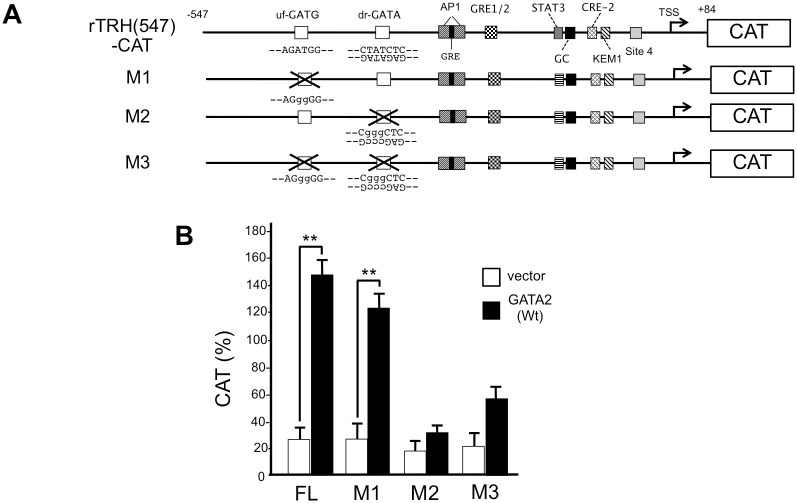
Thyroid hormone (T3) inhibits thyrotropin-releasing hormone (TRH) synthesis in the hypothalamic paraventricular nucleus (PVN). Although the T3 receptor (TR) β2 is known to mediate the negative regulation of the prepro-TRH gene, its molecular mechanism remains unknown. Our previous studies on the T3-dependent negative regulation of the thyrotropin β subunit (TSHβ) gene suggest that there is a tethering mechanism, whereby liganded TRβ2 interferes with the function of the transcription factor, GATA2, a critical activator of the TSHβ gene. Interestingly, the transcription factors Sim1 and Arnt2, the determinants of PVN differentiation in the hypothalamus, are reported to induce expression of TRβ2 and GATA2 in cultured neuronal cells. Here, we confirmed the expression of the GATA2 protein in the TRH neuron of the rat PVN using immunohistochemistry with an anti-GATA2 antibody. According to an experimental study from transgenic mice, a region of the rat prepro-TRH promoter from nt. -547 to nt. +84 was able to mediate its expression in the PVN. We constructed a chloramphenicol acetyltransferase (CAT) reporter gene containing this promoter sequence (rTRH(547)-CAT) and showed that GATA2 activated the promoter in monkey kidney-derived CV1 cells. Deletion and mutation analyses identified a functional GATA-responsive element (GATA-RE) between nt. -357 and nt. -352. When TRβ2 was co-expressed, T3 reduced GATA2-dependent promoter activity to approximately 30%. Unexpectedly, T3-dependent negative regulation was maintained after mutation of the reported negative T3-responsive element, site 4. T3 also inhibited the GATA2-dependent transcription enhanced by cAMP agonist, 8-bromo-cAMP. A rat thyroid medullary carcinoma cell line, CA77, is known to express the preproTRH mRNA. Using a chromatin immunoprecipitation assay with this cell line where GATA2 expression plasmid was transfected, we observed the recognition of the GATA-RE by GATA2. We also confirmed GATA2 binding using gel shift assay with the probe for the GATA-RE. In CA77 cells, the activity of rTRH(547)-CAT was potentiated by overexpression of GATA2, and it was inhibited in a T3-dependent manner. These results suggest that GATA2 transactivates the rat prepro-TRH gene and that liganded TRβ2 interferes with this activation via a tethering mechanism as in the case of the TSHβ gene.
甲状腺激素(T3)抑制下丘脑室旁核(PVN)中促甲状腺激素释放激素(TRH)的合成。虽然已知 T3 受体(TR)β2 介导前促甲状腺激素基因的负调控,但其分子机制尚不清楚。我们之前关于 T3 依赖性促甲状腺激素β亚基(TSHβ)基因负调控的研究表明存在一种连接机制,即配体结合的 TRβ2 干扰转录因子 GATA2 的功能,GATA2 是 TSHβ 基因的关键激活剂。有趣的是,转录因子 Sim1 和 Arnt2 是下丘脑 PVN 分化的决定因素,据报道它们在培养的神经元细胞中诱导 TRβ2 和 GATA2 的表达。在这里,我们使用抗 GATA2 抗体通过免疫组织化学法证实了大鼠 PVN 中 TRH 神经元中 GATA2 蛋白的表达。根据转基因小鼠的一项实验研究,大鼠前促甲状腺激素启动子的 nt. -547 到 nt. +84 区域能够介导其在 PVN 中的表达。我们构建了一个含有该启动子序列的氯霉素乙酰转移酶(CAT)报告基因(rTRH(547)-CAT),并表明 GATA2 在猴肾衍生的 CV1 细胞中激活了该启动子。缺失和突变分析确定了 nt. -357 到 nt. -352 之间的功能性 GATA 反应元件(GATA-RE)。当共表达 TRβ2 时,T3 将 GATA2 依赖性启动子活性降低至约 30%。出乎意料的是,在报道的负 T3 反应元件位点 4 发生突变后,T3 依赖性负调节仍然存在。T3 还抑制了 cAMP 激动剂 8-溴-cAMP 增强的 GATA2 依赖性转录。已知大鼠甲状腺髓样癌细胞系 CA77 表达前促甲状腺素 mRNA。使用该细胞系进行染色质免疫沉淀分析,其中转染了 GATA2 表达质粒,我们观察到 GATA2 对 GATA-RE 的识别。我们还使用 GATA-RE 探针通过凝胶迁移分析证实了 GATA2 结合。在 CA77 细胞中,GATA2 的过表达增强了 rTRH(547)-CAT 的活性,并且以 T3 依赖性方式受到抑制。这些结果表明,GATA2 转激活大鼠前促甲状腺素基因,并且配体结合的 TRβ2 通过连接机制干扰这种激活,就像 TSHβ 基因一样。