Erasmus School of Social and Behavioural Sciences, Erasmus University Rotterdam, The Netherlands; Research Center Adolescent Development, Utrecht University, The Netherlands; Brain and Development Research Center, Leiden University, The Netherlands.
Erasmus School of Social and Behavioural Sciences, Erasmus University Rotterdam, The Netherlands; Brain and Development Research Center, Leiden University, The Netherlands.
Dev Cogn Neurosci. 2020 Dec;46:100880. doi: 10.1016/j.dcn.2020.100880. Epub 2020 Nov 11.
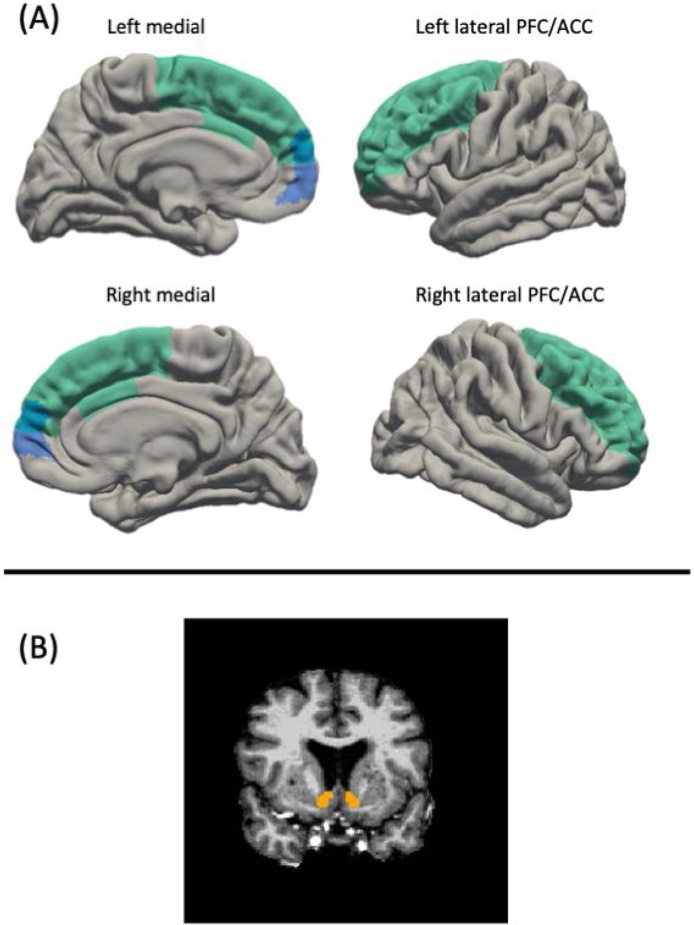
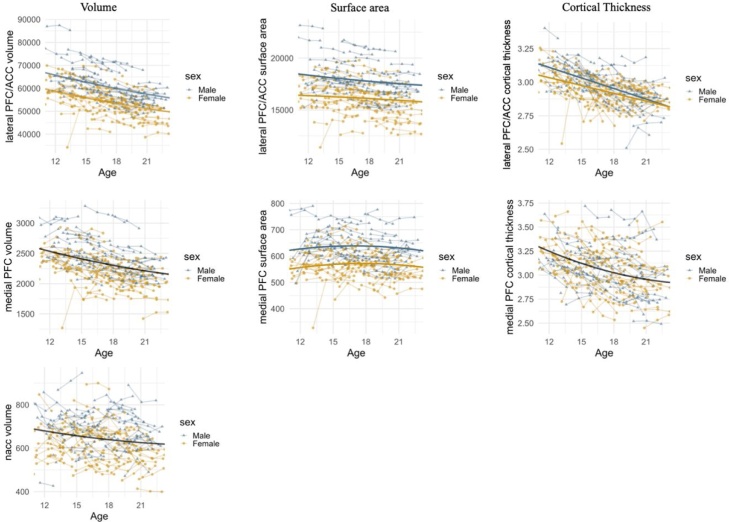
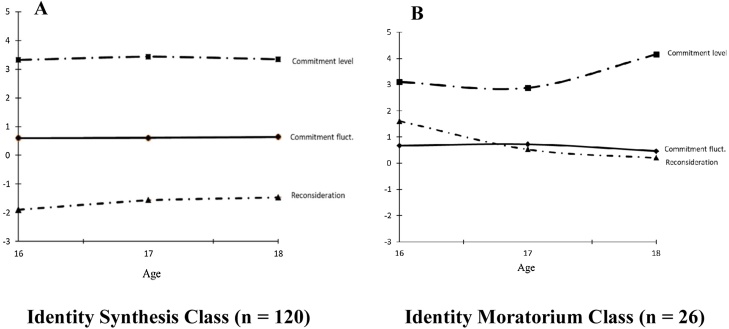
We tested whether adolescents with daily high identity uncertainty showed differential structural brain development across adolescence and young adulthood. Participants (N = 150, M 15.92 years) were followed across three waves, covering 4 years. Self-reported daily educational identity and structural brain data of lateral prefrontal cortex (lPFC)/anterior cingulate cortex (ACC), medial PFC, and nucleus accumbens (NAcc) was collected across three waves. All hypotheses were pre-registered. Latent class growth analyses confirmed 2 identity subgroups: an identity synthesis class (characterized by strong commitments, and low uncertainty), and an identity moratorium class (high daily identity uncertainty). Latent growth curve models revealed, on average, delayed maturation of the lateral PFC/ACC and medial PFC and stable NAcc. Yet, adolescents in identity moratorium showed lower levels and less decline in NAcc gray matter volume. Lateral PFC/ACC and medial PFC trajectories did not differ between identity subgroups. Exploratory analyses revealed that adolescents with higher baseline levels and delayed maturation of lateral PFC/ACC and medial PFC gray matter volume, surface area, and cortical thickness reported higher baseline levels and stronger increases of in-depth exploration. These results provide insight into how individual differences in brain development relate to fluctuations in educational identity development across adolescence and young adulthood.
我们测试了日常身份不确定性高的青少年在整个青春期和青年期是否存在不同的大脑结构发育。参与者(N=150,M 15.92 岁)在三个时间点被跟踪,覆盖了 4 年。在三个时间点收集了自我报告的日常教育身份和外侧前额叶皮层(lPFC)/前扣带皮层(ACC)、内侧前额叶皮层和伏隔核的结构脑数据。所有假设均预先注册。潜在类别增长分析证实了 2 种身份亚组:身份综合类(特征为强烈承诺和低不确定性)和身份暂停类(高日常身份不确定性)。潜在增长曲线模型显示,外侧 PFC/ACC 和内侧 PFC 的成熟度平均延迟,而 NAcc 则稳定。然而,身份暂停的青少年的 NAcc 灰质体积水平较低,下降幅度较小。身份亚组之间的外侧 PFC/ACC 和内侧 PFC 轨迹没有差异。探索性分析表明,基线水平较高且外侧 PFC/ACC 和内侧 PFC 灰质体积、表面积和皮质厚度成熟延迟的青少年报告说,基线水平较高,深入探索的增加幅度更大。这些结果提供了一些见解,说明大脑发育的个体差异如何与青春期和青年期教育身份发展的波动相关。