Section for Experimental Neuropsychiatry, Department of Psychiatry and Psychotherapy, Medical Center-University of Freiburg, Faculty of Medicine, University of Freiburg, 79104 Freiburg, Germany.
Department of Psychiatry and Psychotherapy, Medical Center-University of Freiburg, Faculty of Medicine, University of Freiburg, 79104 Freiburg, Germany.
Int J Mol Sci. 2020 Nov 15;21(22):8611. doi: 10.3390/ijms21228611.
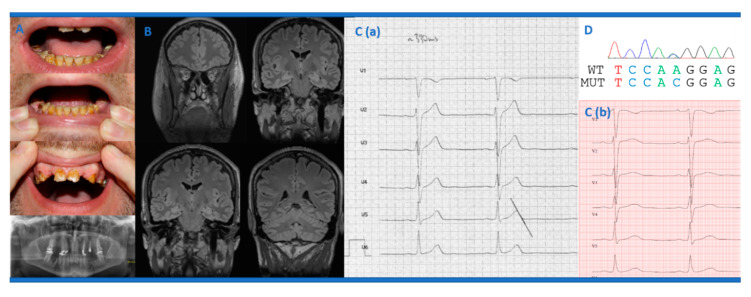
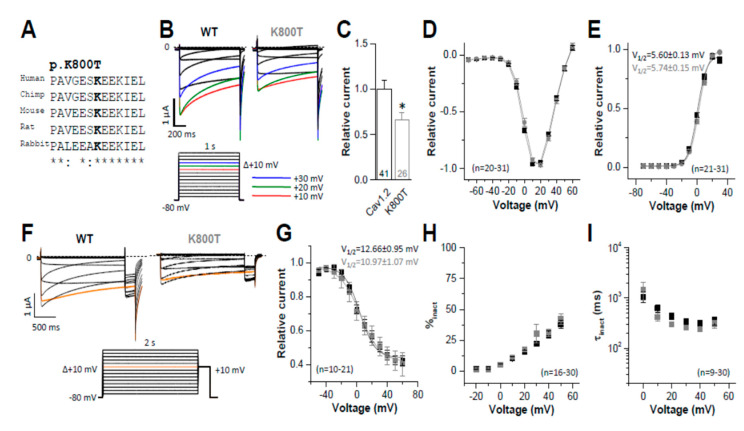
Complex neuropsychiatric-cardiac syndromes can be genetically determined. For the first time, the authors present a syndromal form of short QT syndrome in a 34-year-old German male patient with extracardiac features with predominant psychiatric manifestation, namely a severe form of secondary high-functioning autism spectrum disorder (ASD), along with affective and psychotic exacerbations, and severe dental enamel defects (with rapid wearing off his teeth) due to a heterozygous loss-of-function mutation in the gene (NM_000719.6: c.2399A > C; p.Lys800Thr). This mutation was found only once in control databases; the mutated lysine is located in the Cav1.2 calcium channel, is highly conserved during evolution, and is predicted to affect protein function by most pathogenicity prediction algorithms. L-type Cav1.2 calcium channels are widely expressed in the brain and heart. In the case presented, electrophysiological studies revealed a prominent reduction in the current amplitude without changes in the gating behavior of the Cav1.2 channel, most likely due to a trafficking defect. Due to the demonstrated loss of function, the p.Lys800Thr variant was finally classified as pathogenic (ACMG class 4 variant) and is likely to cause a newly described Cav1.2 channelopathy.
复杂的神经精神-心脏综合征可能具有遗传性。作者首次在一名 34 岁的德国男性患者中提出了短 QT 综合征的综合征形式,该患者具有心脏外特征,主要表现为精神症状,即严重的继发性高功能自闭症谱系障碍(ASD),以及情感和精神病性加重,以及严重的牙釉质缺陷(由于 Cav1.2 钙通道基因的杂合性功能丧失突变 (NM_000719.6: c.2399A > C; p.Lys800Thr),导致牙齿迅速磨损)。该突变仅在对照数据库中发现过一次;突变的赖氨酸位于 Cav1.2 钙通道中,在进化过程中高度保守,并且大多数致病性预测算法预测会影响蛋白功能。L 型 Cav1.2 钙通道在大脑和心脏中广泛表达。在提出的病例中,电生理研究显示电流幅度明显降低,而 Cav1.2 通道的门控行为没有变化,很可能是由于运输缺陷所致。由于该变体具有功能丧失的证据,因此最终将 p.Lys800Thr 变体归类为致病性(ACMG 类别 4 变体),很可能导致一种新描述的 Cav1.2 通道病。