Endres Dominique, Tebartz van Elst Ludger, Meyer Simon A, Feige Bernd, Nickel Kathrin, Bubl Anna, Riedel Andreas, Ebert Dieter, Lange Thomas, Glauche Volkmar, Biscaldi Monica, Philipsen Alexandra, Maier Simon J, Perlov Evgeniy
Section for Experimental Neuropsychiatry, Department of Psychiatry, Medical Center University of Freiburg, Faculty of Medicine, University of Freiburg, Hauptstr. 5, 79104 Freiburg, Germany.
Department for Psychiatry and Psychotherapy, Saarland University Medical Center, Kirrberger Str. 100, 66421 Homburg, Saar Germany.
Mol Autism. 2017 Mar 7;8:10. doi: 10.1186/s13229-017-0122-3. eCollection 2017.
Autism spectrum disorder (ASD) is a neurodevelopmental disease characterized by difficulties in social communication, unusually restricted, repetitive behavior and interests, and specific abnormalities in language and perception. The precise etiology of ASD is still unknown and probably heterogeneous. In a subgroup of patients, toxic environmental exposure might lead to an imbalance between oxidative stress and anti-oxidant systems. Previous serum and postmortem studies measuring levels of glutathione (GSH), the main cellular free radical scavenger in the brain, have supported the hypothesis that this compound might play a role in the pathophysiology of autism.
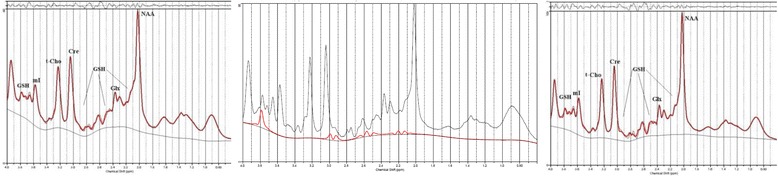
Using the method of single-voxel proton magnetic resonance spectroscopy (MRS), we analyzed the GSH signal in the dorsal anterior cingulate cortex (dACC) and the dorsolateral prefrontal cortex (DLPFC) of 24 ASD patients with normal or above average IQs and 18 matched control subjects. We hypothesized that we would find decreased GSH concentrations in both regions.
We did not find overall group differences in neurometabolites including GSH, neither in the dorsal ACC (Wilks' lambda test; = 0.429) nor in the DLPFC ( = 0.288). In the dACC, we found a trend for decreased GSH signals in ASD patients ( = 0.076).
We were unable to confirm our working hypothesis regarding decreased GSH concentrations in the ASD group. Further studies combining MRS, serum, and cerebrospinal fluid measurements of GSH metabolism including other regions of interest or even whole brain spectroscopy are needed.
自闭症谱系障碍(ASD)是一种神经发育疾病,其特征为社交沟通困难、异常受限的重复行为和兴趣,以及语言和感知方面的特定异常。ASD的确切病因仍不清楚,可能具有异质性。在一部分患者中,有毒环境暴露可能导致氧化应激与抗氧化系统之间失衡。此前测量大脑中主要细胞自由基清除剂谷胱甘肽(GSH)水平的血清和尸检研究支持了这样一种假说,即这种化合物可能在自闭症的病理生理学中发挥作用。
我们使用单体素质子磁共振波谱(MRS)方法,分析了24名智商正常或高于平均水平的ASD患者以及18名匹配的对照受试者背侧前扣带回皮质(dACC)和背外侧前额叶皮质(DLPFC)中的GSH信号。我们假设在这两个区域会发现GSH浓度降低。
我们未发现包括GSH在内的神经代谢物在总体组间存在差异,无论是在背侧ACC(威尔克斯λ检验;=0.429)还是在DLPFC(=0.288)。在dACC中,我们发现ASD患者的GSH信号有降低趋势(=0.076)。
我们无法证实关于ASD组GSH浓度降低的工作假设。需要进一步开展结合MRS、血清和脑脊液中GSH代谢测量的研究,包括其他感兴趣区域甚至全脑波谱分析。