Queen Mary University of London, London, UK.
Institute of Population Health Sciences, Yvonne Carter Building, 58 Turner Street, Whitechapel, London, E1 2AB, UK.
BMC Med Res Methodol. 2020 Nov 17;20(1):279. doi: 10.1186/s12874-020-01155-z.
We consider the design of stepped wedge trials with continuous recruitment and continuous outcome measures. Suppose we recruit from a fixed number of clusters where eligible participants present continuously, and suppose we have fine control over when each cluster crosses to the intervention. Suppose also that we want to minimise the number of participants, leading us to consider "incomplete" designs (i.e. without full recruitment). How can we schedule recruitment and cross-over at different clusters to recruit efficiently while achieving good precision?
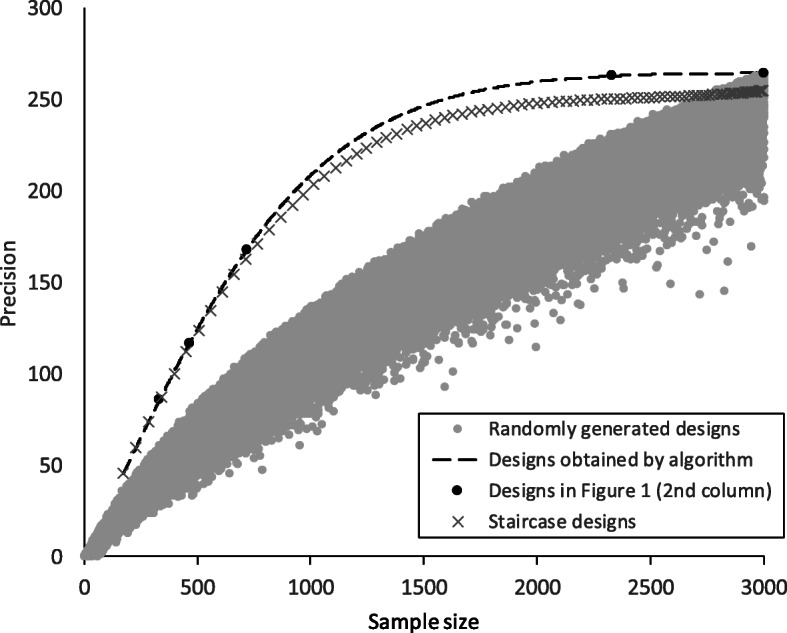
The large number of possible designs can make exhaustive searches impractical. Instead we consider an algorithm using iterative improvements to hunt for an efficient design. At each iteration (starting from a complete design) a single participant - the one with the smallest impact on precision - is removed, and small changes preserving total sample size are made until no further improvement in precision can be found.
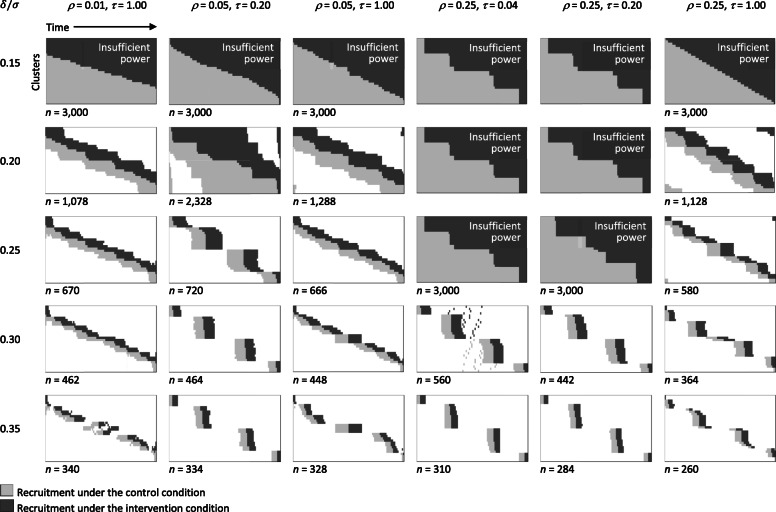
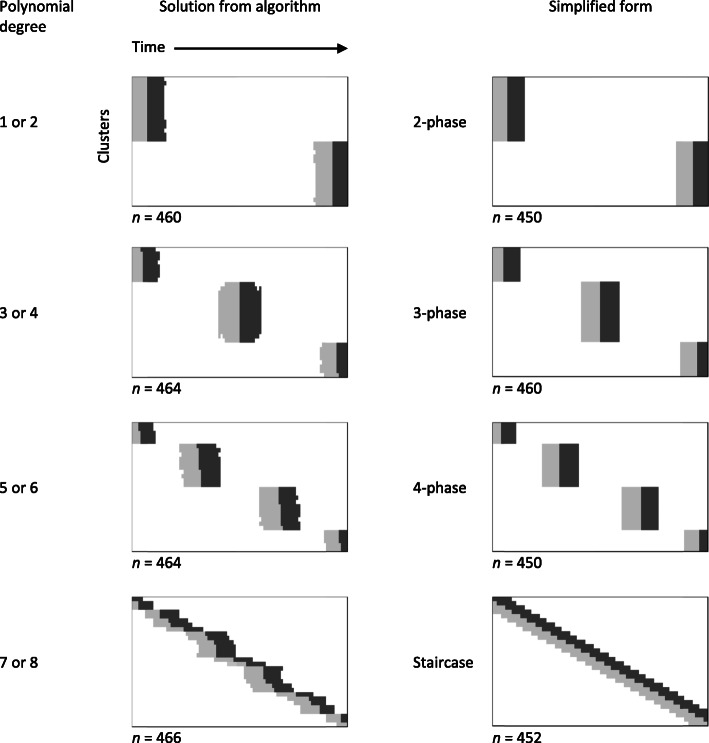
Striking patterns emerge. Solutions typically focus recruitment and cross-over on the leading diagonal of the cluster-by-time diagram, but in some scenarios clusters form distinct phases resembling before-and-after designs.
There is much to be learned about optimal design for incomplete stepped wedge trials. Algorithmic searches could offer a practical approach to trial design in complex settings generally.
我们考虑采用连续招募和连续结果测量的阶梯式楔形试验设计。假设我们从固定数量的群组中招募,合格的参与者持续出现,并且我们可以精细地控制每个群组何时切换到干预措施。此外,我们还希望尽量减少参与者的数量,这导致我们考虑使用“不完整”设计(即没有完全招募)。我们如何在不同的群组中安排招募和交叉,以在实现良好精度的同时提高效率?
大量可能的设计使得穷尽搜索变得不切实际。相反,我们考虑使用一种使用迭代改进来寻找有效设计的算法。在每次迭代中(从完整设计开始),移除一个对精度影响最小的参与者,并进行小的更改以保持总样本量,直到无法进一步提高精度为止。
出现了引人注目的模式。解决方案通常集中在群组-时间图的主对角线上进行招募和交叉,但在某些情况下,群组形成了类似于前后设计的不同阶段。
对于不完整的阶梯式楔形试验设计,有很多值得学习的地方。算法搜索可能为复杂环境中的试验设计提供一种实用方法。