CeMM Research Center for Molecular Medicine of the Austrian Academy of Sciences, 1090 Vienna, Austria.
Christian Doppler Laboratory for Chemical Epigenetics and Antiinfectives, CeMM Research Center for Molecular Medicine of the Austrian Academy of Sciences, 1090 Vienna, Austria.
Genome Res. 2020 Dec;30(12):1846-1855. doi: 10.1101/gr.261503.120. Epub 2020 Nov 17.
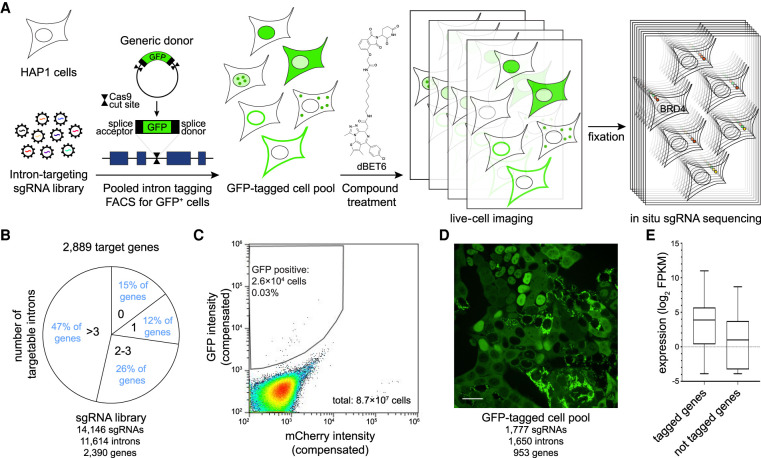
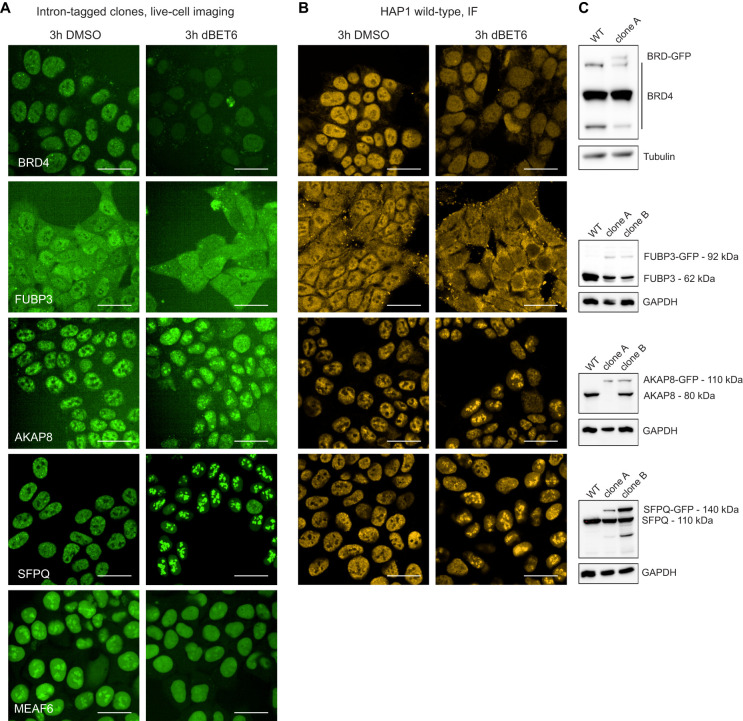
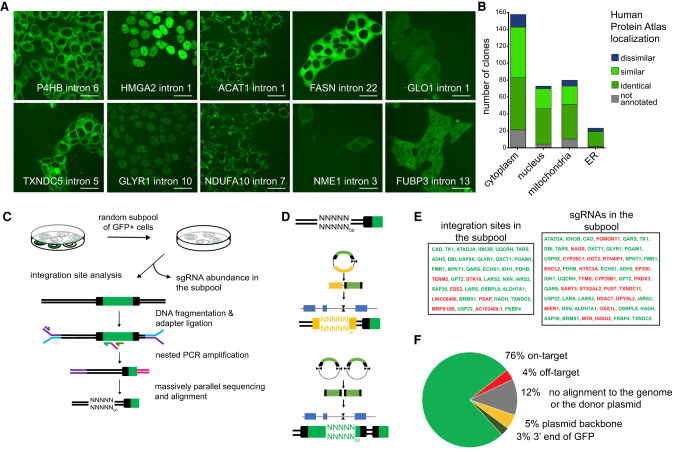
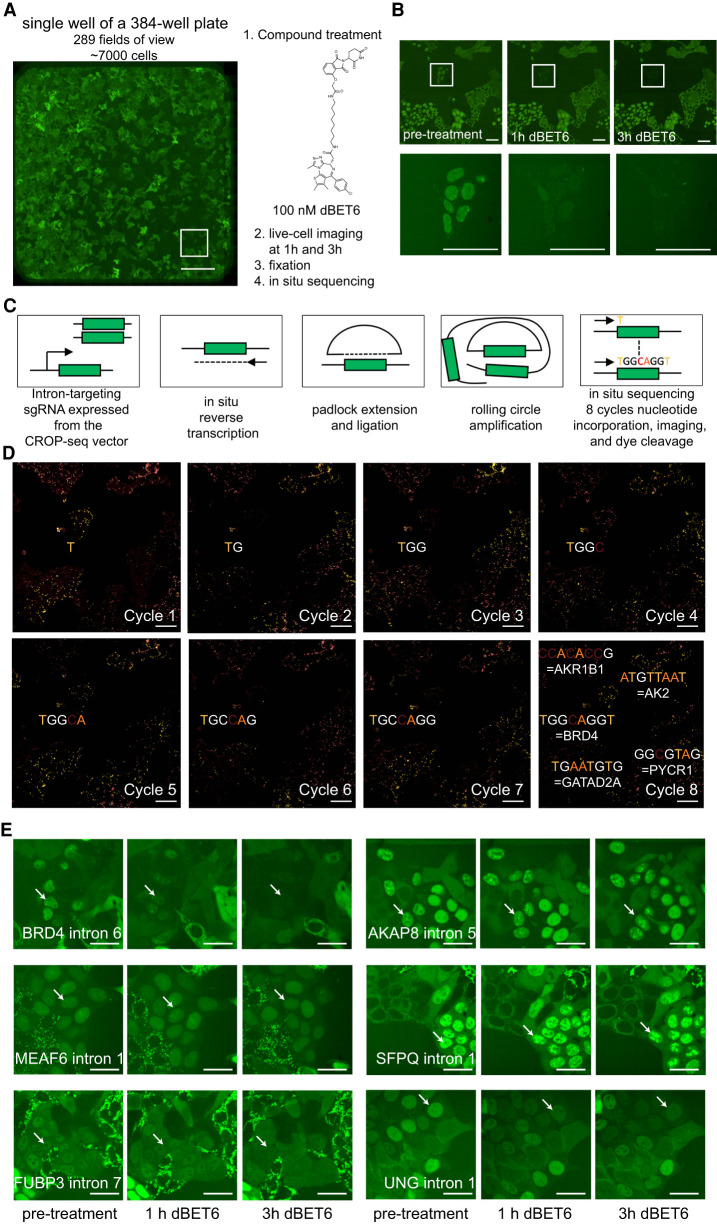
The levels and subcellular localizations of proteins regulate critical aspects of many cellular processes and can become targets of therapeutic intervention. However, high-throughput methods for the discovery of proteins that change localization either by shuttling between compartments, by binding larger complexes, or by localizing to distinct membraneless organelles are not available. Here we describe a scalable strategy to characterize effects on protein localizations and levels in response to different perturbations. We use CRISPR-Cas9-based intron tagging to generate cell pools expressing hundreds of GFP-fusion proteins from their endogenous promoters and monitor localization changes by time-lapse microscopy followed by clone identification using in situ sequencing. We show that this strategy can characterize cellular responses to drug treatment and thus identify nonclassical effects such as modulation of protein-protein interactions, condensate formation, and chemical degradation.
蛋白质的水平和亚细胞定位调节着许多细胞过程的关键方面,并且可以成为治疗干预的目标。然而,目前还没有高通量的方法来发现那些通过在隔室之间穿梭、与更大的复合物结合或定位到不同无膜细胞器而改变定位的蛋白质。在这里,我们描述了一种可扩展的策略,用于描述针对不同扰动时对蛋白质定位和水平的影响。我们使用基于 CRISPR-Cas9 的内含子标记,从内源性启动子生成表达数百种 GFP 融合蛋白的细胞池,并通过延时显微镜监测定位变化,然后使用原位测序进行克隆鉴定。我们表明,这种策略可以描述细胞对药物治疗的反应,从而识别非经典效应,如蛋白质-蛋白质相互作用的调节、凝聚物的形成和化学降解。