Bedoyan Jirair K, Hage Rosemary, Shin Ha Kyung, Linard Sharon, Ferren Edwin, Ducich Nicole, Wilson Kirkland, Lehman April, Schillaci Lori-Anne, Manickam Kandamurugu, Mori Mari, Bartholomew Dennis, DeBrosse Suzanne, Cohen Bruce, Parikh Sumit, Kerr Douglas
Departments of Genetics and Genome Sciences Case Western Reserve University (CWRU) Cleveland Ohio USA.
Pediatrics CWRU Cleveland Ohio USA.
JIMD Rep. 2020 Aug 16;56(1):70-81. doi: 10.1002/jmd2.12153. eCollection 2020 Nov.
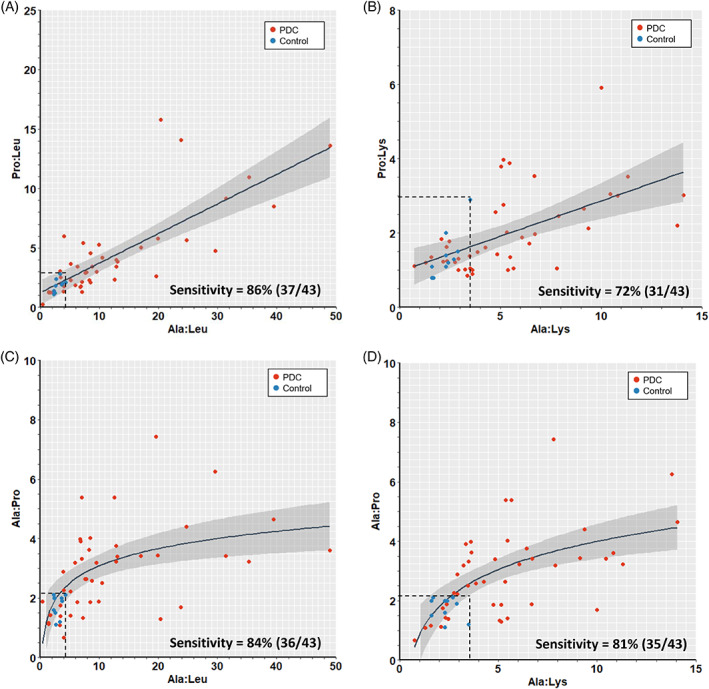
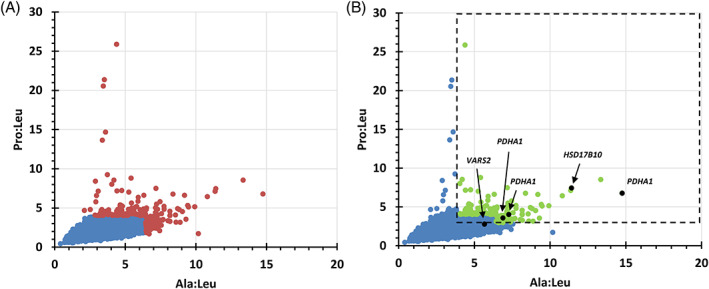
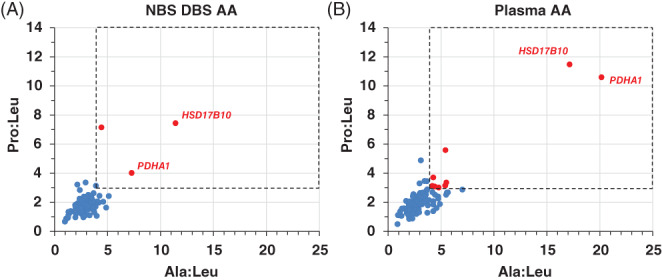
Pyruvate dehydrogenase complex deficiencies (PDCDs) and other mitochondrial disorders (MtDs) can (a) result in congenital lactic acidosis with elevations of blood alanine (Ala) and proline (Pro), (b) lead to decreased ATP production, and (c) result in high morbidity and mortality. With ~140,000 live births annually in Ohio and ~1 in 9,000 overall prevalence of MtDs, we estimate 2 to 3 newborns will have PDCD and 13 to 14 others likely will have another MtD annually. We compared the sensitivities of plasma amino acids (AA) Alanine (Ala), Alanine:Leucine (Ala:Leu), Alanine:Lysine and the combination of Ala:Leu and Proline:Leucine (Pro:Leu), in subjects with known primary-specific PDCD due to and mutations vs controls. Furthermore, in collaboration with the Ohio newborn screening (NBS) laboratory, we determined Ala and Pro concentrations in dried blood spot (DBS) specimens using existing NBS analytic approaches and evaluated Ala:Leu and Pro:Leu ratios from DBS specimens of 123,414 Ohio newborns in a 12-month period. We used the combined Ala:Leu ≥4.0 and Pro:Leu ≥3.0 ratio criterion from both DBS and plasma specimens as a screening tool in our retrospective review of newborn data. The screening tool applied on DBS and/or plasma (or serum) AA specimens successfully identified three unrelated females with novel mutations, one male with a novel X-linked mutation, and a female with mutations. This work lays the first step for piloting an NBS protocol in Ohio for identifying newborns at high risk for primary-specific PDCD and other MtDs who might benefit from neonatal diagnosis and early institution of known therapy and/or potential novel therapies for such disorders.
丙酮酸脱氢酶复合物缺乏症(PDCDs)和其他线粒体疾病(MtDs)可(a)导致先天性乳酸酸中毒,并伴有血液丙氨酸(Ala)和脯氨酸(Pro)升高,(b)导致ATP生成减少,以及(c)导致高发病率和死亡率。俄亥俄州每年约有140,000例活产婴儿,MtDs的总体患病率约为1/9000,我们估计每年有2至3名新生儿患有PDCD,另外13至14名可能患有其他MtD。我们比较了血浆氨基酸(AA)丙氨酸(Ala)、丙氨酸:亮氨酸(Ala:Leu)、丙氨酸:赖氨酸以及Ala:Leu和脯氨酸:亮氨酸(Pro:Leu)组合在因[具体突变基因1]和[具体突变基因2]突变导致的已知原发性特异性PDCD患者与对照组中的敏感性。此外,我们与俄亥俄州新生儿筛查(NBS)实验室合作,使用现有的NBS分析方法测定干血斑(DBS)标本中的Ala和Pro浓度,并评估了12个月内123,414名俄亥俄州新生儿DBS标本中的Ala:Leu和Pro:Leu比值。在对新生儿数据的回顾性研究中,我们使用DBS和血浆标本中联合的Ala:Leu≥4.0和Pro:Leu≥3.0比值标准作为筛查工具。应用于DBS和/或血浆(或血清)AA标本的筛查工具成功识别出三名具有新型[具体突变基因1]突变的无关女性、一名具有新型X连锁[具体突变基因2]突变的男性以及一名具有[具体突变基因3]突变的女性。这项工作为在俄亥俄州试行一项NBS方案迈出了第一步,该方案用于识别原发性特异性PDCD和其他MtD的高危新生儿,这些新生儿可能从新生儿诊断以及对此类疾病已知疗法和/或潜在新疗法的早期应用中获益。