Department of Molecular Biology, NYS Institute for Basic Research in Developmental Disabilities, Staten Island, NY 10314, USA.
Department of Human Genetics, NYS Institute for Basic Research in Developmental Disabilities, Staten Island, NY 10314, USA.
Int J Mol Sci. 2023 May 9;24(10):8487. doi: 10.3390/ijms24108487.
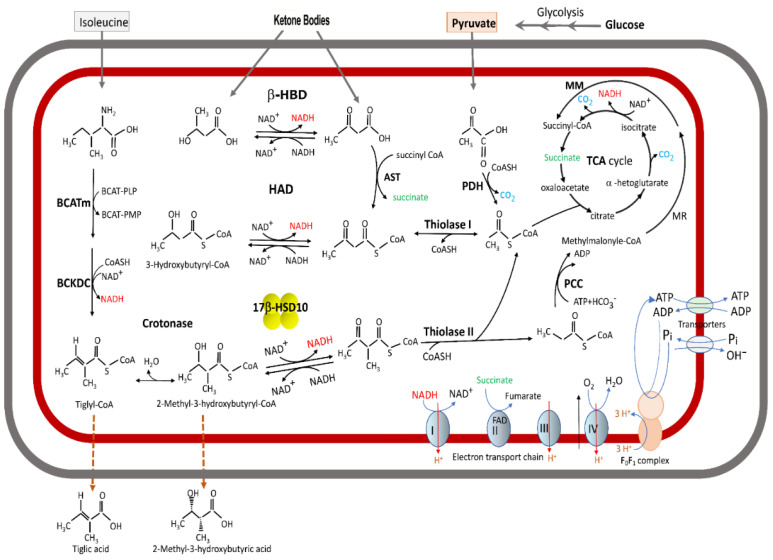
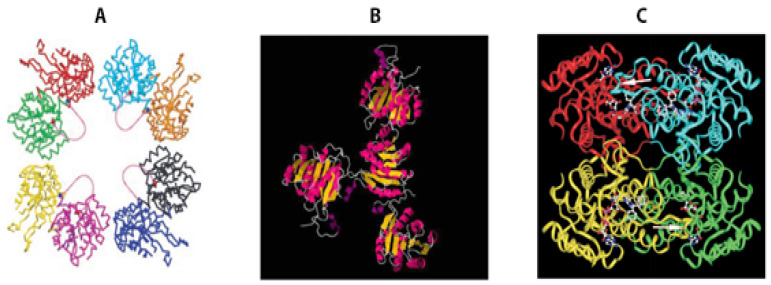
Type 10 17β-hydroxysteroid dehydrogenase (17β-HSD10), a homo-tetrameric multifunctional protein with 1044 residues encoded by the gene, is necessary for brain cognitive function. Missense mutations result in infantile neurodegeneration, an inborn error in isoleucine metabolism. A 5-methylcytosine hotspot underlying a 388-T transition leads to the HSD10 (p.R130C) mutant to be responsible for approximately half of all cases suffering with this mitochondrial disease. Fewer females suffer with this disease due to X-inactivation. The binding capability of this dehydrogenase to Aβ-peptide may play a role in Alzheimer's disease, but it appears unrelated to infantile neurodegeneration. Research on this enzyme was complicated by reports of a purported Aβ-peptide-binding alcohol dehydrogenase (ABAD), formerly referred to as endoplasmic-reticulum-associated Aβ-binding protein (ERAB). Reports concerning both ABAD and ERAB in the literature reflect features inconsistent with the known functions of 17β-HSD10. It is clarified here that ERAB is reportedly a longer subunit of 17β-HSD10 (262 residues). 17β-HSD10 exhibits L-3-hydroxyacyl-CoA dehydrogenase activity and is thus also referred to in the literature as short-chain 3-hydorxyacyl-CoA dehydrogenase or type II 3-hydorxyacyl-CoA dehydrogenase. However, 17β-HSD10 is not involved in ketone body metabolism, as reported in the literature for ABAD. Reports in the literature referring to ABAD (i.e., 17β-HSD10) as a alcohol dehydrogenase, relying on data underlying ABAD's activities, were found to be unreproducible. Furthermore, the rediscovery of ABAD/ERAB's mitochondrial localization did not cite any published research on 17β-HSD10. Clarification of the purported ABAD/ERAB function derived from these reports on ABAD/ERAB may invigorate this research field and encourage new approaches to the understanding and treatment of -gene-related disorders. We establish here that infantile neurodegeneration is caused by mutants of 17β-HSD10 but not ABAD, and so we conclude that ABAD represents a misnomer employed in high-impact journals.
类型 10 17β-羟甾类脱氢酶 (17β-HSD10),一种具有 1044 个残基的同四聚体多功能蛋白,由 基因编码,对大脑认知功能是必要的。错义突变导致婴儿神经退行性变,这是一种异亮氨酸代谢的先天性错误。一个 5-甲基胞嘧啶热点位于 388-T 转换之下,导致 HSD10(p.R130C)突变体负责大约一半患有这种线粒体疾病的病例。由于 X 染色体失活,较少的女性患有这种疾病。这种脱氢酶与 Aβ-肽的结合能力可能在阿尔茨海默病中起作用,但似乎与婴儿神经退行性变无关。由于报道了一种所谓的 Aβ-肽结合醇脱氢酶 (ABAD),以前称为内质网相关 Aβ结合蛋白 (ERAB),对这种酶的研究变得复杂。文献中关于 ABAD 和 ERAB 的报道反映了与已知的 17β-HSD10 功能不一致的特征。这里澄清的是,据报道 ERAB 是 17β-HSD10 的较长亚基 (262 个残基)。17β-HSD10 表现出 L-3-羟酰基辅酶 A 脱氢酶活性,因此在文献中也被称为短链 3-羟酰基辅酶 A 脱氢酶或 II 型 3-羟酰基辅酶 A 脱氢酶。然而,正如文献中报道的 ABAD 那样,17β-HSD10 不参与酮体代谢。文献中报道的 ABAD (即 17β-HSD10)作为醇脱氢酶的情况,依赖于 ABAD 活性的基础数据,被发现是不可重复的。此外,ABAD/ERAB 的线粒体定位的重新发现并没有引用任何关于 17β-HSD10 的已发表研究。从这些关于 ABAD/ERAB 的报告中澄清所谓的 ABAD/ERAB 功能可能会激发这个研究领域,并鼓励采用新的方法来理解和治疗与 -基因相关的疾病。我们在这里确定婴儿神经退行性变是由 17β-HSD10 的突变体引起的,而不是 ABAD,因此我们得出结论,ABAD 是在高影响力期刊中使用的错误名称。