• 文献检索
  • 文档翻译
  • 深度研究
  • 学术资讯
  • Suppr Zotero 插件Zotero 插件
  • 邀请有礼
  • 套餐&价格
  • 历史记录
应用&插件
Suppr Zotero 插件Zotero 插件浏览器插件Mac 客户端Windows 客户端微信小程序
定价
高级版会员购买积分包购买API积分包
服务
文献检索文档翻译深度研究API 文档MCP 服务
关于我们
关于 Suppr公司介绍联系我们用户协议隐私条款
关注我们

Suppr 超能文献

核心技术专利:CN118964589B侵权必究
粤ICP备2023148730 号-1Suppr @ 2026

文献检索

告别复杂PubMed语法,用中文像聊天一样搜索,搜遍4000万医学文献。AI智能推荐,让科研检索更轻松。

立即免费搜索

文件翻译

保留排版,准确专业,支持PDF/Word/PPT等文件格式,支持 12+语言互译。

免费翻译文档

深度研究

AI帮你快速写综述,25分钟生成高质量综述,智能提取关键信息,辅助科研写作。

立即免费体验

患者-临床团队安全消息传递对沟通模式和患者体验的影响:随机鼓励设计试验。

Impact of Patient-Clinical Team Secure Messaging on Communication Patterns and Patient Experience: Randomized Encouragement Design Trial.

机构信息

Center for Healthcare Organization and Implementation Research (CHOIR), VA Bedford Healthcare System, Department of Veterans Affairs, Bedford, MA, United States.

Department of Health Law, Policy, and Management, Boston University School of Public Health, Boston, MA, United States.

出版信息

J Med Internet Res. 2020 Nov 18;22(11):e22307. doi: 10.2196/22307.

DOI:10.2196/22307
PMID:33206052
原文链接:
https://pmc.ncbi.nlm.nih.gov/articles/PMC7710447/
Abstract

BACKGROUND

Although secure messaging (SM) between patients and clinical team members is a recommended component of continuous care, uptake by patients remains relatively low. We designed a multicomponent Supported Adoption Program (SAP) to increase SM adoption among patients using the Veterans Health Administration (VHA) for primary care.

OBJECTIVE

Our goals were to (1) conduct a multisite, randomized, encouragement design trial to test the effectiveness of an SAP designed to increase patient engagement with SM through VHA's online patient portal (My HealtheVet [MHV]) and (2) evaluate the impact of the SAP and patient-level SM adoption on perceived provider autonomy support and communication. Patient-reported barriers to SM adoption were also assessed.

METHODS

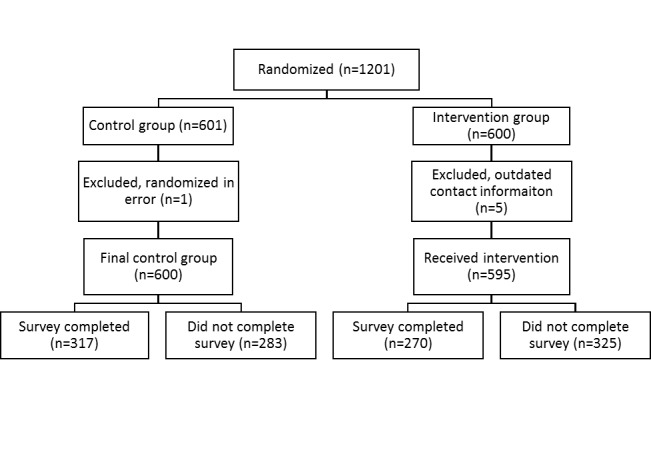
We randomized 1195 patients at 3 VHA facilities who had MHV portal accounts but had never used SM. Half were randomized to receive the SAP, and half served as controls receiving usual care. The SAP consisted of encouragement to adopt SM via mailed educational materials, proactive SM sent to patients, and telephone-based motivational interviews. We examined differences in SM adoption rates between SAP recipients and controls at 9 months and 21 months. Follow-up telephone surveys were conducted to assess perceived provider autonomy support and self-report of telephone communication with clinical teams.

RESULTS

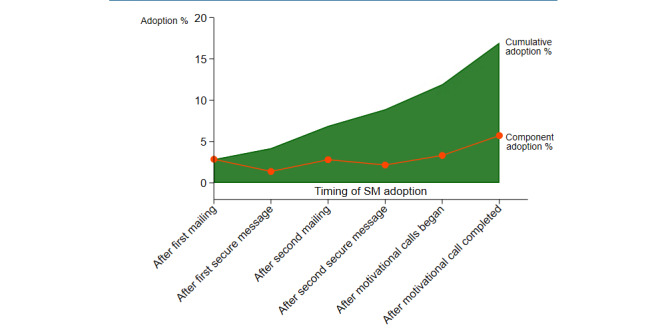
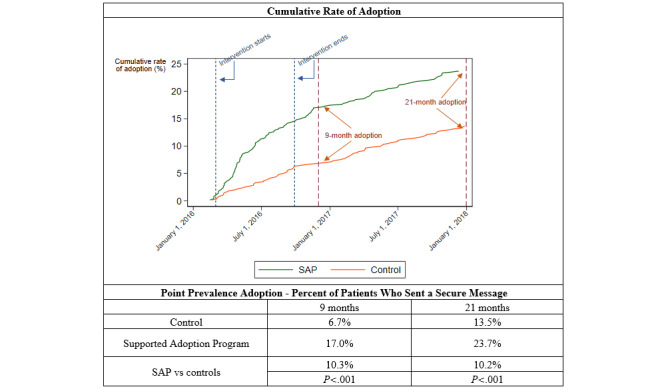
Patients randomized to the SAP had significantly higher rates of SM adoption than the control group (101/595, 17.0% vs 40/600, 6.7%; P<.001). Most adopters in the SAP sent their first message without a motivational interview (71/101, 70.3%). The 10-percentage point difference in adoption persisted a full year after the encouragement ended (23.7%, 142/600 in the SAP group vs 13.5%, 80/595 in the control group, P<.001). We obtained follow-up survey data from 49.54% (592/1195) of the participants. SAP participants reported higher perceived provider autonomy support (5.7 vs 5.4, P=.007) and less telephone use to communicate with their provider (68.8% vs 76.0%, P=.05), compared to patients in the control group. Patient-reported barriers to SM adoption included self-efficacy (eg, not comfortable using a computer, 24%), no perceived need for SM (22%), and difficulties with portal password or login (17%).

CONCLUSIONS

The multicomponent SAP was successful in increasing use of SM 10 percentage points above standard care; new SM adopters reported improved perceptions of provider autonomy support and less use of the telephone to communicate with their providers. Still, despite the encouragement and technical assistance provided through the SAP, adoption rates were lower than anticipated, reaching only 24% at 21 months (10% above controls). Common barriers to adoption such as limited perceived need for SM may be more challenging to address and require different interventions than barriers related to patient self-efficacy or technical difficulties.

TRIAL REGISTRATION

ClinicalTrials.gov NCT02665468; https://clinicaltrials.gov/ct2/show/NCT02665468.
摘要

背景

尽管患者与临床团队成员之间的安全消息传递(SM)是连续护理的推荐组成部分,但患者的采用率仍然相对较低。我们设计了一个多组件支持采用计划(SAP),以通过退伍军人事务部(VHA)的在线患者门户(My HealtheVet [MHV])增加使用 SM 的患者的采用率。

目的

我们的目标是(1)进行一项多站点、随机、鼓励设计试验,以测试旨在通过 VHA 的在线患者门户(My HealtheVet [MHV])增加患者对 SM 的参与度的 SAP 的有效性,以及(2)评估 SAP 和患者对 SM 的采用对感知提供者自主性支持和沟通的影响。还评估了患者采用 SM 的障碍。

方法

我们在 3 家 VHA 设施中随机选择了 1195 名有 MHV 门户账户但从未使用过 SM 的患者。一半被随机分配接受 SAP,另一半作为对照组接受常规护理。SAP 包括通过邮寄教育材料、向患者发送主动 SM 和基于电话的动机访谈来鼓励采用 SM。我们在 9 个月和 21 个月时检查了 SAP 接受者和对照组之间 SM 采用率的差异。进行后续电话调查,以评估感知提供者自主性支持和与临床团队进行电话沟通的自我报告。

结果

与对照组相比,接受 SAP 的患者的 SM 采用率显著更高(101/595,17.0%比 40/600,6.7%;P<.001)。SAP 中的大多数采用者在没有接受动机访谈的情况下发送了他们的第一条消息(71/101,70.3%)。这种 10 个百分点的采用率差异在鼓励结束后整整一年仍持续存在(23.7%,142/600 在 SAP 组中,而 13.5%,80/595 在对照组中,P<.001)。我们从 1195 名参与者中的 49.54%(592/1195)获得了后续调查数据。与对照组相比,SAP 参与者报告了更高的感知提供者自主性支持(5.7 比 5.4,P=.007)和更少使用电话与提供者沟通(68.8%比 76.0%,P=.05)。患者报告采用 SM 的障碍包括自我效能感(例如,不舒适使用计算机,24%)、没有感知到对 SM 的需求(22%)以及门户密码或登录困难(17%)。

结论

多组件 SAP 成功地将 SM 的使用率提高了比标准护理高 10 个百分点;新的 SM 采用者报告说,他们对提供者自主性支持的感知有所改善,并且与他们的提供者通过电话进行沟通的次数减少了。尽管通过 SAP 提供了鼓励和技术援助,但采用率仍低于预期,21 个月时仅达到 24%(比对照组高 10%)。有限的感知到对 SM 的需求等常见采用障碍可能更难解决,并且需要与与患者自我效能或技术困难相关的障碍不同的干预措施。

试验注册

ClinicalTrials.gov NCT02665468;https://clinicaltrials.gov/ct2/show/NCT02665468.

https://cdn.ncbi.nlm.nih.gov/pmc/blobs/e725/7710447/5593d7c50055/jmir_v22i11e22307_fig3.jpg
https://cdn.ncbi.nlm.nih.gov/pmc/blobs/e725/7710447/258d54829357/jmir_v22i11e22307_fig1.jpg
https://cdn.ncbi.nlm.nih.gov/pmc/blobs/e725/7710447/1b40e537c3ae/jmir_v22i11e22307_fig2.jpg
https://cdn.ncbi.nlm.nih.gov/pmc/blobs/e725/7710447/5593d7c50055/jmir_v22i11e22307_fig3.jpg
https://cdn.ncbi.nlm.nih.gov/pmc/blobs/e725/7710447/258d54829357/jmir_v22i11e22307_fig1.jpg
https://cdn.ncbi.nlm.nih.gov/pmc/blobs/e725/7710447/1b40e537c3ae/jmir_v22i11e22307_fig2.jpg
https://cdn.ncbi.nlm.nih.gov/pmc/blobs/e725/7710447/5593d7c50055/jmir_v22i11e22307_fig3.jpg

相似文献

1
Impact of Patient-Clinical Team Secure Messaging on Communication Patterns and Patient Experience: Randomized Encouragement Design Trial.患者-临床团队安全消息传递对沟通模式和患者体验的影响:随机鼓励设计试验。
J Med Internet Res. 2020 Nov 18;22(11):e22307. doi: 10.2196/22307.
2
Secure Messaging, Diabetes Self-management, and the Importance of Patient Autonomy: a Mixed Methods Study.安全消息传递、糖尿病自我管理与患者自主性的重要性:一项混合方法研究
J Gen Intern Med. 2020 Oct;35(10):2955-2962. doi: 10.1007/s11606-020-05834-x. Epub 2020 May 21.
3
4
Association of Secure Messaging with Primary Care In-Person and Telephone Visits Among Veterans: a Matched Difference-in-Difference Analysis.退伍军人中安全消息传递与初级保健面对面和电话就诊的关联:一项匹配的双重差分分析
J Gen Intern Med. 2021 Apr;36(4):946-951. doi: 10.1007/s11606-020-06541-3. Epub 2021 Feb 2.
5
Evaluating user experiences of the secure messaging tool on the Veterans Affairs' patient portal system.评估退伍军人事务部患者门户系统上安全消息传递工具的用户体验。
J Med Internet Res. 2014 Mar 6;16(3):e75. doi: 10.2196/jmir.2976.
6
Patient Portals Facilitating Engagement With Inpatient Electronic Medical Records: A Systematic Review.促进住院电子病历参与度的患者门户:一项系统综述。
J Med Internet Res. 2019 Apr 11;21(4):e12779. doi: 10.2196/12779.
7
Electronic Health Record Portal Messages and Interactive Voice Response Calls to Improve Rates of Early Season Influenza Vaccination: Randomized Controlled Trial.电子健康记录门户消息和交互式语音应答呼叫以提高流感疫苗接种率:随机对照试验。
J Med Internet Res. 2020 Sep 25;22(9):e16373. doi: 10.2196/16373.
8
Connecting Families to Their Health Record and Care Team: The Use, Utility, and Impact of a Client/Family Health Portal at a Children's Rehabilitation Hospital.将家庭与他们的健康记录及护理团队相连:一家儿童康复医院中客户/家庭健康门户的使用、效用及影响。
J Med Internet Res. 2017 Apr 6;19(4):e97. doi: 10.2196/jmir.6811.
9
10
An analysis of patient-provider secure messaging at two Veterans Health Administration medical centers: message content and resolution through secure messaging.对两个退伍军人健康管理局医疗中心患者与医疗服务提供者之间安全消息传递的分析:消息内容及通过安全消息传递实现的问题解决情况。
J Am Med Inform Assoc. 2017 Sep 1;24(5):942-949. doi: 10.1093/jamia/ocx021.

引用本文的文献

1
Impact of Electronic Health Services on Patient Satisfaction in Primary Care: A Systematic Review.电子健康服务对初级保健中患者满意度的影响:一项系统评价。
Cureus. 2025 May 12;17(5):e83949. doi: 10.7759/cureus.83949. eCollection 2025 May.
2
Electronic Health Interventions and Cervical Cancer Screening: Systematic Review and Meta-Analysis.电子健康干预措施与宫颈癌筛查:系统评价与荟萃分析。
J Med Internet Res. 2024 Oct 31;26:e58066. doi: 10.2196/58066.
3
Improving Veteran Engagement with Virtual Care Technologies: a Veterans Health Administration State of the Art Conference Research Agenda.

本文引用的文献

1
Secure Messaging, Diabetes Self-management, and the Importance of Patient Autonomy: a Mixed Methods Study.安全消息传递、糖尿病自我管理与患者自主性的重要性:一项混合方法研究
J Gen Intern Med. 2020 Oct;35(10):2955-2962. doi: 10.1007/s11606-020-05834-x. Epub 2020 May 21.
2
Patient portal messaging for care coordination: a qualitative study of perspectives of experienced users with chronic conditions.患者门户消息传递用于医疗协调:一项对有慢性疾病经验丰富的用户观点的定性研究。
BMC Fam Pract. 2019 May 3;20(1):57. doi: 10.1186/s12875-019-0948-1.
3
Can Secure Patient-Provider Messaging Improve Diabetes Care?
提高退伍军人对虚拟护理技术的参与度:退伍军人健康管理局最新技术会议研究议程。
J Gen Intern Med. 2024 Feb;39(Suppl 1):21-28. doi: 10.1007/s11606-023-08488-7. Epub 2024 Jan 22.
4
The State-of-the-Art of Patient Portals: Adapting to External Factors, Addressing Barriers, and Innovating.患者门户的最新进展:适应外部因素、解决障碍和创新。
Appl Clin Inform. 2023 Aug;14(4):654-669. doi: 10.1055/s-0043-1770901. Epub 2023 Aug 23.
5
The Impact of Secure Messaging in the Treatment of Patients With Diabetes Within a Primary Care Setting: Protocol for a Scoping Review.安全消息传递在基层医疗环境中对糖尿病患者治疗的影响:一项范围综述方案
JMIR Res Protoc. 2023 May 2;12:e42339. doi: 10.2196/42339.
6
Tablet distribution to veterans: an opportunity to increase patient portal adoption and use.向退伍军人分发平板电脑:提高患者门户采用率和使用率的机会。
J Am Med Inform Assoc. 2022 Dec 13;30(1):73-82. doi: 10.1093/jamia/ocac195.
7
Scoping review protocol to map the use of text-based two-way communication between patients and healthcare professionals after hospital discharge and identify facilitators and barriers to implementation.范围综述方案,用于绘制患者和医疗保健专业人员在出院后的基于文本的双向沟通使用情况,并确定实施的促进因素和障碍。
BMJ Open. 2022 Sep 22;12(9):e062087. doi: 10.1136/bmjopen-2022-062087.
8
Patient-Provider Text Messaging and Video Calling Among Case-Managed Patients Living With HIV: Formative Acceptability and Feasibility Study.接受病例管理的艾滋病毒感染者中的患者与医护人员短信和视频通话:形成性可接受性和可行性研究。
JMIR Form Res. 2021 May 27;5(5):e22513. doi: 10.2196/22513.
安全的医患信息沟通能否改善糖尿病护理?
Diabetes Care. 2017 Oct;40(10):1342-1348. doi: 10.2337/dc17-0140. Epub 2017 Aug 14.
4
Is Provider Secure Messaging Associated With Patient Messaging Behavior? Evidence From the US Army.医疗服务提供者的安全消息传递与患者消息传递行为有关联吗?来自美国陆军的证据。
J Med Internet Res. 2017 Apr 6;19(4):e103. doi: 10.2196/jmir.6804.
5
An analysis of patient-provider secure messaging at two Veterans Health Administration medical centers: message content and resolution through secure messaging.对两个退伍军人健康管理局医疗中心患者与医疗服务提供者之间安全消息传递的分析:消息内容及通过安全消息传递实现的问题解决情况。
J Am Med Inform Assoc. 2017 Sep 1;24(5):942-949. doi: 10.1093/jamia/ocx021.
6
Patient Use of Electronic Prescription Refill and Secure Messaging and Its Association With Undetectable HIV Viral Load: A Retrospective Cohort Study.患者使用电子处方续方和安全消息传递及其与无法检测到的艾滋病毒载量的关联:一项回顾性队列研究。
J Med Internet Res. 2017 Feb 15;19(2):e34. doi: 10.2196/jmir.6932.
7
Current and Projected Characteristics and Unique Health Care Needs of the Patient Population Served by the Department of Veterans Affairs.退伍军人事务部所服务患者群体的当前及预计特征与独特医疗需求。
Rand Health Q. 2016 May 9;5(4):13.
8
Sustained Use of Patient Portal Features and Improvements in Diabetes Physiological Measures.患者门户网站功能的持续使用与糖尿病生理指标的改善
J Med Internet Res. 2016 Jul 1;18(7):e179. doi: 10.2196/jmir.5663.
9
Large-Scale Survey Findings Inform Patients' Experiences in Using Secure Messaging to Engage in Patient-Provider Communication and Self-Care Management: A Quantitative Assessment.大规模调查结果揭示患者使用安全消息进行医患沟通和自我护理管理的体验:一项定量评估
J Med Internet Res. 2015 Dec 21;17(12):e282. doi: 10.2196/jmir.5152.
10
Personal health record reach in the Veterans Health Administration: a cross-sectional analysis.退伍军人健康管理局中个人健康记录的普及情况:一项横断面分析。
J Med Internet Res. 2014 Dec 12;16(12):e272. doi: 10.2196/jmir.3751.