Costantino Claudio, Ledda Caterina, Squeri Raffaele, Restivo Vincenzo, Casuccio Alessandra, Rapisarda Venerando, Graziano Giorgio, Alba Davide, Cimino Livia, Conforto Arianna, Costa Gaetano Bruno, D'Amato Smeralda, Mazzitelli Francesco, Vitale Francesco, Genovese Cristina
Department of Health Promotion Sciences, Maternal and Infant Care, Internal Medicine and Medical Specialties (PROMISE) "G. D'Alessandro", University of Palermo, 90127 Palermo, Italy.
Occupational Medicine, Department of Clinical and Experimental Medicine, University of Catania, 95100 Catania, Italy.
Vaccines (Basel). 2020 Nov 16;8(4):686. doi: 10.3390/vaccines8040686.
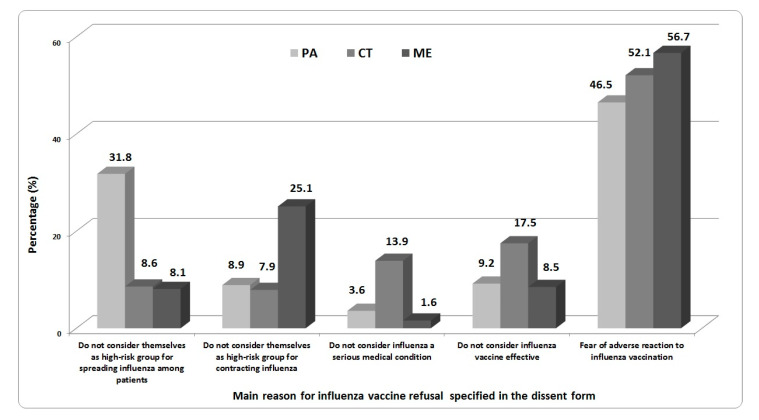
Influenza is an infectious disease with a high impact on the population in terms of morbidity and mortality, but despite International and European guidelines, vaccination coverage rates among healthcare workers (HCWs) remain very low. The aim of the present study was to evaluate influenza vaccination adherence in the three Sicilian University Hospitals of Catania, Messina, and Palermo and to understand the attitudes and perceptions of vaccinated healthcare workers and the main reasons for vaccination refusal. A cross-sectional survey through a self-administered questionnaire was conducted during the 2019/2020 influenza season. Overall, 2356 vaccinated healthcare workers answered the questionnaire. The main reason reported for influenza vaccination adherence during the 2019/2020 season was to protect patients. Higher self-perceived risk of contracting influenza and a positive attitude to recommending vaccination to patients were significantly associated with influenza vaccination adherence during the last five seasons via multivariable analysis. Fear of an adverse reaction was the main reason for influenza vaccine refusal. In accordance with these findings, Public Health institutions should develop and tailor formative and informative campaigns to reduce principal barriers to the immunization process and promote influenza vaccination adherence among HCWs.
流感是一种在发病率和死亡率方面对人群有重大影响的传染病,但尽管有国际和欧洲的指导方针,医护人员的疫苗接种覆盖率仍然很低。本研究的目的是评估卡塔尼亚、墨西拿和巴勒莫这三家西西里岛大学医院的医护人员对流感疫苗的接种依从性,并了解接种疫苗的医护人员的态度和看法以及拒绝接种的主要原因。在2019/2020流感季节期间,通过自我填写问卷进行了一项横断面调查。总体而言,2356名接种疫苗的医护人员回答了问卷。2019/2020季节报告的接种流感疫苗的主要原因是保护患者。通过多变量分析,较高的自我感知感染流感风险以及向患者推荐接种疫苗的积极态度与过去五个季节的流感疫苗接种依从性显著相关。对不良反应的恐惧是拒绝接种流感疫苗的主要原因。根据这些发现,公共卫生机构应制定并量身定制宣传和信息活动,以减少免疫过程中的主要障碍,并促进医护人员对流感疫苗的接种依从性。