Huang Hsuan-Ti, Cheng Tsung-Lin, Lin Sung-Yen, Ho Cheng-Jung, Chyu Joanna Y, Yang Rong-Sen, Chen Chung-Hwan, Shen Chwan-Li
Orthopaedic Research Center, Kaohsiung Medical University, Kaohsiung 80701, Taiwan.
Department of Orthopedics, Kaohsiung Medical University Hospital, Kaohsiung Medical University, Kaohsiung 80701, Taiwan.
Antioxidants (Basel). 2020 Nov 16;9(11):1136. doi: 10.3390/antiox9111136.
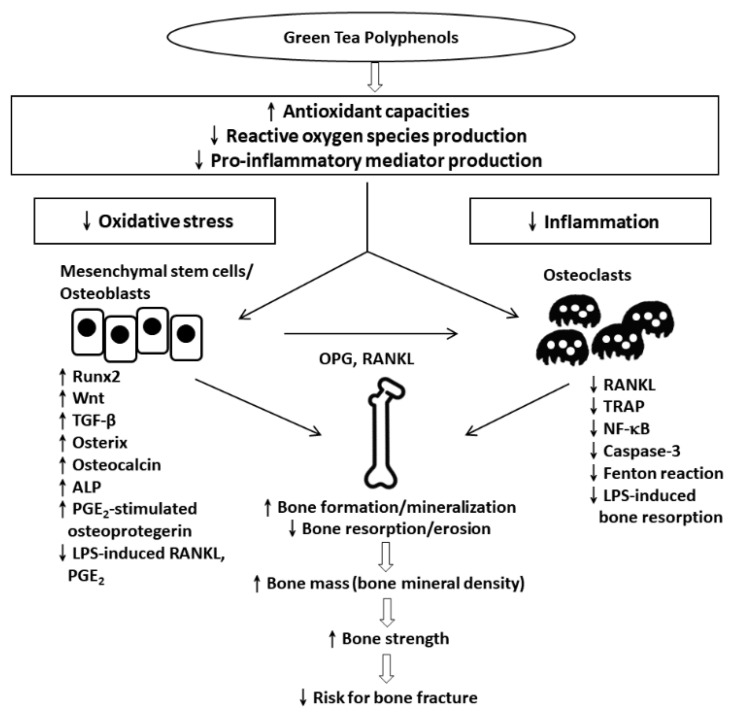
Osteoporosis is the second most common disease only secondary to cardiovascular disease, with the risk of fracture increasing with age. Osteoporosis is caused by an imbalance between osteoblastogenesis and osteoclastogenesis processes. Osteoclastogenesis may be enhanced, osteoblastogenesis may be reduced, or both may be evident. Inflammation and high reactive oxygen enhance osteoclastogenesis while reducing osteoblastogenesis by inducing osteoblast apoptosis and suppressing osteoblastic proliferation and differentiation. Catechins, the main polyphenols found in green tea with potent anti-oxidant and anti-inflammatory properties, can counteract the deleterious effects of the imbalance of osteoblastogenesis and osteoclastogenesis caused by osteoporosis. Green tea catechins can attenuate osteoclastogenesis by enhancing apoptosis of osteoclasts, hampering osteoclastogenesis, and prohibiting bone resorption in vitro. Catechin effects can be directly exerted on pre-osteoclasts/osteoclasts or indirectly exerted via the modulation of mesenchymal stem cells (MSCs)/stromal cell regulation of pre-osteoclasts through activation of the nuclear factor kB (RANK)/RANK ligand (RANKL)/osteoprotegerin (OPG) system. Catechins also can enhance osteoblastogenesis by enhancing osteogenic differentiation of MSCs and increasing osteoblastic survival, proliferation, differentiation, and mineralization. The in vitro effects of catechins on osteogenesis have been confirmed in several animal models, as well as in epidemiological observational studies on human subjects. Even though randomized control trials have not shown that catechins provide anti-fracture efficacy, safety data in the trials are promising. A large-scale, placebo-controlled, long-term randomized trial with a tea regimen intervention of optimal duration is required to determine anti-fracture efficacy.
骨质疏松症是仅次于心血管疾病的第二常见疾病,骨折风险随年龄增长而增加。骨质疏松症是由成骨细胞生成与破骨细胞生成过程之间的失衡引起的。破骨细胞生成可能增强,成骨细胞生成可能减少,或者两者都可能明显。炎症和高活性氧会增强破骨细胞生成,同时通过诱导成骨细胞凋亡以及抑制成骨细胞增殖和分化来减少成骨细胞生成。儿茶素是绿茶中发现的主要多酚类物质,具有强大的抗氧化和抗炎特性,可以抵消骨质疏松症导致的成骨细胞生成与破骨细胞生成失衡的有害影响。绿茶儿茶素可通过增强破骨细胞凋亡、阻碍破骨细胞生成以及在体外抑制骨吸收来减弱破骨细胞生成。儿茶素的作用可直接作用于前破骨细胞/破骨细胞,或通过激活核因子κB(RANK)/RANK配体(RANKL)/骨保护素(OPG)系统,间接调节间充质干细胞(MSC)/基质细胞对前破骨细胞的调节来发挥作用。儿茶素还可通过增强MSC的成骨分化以及提高成骨细胞的存活率、增殖、分化和矿化来增强成骨细胞生成。儿茶素对成骨作用的体外影响已在多种动物模型以及对人类受试者的流行病学观察研究中得到证实。尽管随机对照试验尚未表明儿茶素具有抗骨折疗效,但试验中的安全性数据很有前景。需要进行一项大规模、安慰剂对照、长期的随机试验,采用最佳持续时间的茶疗法干预来确定抗骨折疗效。