Luk Hui-Ying, Appell Casey, Chyu Ming-Chien, Chen Chung-Hwan, Wang Chien-Yuan, Yang Rong-Sen, Shen Chwan-Li
Department of Kinesiology and Sport Management, Texas Tech University, Lubbock, TX 79409, USA.
Center of Excellence for Integrative Health, Texas Tech University Health Sciences Center, Lubbock, TX 79430, USA.
Antioxidants (Basel). 2020 Oct 28;9(11):1050. doi: 10.3390/antiox9111050.
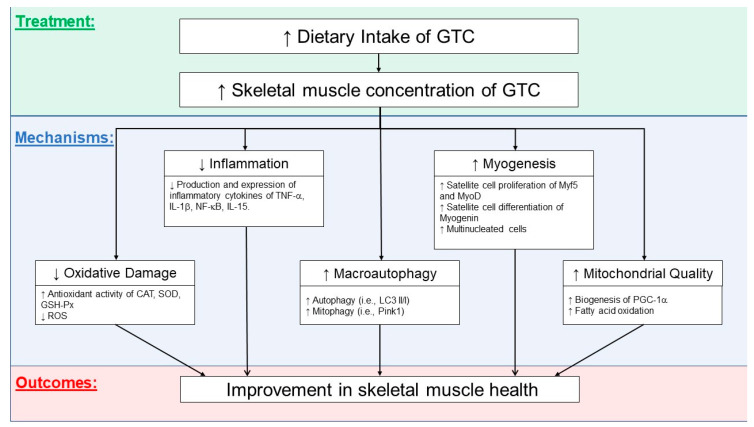
Osteoarthritis and sarcopenia are two major joint and skeletal muscle diseases prevalent during aging. Osteoarthritis is a multifactorial progressive degenerative and inflammatory disorder of articular cartilage. Cartilage protection and pain management are the two most important strategies in the management of osteoarthritis. Sarcopenia, a condition of loss of muscle mass and strength, is associated with impaired neuromuscular innervation, the transition of skeletal muscle fiber type, and reduced muscle regenerative capacity. Management of sarcopenia requires addressing both skeletal muscle quantity and quality. Emerging evidence suggests that green tea catechins play an important role in maintaining healthy joints and skeletal muscle. This review covers (i) the prevalence and etiology of osteoarthritis and sarcopenia, such as excessive inflammation and oxidative stress, mitochondrial dysfunction, and reduced autophagy; (ii) the effects of green tea catechins on joint health by downregulating inflammatory signaling mediators, upregulating anabolic mediators, and modulating miRNAs expression, resulting in reduced chondrocyte death, collagen degradation, and cartilage protection; (iii) the effects of green tea catechins on skeletal muscle health via maintaining a dynamic balance between protein synthesis and degradation and boosting the synthesis of mitochondrial energy metabolism, resulting in favorable muscle homeostasis and mitigation of muscle atrophy with aging; and (iv) the current study limitations and future research directions.
骨关节炎和肌肉减少症是衰老过程中常见的两种主要关节和骨骼肌疾病。骨关节炎是一种多因素的、渐进性的关节软骨退行性和炎症性疾病。软骨保护和疼痛管理是骨关节炎管理中两个最重要的策略。肌肉减少症是一种肌肉质量和力量丧失的病症,与神经肌肉神经支配受损、骨骼肌纤维类型转变以及肌肉再生能力降低有关。肌肉减少症的管理需要解决骨骼肌的数量和质量问题。新出现的证据表明,绿茶儿茶素在维持健康的关节和骨骼肌方面发挥着重要作用。本综述涵盖:(i)骨关节炎和肌肉减少症的患病率和病因,如过度炎症和氧化应激、线粒体功能障碍以及自噬减少;(ii)绿茶儿茶素通过下调炎症信号介质、上调合成代谢介质和调节miRNA表达对关节健康的影响,从而减少软骨细胞死亡、胶原蛋白降解并保护软骨;(iii)绿茶儿茶素通过维持蛋白质合成与降解之间的动态平衡以及促进线粒体能量代谢的合成,对骨骼肌健康产生影响,从而实现良好的肌肉稳态并减轻衰老引起的肌肉萎缩;以及(iv)当前研究的局限性和未来的研究方向。