Department of Chemistry and Applied Biosciences, Institute for Chemical and Bioengineering, ETH Zurich, Vladimir-Prelog-Weg 1, CH-8093, Zurich, Switzerland.
Department of Electrical and Computer Engineering, Technical University of Munich, Arcistrasse 21, 80333, Munich, Germany.
Nat Commun. 2020 Nov 18;11(1):5869. doi: 10.1038/s41467-020-19757-y.
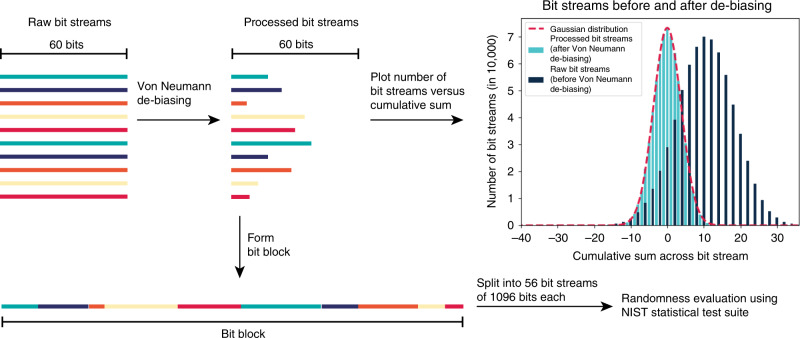
The volume of securely encrypted data transmission required by today's network complexity of people, transactions and interactions increases continuously. To guarantee security of encryption and decryption schemes for exchanging sensitive information, large volumes of true random numbers are required. Here we present a method to exploit the stochastic nature of chemistry by synthesizing DNA strands composed of random nucleotides. We compare three commercial random DNA syntheses giving a measure for robustness and synthesis distribution of nucleotides and show that using DNA for random number generation, we can obtain 7 million GB of randomness from one synthesis run, which can be read out using state-of-the-art sequencing technologies at rates of ca. 300 kB/s. Using the von Neumann algorithm for data compression, we remove bias introduced from human or technological sources and assess randomness using NIST's statistical test suite.
当今网络的复杂性使得人们对安全加密数据传输的需求不断增加,包括人员、交易和互动等方面。为了保证交换敏感信息的加密和解密方案的安全性,需要大量真正的随机数。在这里,我们提出了一种利用化学随机性质的方法,通过合成由随机核苷酸组成的 DNA 链。我们比较了三种商业随机 DNA 合成方法,以衡量核苷酸的稳健性和合成分布,并表明使用 DNA 进行随机数生成,我们可以从一次合成中获得 700 万 GB 的随机性,这些随机性可以使用最先进的测序技术以约 300 kB/s 的速率读取。我们使用冯·诺依曼算法进行数据压缩,消除了人为或技术来源带来的偏差,并使用 NIST 的统计测试套件评估随机性。