Department of Chemistry and Applied Biosciences, ETH Zürich, Vladimir-Prelog-Weg 1-5, 8093, Zürich, Switzerland.
Department of Computer Engineering, Technical University of Munich, Arcisstrasse 21, 80333, Munich, Germany.
Nat Commun. 2024 Apr 5;15(1):2955. doi: 10.1038/s41467-024-47187-7.
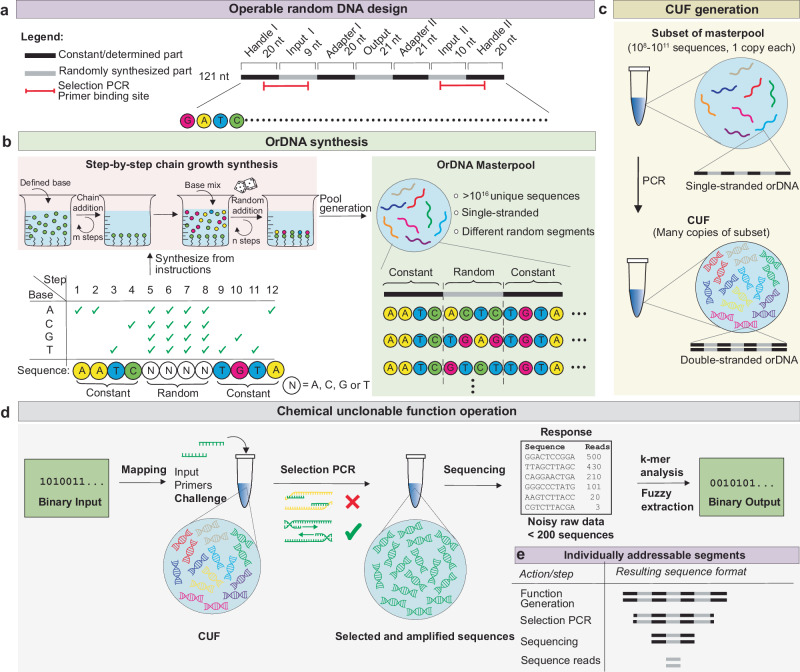
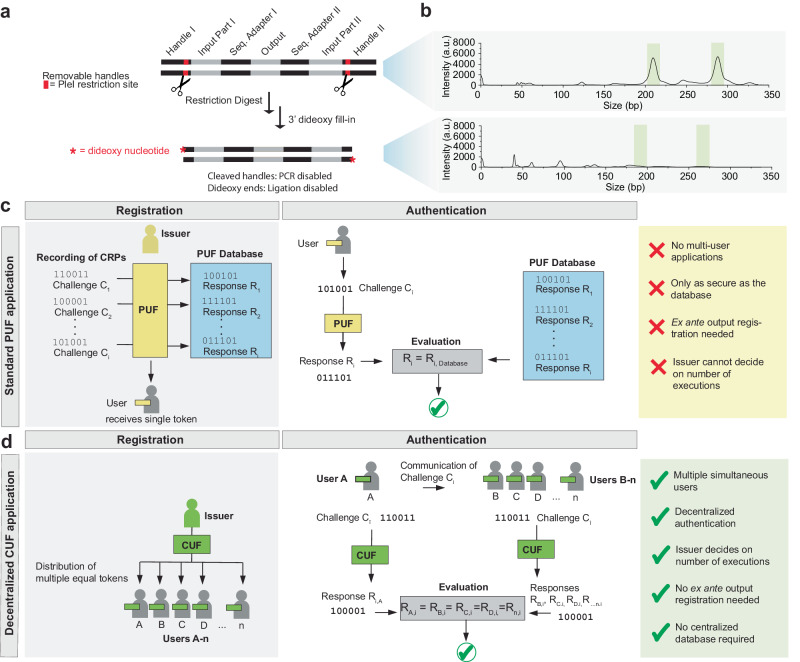
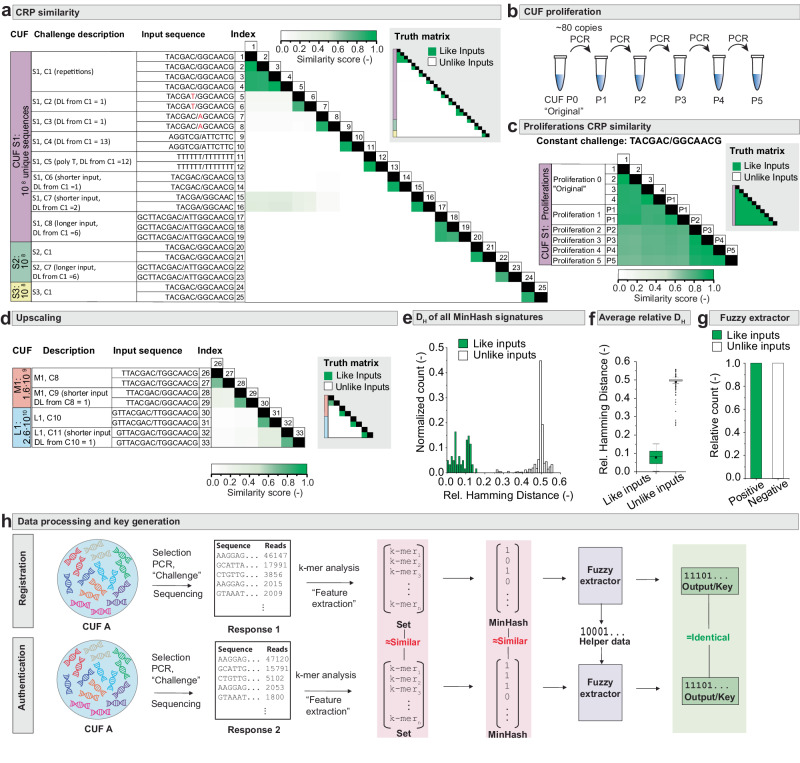
Physical unclonable functions (PUFs) based on unique tokens generated by random manufacturing processes have been proposed as an alternative to mathematical one-way algorithms. However, these tokens are not distributable, which is a disadvantage for decentralized applications. Finding unclonable, yet distributable functions would help bridge this gap and expand the applications of object-bound cryptography. Here we show that large random DNA pools with a segmented structure of alternating constant and randomly generated portions are able to calculate distinct outputs from millions of inputs in a specific and reproducible manner, in analogy to physical unclonable functions. Our experimental data with pools comprising up to >10 unique sequences and encompassing >750 comparisons of resulting outputs demonstrate that the proposed chemical unclonable function (CUF) system is robust, distributable, and scalable. Based on this proof of concept, CUF-based anti-counterfeiting systems, non-fungible objects and decentralized multi-user authentication are conceivable.
基于随机制造过程生成的唯一标记的物理不可克隆函数(PUFs)已被提议作为数学单向算法的替代方案。然而,这些标记是不可分发的,这对于去中心化应用来说是一个缺点。找到不可克隆但可分发的函数将有助于弥合这一差距,并扩展对象绑定密码术的应用。在这里,我们表明,具有交替恒定和随机生成部分的分段结构的大型随机 DNA 池能够以类似于物理不可克隆函数的方式,以特定且可重复的方式从数百万个输入中计算出不同的输出。我们的实验数据表明,由多达 >10 个独特序列组成的池和包含 >750 个结果输出比较的池证明了所提出的化学不可克隆函数(CUF)系统是稳健的、可分发的和可扩展的。基于这一概念验证,基于 CUF 的防伪系统、非同质化对象和去中心化多用户认证是可以想象的。