Li Shuyan, Chu Xiao, Ye Luxi, Ni Jianjiao, Zhu Zhengfei
Department of Radiation Oncology, Fudan University Shanghai Cancer Center, Shanghai, China.
Department of Oncology, Shanghai Medical College, Fudan University, Shanghai, China.
Transl Lung Cancer Res. 2020 Oct;9(5):2082-2096. doi: 10.21037/tlcr-20-512.
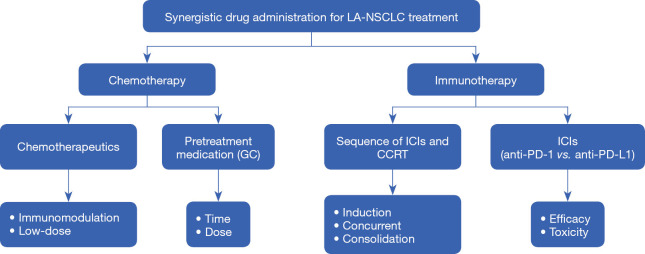
Based on the PACIFIC study, the standard care of unresectable locally advanced non-small cell lung cancer (LA-NSCLC) shifted from concurrent chemo-radiotherapy (CCRT) alone to CCRT followed by durvalumab consolidation in 2017. In the era of immunotherapy, two kinds of therapeutic drugs are involved in the management of LA-NSCLC: chemotherapeutics and anti-PD-1/PD-L1 agents. However, the best choices of systematic chemotherapy, immunotherapy, and treatment schedule remain controversial. The immune modulation effects of chemotherapy, as well as the potential immunosuppressive impact of pretreatment medications, should be taken into consideration. Indeed, chemotherapeutics are double-edged swords to immunotherapy, with both stimulatory and suppressive effects on the immune system. Moreover, low-dose chemotherapy is reported to enhance anti-tumor immune responses with reduced toxicities. As for glucocorticoids, there is no consensus about its exact impact on the efficacy of immunotherapy. In addition, the timing of anti-PD-1/PD-L1 agent related to CCRT has three modes: induction, concurrent, and consolidation therapy. Although CCRT followed by durvalumab consolidation is the standard of care, the best sequence of immunotherapy and chemo-radiotherapy is still under debate. Furthermore, the efficacy and toxicity of various PD-1/PD-L1 inhibitors should be compared, especially in the background of CCRT. In this review, we will summarize the detailed knowledge about chemotherapeutics and anti-PD-1/PD-L1 axis agents, and discuss the potential implications in designing novel, effective treatment strategies for LA-NSCLC.
基于 PACIFIC 研究,不可切除的局部晚期非小细胞肺癌(LA-NSCLC)的标准治疗在 2017 年从单纯同步放化疗(CCRT)转变为 CCRT 后进行度伐利尤单抗巩固治疗。在免疫治疗时代,LA-NSCLC 的治疗涉及两种治疗药物:化疗药物和抗 PD-1/PD-L1 药物。然而,系统化疗、免疫治疗的最佳选择以及治疗方案仍存在争议。应考虑化疗的免疫调节作用以及预处理药物的潜在免疫抑制影响。事实上,化疗药物对免疫治疗来说是双刃剑,对免疫系统既有刺激作用又有抑制作用。此外,据报道低剂量化疗可增强抗肿瘤免疫反应并降低毒性。至于糖皮质激素,其对免疫治疗疗效的确切影响尚无共识。此外,抗 PD-1/PD-L1 药物与 CCRT 相关的使用时机有三种模式:诱导、同步和巩固治疗。尽管 CCRT 后进行度伐利尤单抗巩固治疗是标准治疗方案,但免疫治疗和放化疗的最佳顺序仍在争论中。此外,应比较各种 PD-1/PD-L1 抑制剂的疗效和毒性,尤其是在 CCRT 的背景下。在本综述中,我们将总结关于化疗药物和抗 PD-1/PD-L1 轴药物的详细知识,并讨论其在设计针对 LA-NSCLC 的新型有效治疗策略中的潜在意义。