Huang Houfeng, Fan Xinrong, Zhang Xuebin, Xie Yi, Ji Zhigang
Department of Urology, Peking Union Medical College Hospital, Chinese Academy of Medical Sciences and Peking Union Medical College, Beijing, China.
Transl Androl Urol. 2020 Oct;9(5):2251-2261. doi: 10.21037/tau-20-1293.
Aberrant expression of long noncoding RNAs (lncRNAs) has been found to enroll in the initiation and progression of bladder cancer (BC). Earlier results show cancer-associated region long noncoding RNA-7 (CARLo-7) can be a prognostic marker for BC, but its biological function and the underlying mechanism is still to be discovered. Our study aims to explore the effects of CARLo-7 on the initiation and progression of BC and the potential mechanisms.
The expression of CARLo-7 in BC tissues and cell lines was determined by quantitative real-time polymerase chain reaction (qRT-PCR). T24 and HT1197 cells were transfected with CARLo-7 expression vector or sh-CARLo-7, then cell viability assay, BrdU assay, flow cytometry, Transwell cell migration, and invasion assay, and western blot were conducted to evaluate cell proliferation, apoptosis, invasion, migration, and epithelial-mesenchymal transition (EMT).
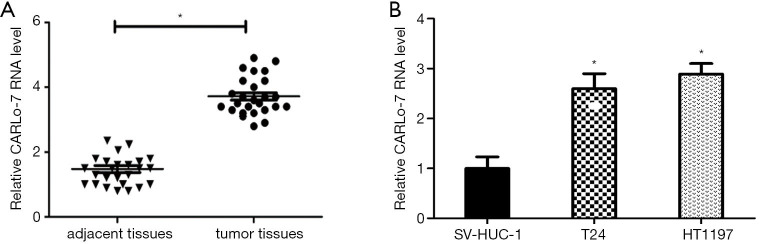
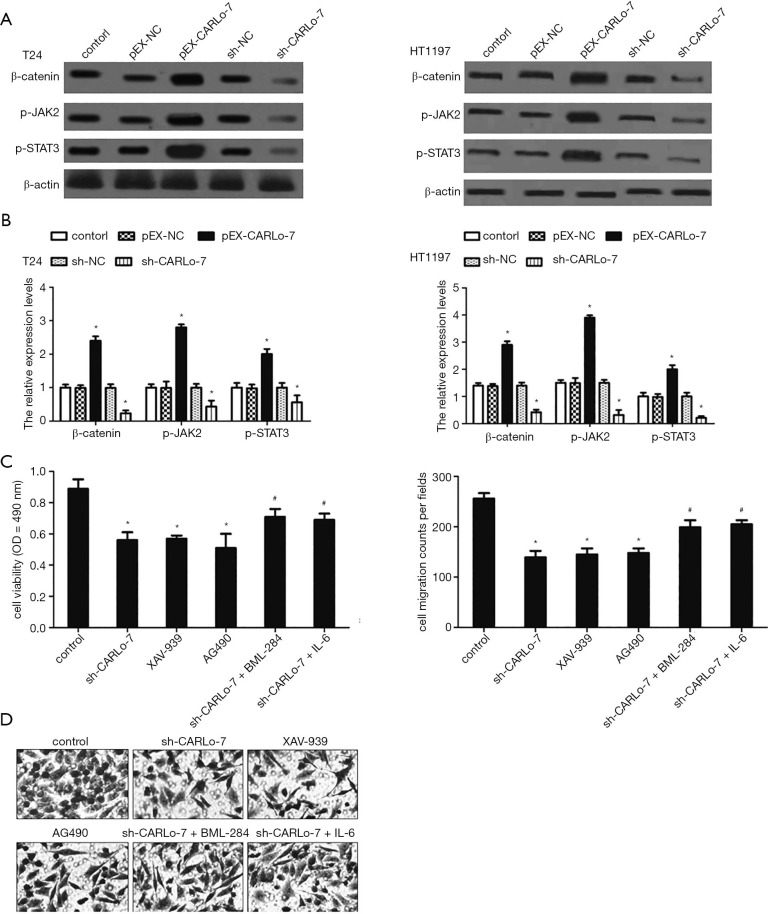
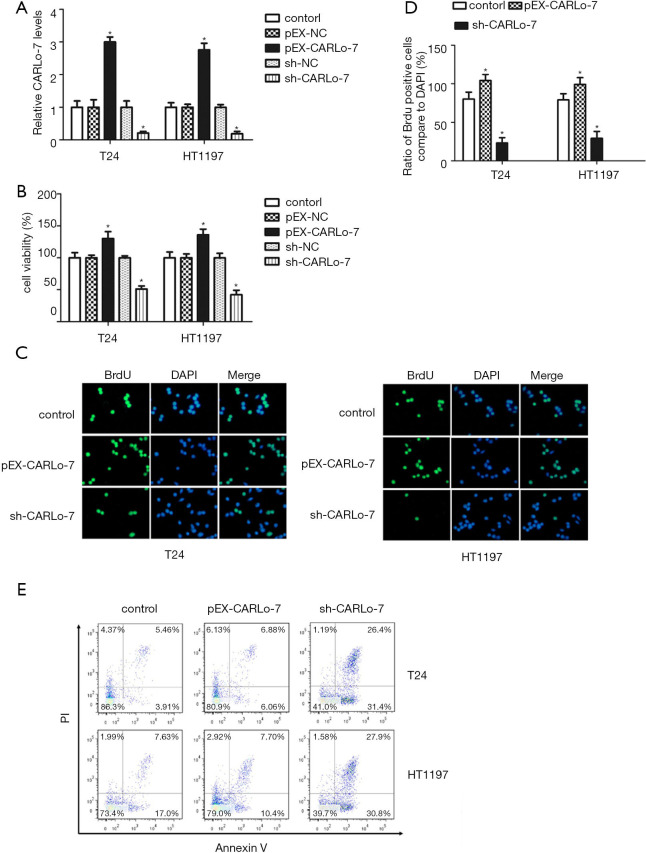
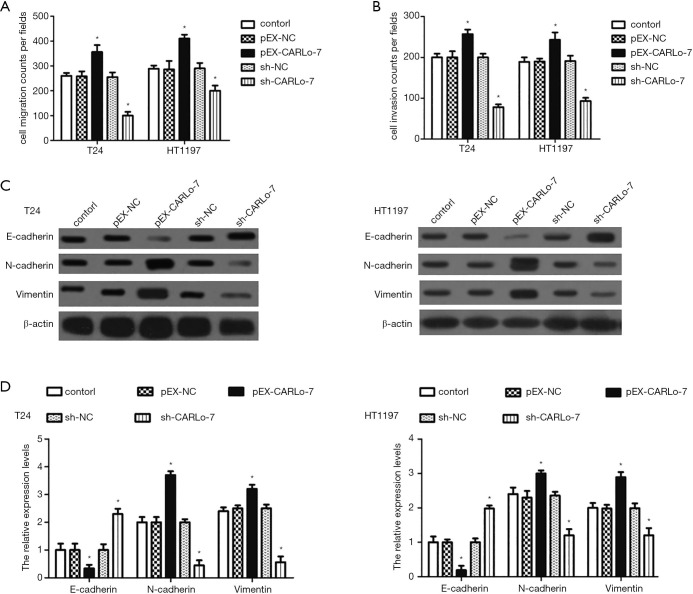
CARLo-7 was dramatically upregulated in BC tissues and cell lines. Silencing CARLo-7 by sh-CARLo-7 significantly suppressed proliferation and induced apoptosis of BC cells, while enforced CARLo-7 expression promoted cell proliferation. Meanwhile, silencing CARLo-7 attenuated migration, invasion, and EMT of BC cells, while CARLo-7 overexpression had the contrary effects. The β-catenin, p-JAK2 and p-STAT3 levels were decreased by CARLo-7 knockdown, while activation of Wnt/β-catenin or JAK2/STAT3 pathways abolished the effects of CARLo-7 knockdown on cell proliferation and migration.
Collectively, CARLo-7 plays a critical role in regulating BC development by regulating cell proliferation, migration, invasion, and EMT through Wnt/β-catenin and JAK2/STAT3 signaling. Therefore, CARLo-7 might be a promising therapeutic target for BC.
长链非编码RNA(lncRNAs)的异常表达已被发现参与膀胱癌(BC)的发生和发展。早期结果表明,癌症相关区域长链非编码RNA-7(CARLo-7)可能是BC的一个预后标志物,但其生物学功能和潜在机制仍有待探索。我们的研究旨在探讨CARLo-7对BC发生发展的影响及其潜在机制。
通过定量实时聚合酶链反应(qRT-PCR)检测BC组织和细胞系中CARLo-7的表达。将CARLo-7表达载体或sh-CARLo-7转染至T24和HT1197细胞,然后进行细胞活力测定、BrdU测定、流式细胞术、Transwell细胞迁移和侵袭测定以及蛋白质免疫印迹,以评估细胞增殖、凋亡、侵袭、迁移和上皮-间质转化(EMT)。
CARLo-7在BC组织和细胞系中显著上调。通过sh-CARLo-7沉默CARLo-7可显著抑制BC细胞的增殖并诱导其凋亡,而增强CARLo-7表达则促进细胞增殖。同时,沉默CARLo-7可减弱BC细胞的迁移、侵袭和EMT,而CARLo-7过表达则产生相反的效果。CARLo-7敲低可降低β-连环蛋白、p-JAK2和p-STAT3的水平,而Wnt/β-连环蛋白或JAK2/STAT3信号通路的激活则消除了CARLo-7敲低对细胞增殖和迁移的影响。
总体而言,CARLo-7通过Wnt/β-连环蛋白和JAK2/STAT3信号传导调节细胞增殖、迁移、侵袭和EMT,在BC发展过程中起关键作用。因此,CARLo-7可能是BC一个有前景的治疗靶点。