Ohwaki Akiko, Nishizawa Haruki, Kato Asuka, Kato Takema, Miyazaki Jun, Yoshizawa Hikari, Noda Yoshiteru, Sakabe Yoshiko, Ichikawa Ryoko, Sekiya Takao, Fujii Takuma, Kurahashi Hiroki
Department of Obstetrics and Gynecology, Fujita Health University School of Medicine, Toyoake, Japan.
Division of Molecular Genetics, Institute for Comprehensive Medical Science, Fujita Health University, Toyoake, Japan.
J Reprod Infertil. 2020 Oct-Dec;21(4):240-246. doi: 10.18502/jri.v21i4.4325.
Soluble fms-like tyrosine kinase 1 (sFlt-1) is believed to be a prominent component in the pathogenesis of pre-eclampsia, although the precise etiology has remained elusive. In this study, the etiological role of FLT1 variant was further validated in pre-eclampsia by examining this association in a Japanese sample population.
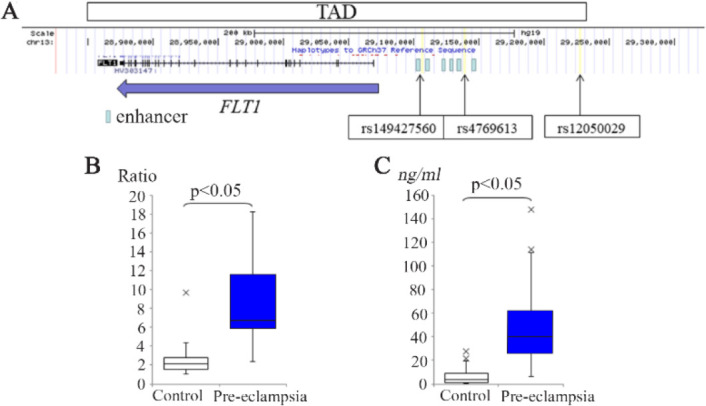
The genotypes of three variants (rs4769613, rs12050029 and rs149427560) were examined in the upstream region of the FLT1 gene in placentas from pre-eclamptic (n=47) or normotensive control (n=49) pregnancy samples. Additionally, FLT1 mRNA levels in placenta were determined by qRT-PCR. ELISA was further used to detect circulating sFlt-1 levels in maternal sera. The intergroup comparisons were made using the Mann-Whitney U test or one way analysis of variance and P values of less than 0.05 were considered statistically significant.
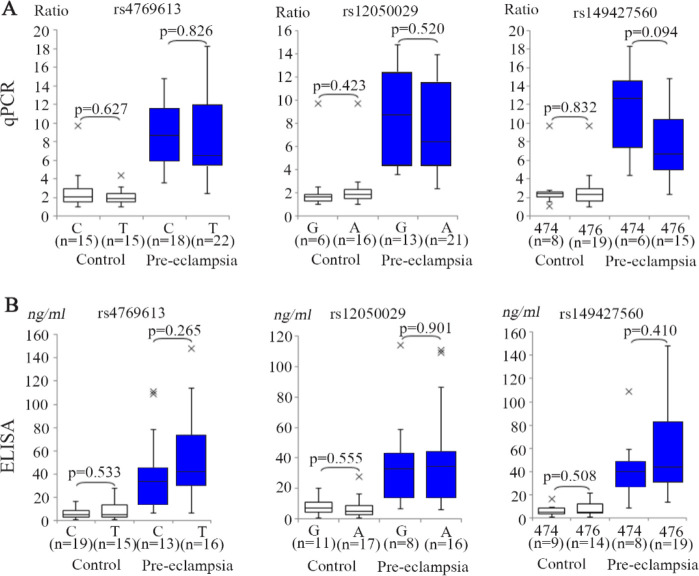
First, the rs4769613 (C>T) and rs12050029 (G>A) genotypes were examined in placentas but no significant differences were found in the genotype or allele-type frequencies. Next, nearby short tandem repeat, rs149427560, was examined which manifested four size variants. In the genotypewise analysis, the frequency of the 474/476 heterozygote was significantly lower in pre-eclampsia (p<0.05). As expected, the FLT1 mRNA levels were significantly elevated in the pre-eclamptic placentas and sFlt-1 was higher in pre-eclamptic maternal sera. However, the genotype of these variants did not affect the FLT1 mRNA or serum sFlt-1 levels.
Our findings did not support the hypothesis that genetic variations around the FLT1 gene affect the subtle expression changes underlying the etiologic pathway of pre-eclampsia. The hypothesis deserves further investigation through a larger sample size.
可溶性fms样酪氨酸激酶1(sFlt-1)被认为是子痫前期发病机制中的一个重要成分,尽管其确切病因仍不清楚。在本研究中,通过在日本样本人群中检测这种关联,进一步验证了FLT1变异在子痫前期中的病因学作用。
在子痫前期(n=47)或血压正常对照(n=49)妊娠样本的胎盘FLT1基因上游区域检测了三个变异(rs4769613、rs12050029和rs149427560)的基因型。此外,通过qRT-PCR测定胎盘FLT1 mRNA水平。进一步用ELISA检测孕妇血清中循环sFlt-1水平。采用Mann-Whitney U检验或单因素方差分析进行组间比较,P值小于0.05被认为具有统计学意义。
首先,检测了胎盘中的rs4769613(C>T)和rs12050029(G>A)基因型,但在基因型或等位基因频率上未发现显著差异。接下来,检测了附近的短串联重复序列rs149427560,其表现出四种大小变异。在基因型分析中,子痫前期中474/476杂合子的频率显著较低(p<0.05)。正如预期的那样,子痫前期胎盘中FLT1 mRNA水平显著升高,子痫前期孕妇血清中sFlt-1水平更高。然而,这些变异的基因型并未影响FLT1 mRNA或血清sFlt-1水平。
我们的研究结果不支持FLT1基因周围的遗传变异影响子痫前期病因途径中微妙表达变化的假设。该假设值得通过更大样本量进一步研究。