Li Jianshe, He Wenlong, Wang Yan, Zhao Jianting, Zhao Xinli
Department of Neurology, Xinxiang Central Hospital, Xinxiang, China.
Department of Neurology, The Third Affiliated Hospital of Xinxiang Medical College, Xinxiang, China.
Ann Transl Med. 2020 Oct;8(20):1296. doi: 10.21037/atm-20-5856.
Cerebral ischemia-reperfusion injury (CI/R) is among the most common diseases affecting the central nervous system. Due to the poor efficacy and adverse side effects of the drugs used to treat CI/R in clinical trials, a new treatment strategy is urgently needed. In this study, we aimed to investigate whether miR-103a-3p alleviates CI/R and and to explore the relevant mechanisms.
BV2 microglial cells underwent oxygen-glucose deprivation (OGD) treatment to imitate the pathophysiology of CI/R . A middle cerebral artery occlusion (MCAO) rat model was established to imitate the pathophysiology of CI/R . The expression levels of miR-103a-3p and HMGB1 were detected by reverse transcription-polymerase chain reaction (RT-PCR) and western blot. Flow cytometry, terminal deoxynucleotidyl transferase dUTP nick end labeling (TUNEL) assay, enzyme-linked immunosorbent assay (ELISA), and hematoxylin and eosin (H&E) and Nissl staining were used to evaluated apoptosis, oxidative stress, inflammatory response, and histopathology, respectively.
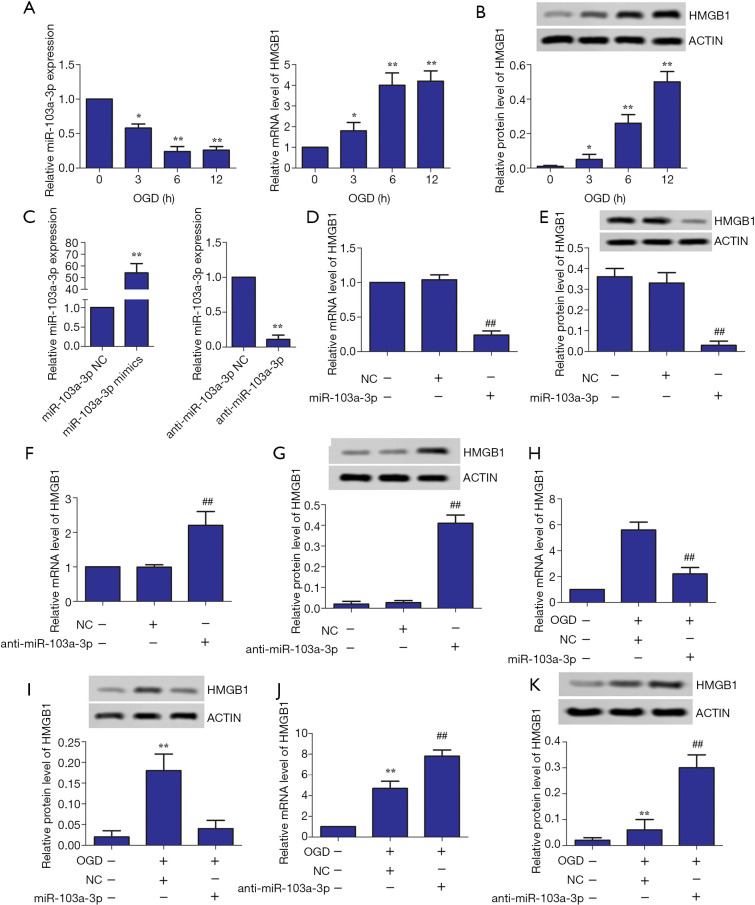
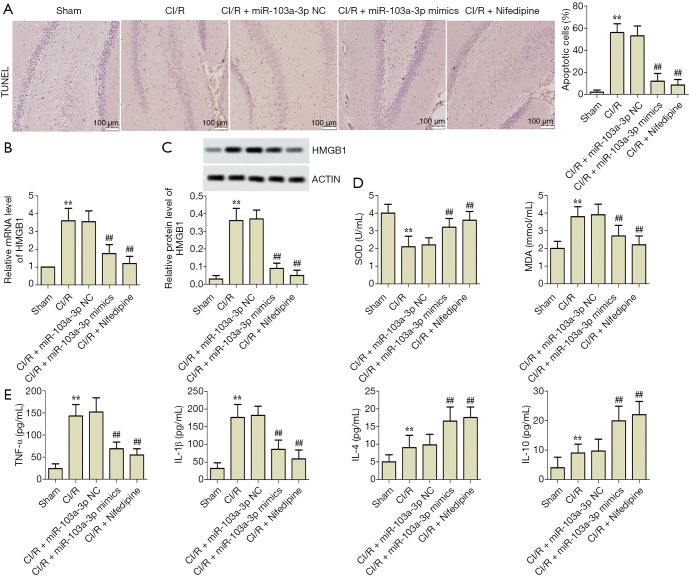
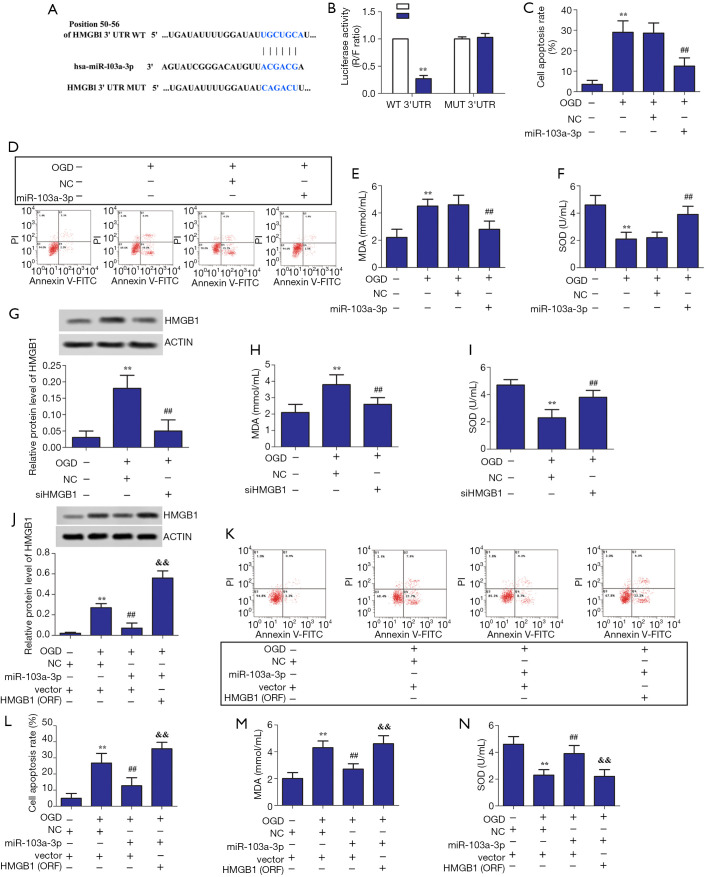
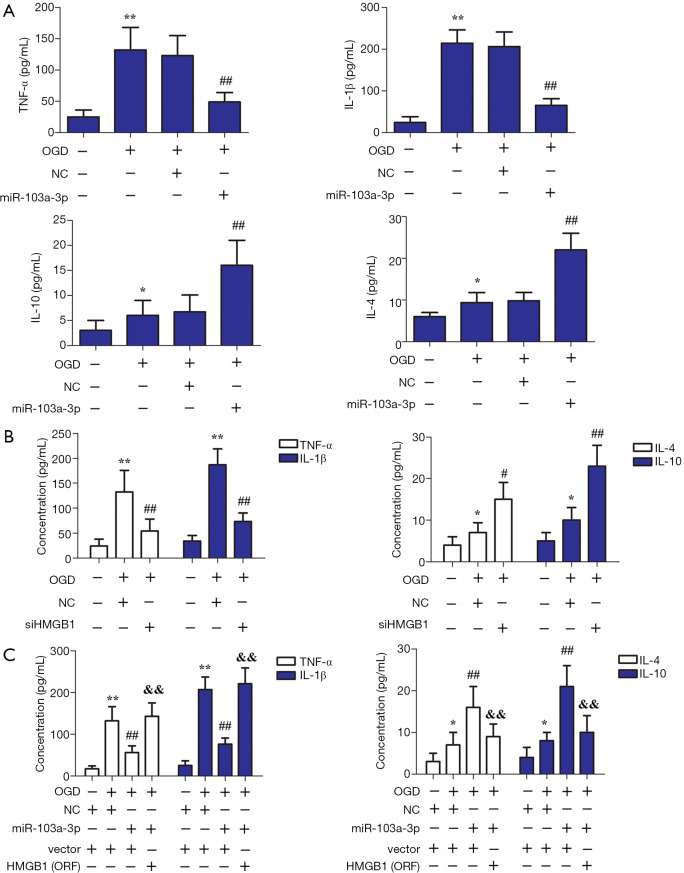
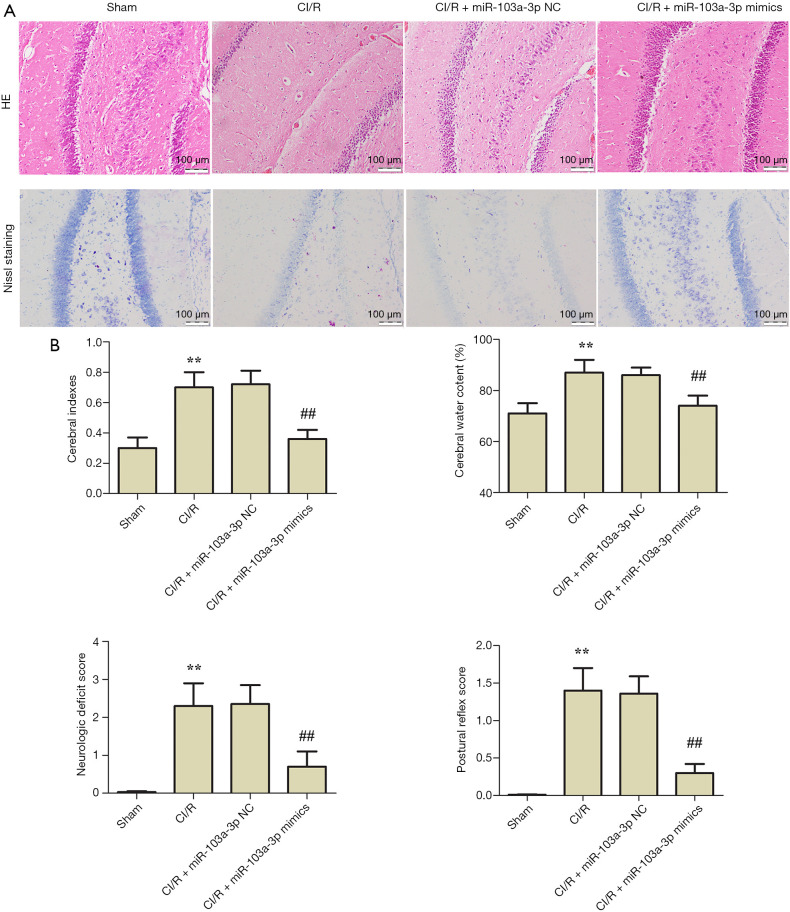
OGD-stimulated BV2 microglial cells and brain tissues with CI/R had low expression of miR-103a-3p but high expression of high mobility group box 1 (HMGB1). As expected, miR-103a-3p and HMGB1 had a targeting relationship. Overexpression of HMGB1 enhanced the the levels of interleukin (IL)-1 beta, tumor necrosis factor-alpha (TNF-α) and malondialdehyde (MDA), but reduced the content of superoxide dismutase (SOD), IL-4, and IL-10, . Moreover, high expression of HMGB1 aggravated the brain injury of the model rats, and increased the secretion of inflammatory factors, exacerbated oxidative stress, and further induced tissue apoptosis in the brain tissue. Importantly, these effects of HMGB1 overexpression were partly reversed by miR-103a-3p overexpression on HMGB1 interference.
HMGB1 is targeted by miR-103a-3p, which may be a new strategy in the treatment of CI/R.
脑缺血再灌注损伤(CI/R)是影响中枢神经系统的最常见疾病之一。由于临床试验中用于治疗CI/R的药物疗效不佳且有不良副作用,迫切需要一种新的治疗策略。在本研究中,我们旨在研究miR-103a-3p是否能减轻CI/R并探索相关机制。
对BV2小胶质细胞进行氧糖剥夺(OGD)处理以模拟CI/R的病理生理学。建立大脑中动脉闭塞(MCAO)大鼠模型以模拟CI/R的病理生理学。通过逆转录-聚合酶链反应(RT-PCR)和蛋白质印迹法检测miR-103a-3p和高迁移率族蛋白B1(HMGB1)的表达水平。分别使用流式细胞术、末端脱氧核苷酸转移酶dUTP缺口末端标记(TUNEL)法、酶联免疫吸附测定(ELISA)以及苏木精-伊红(H&E)和尼氏染色来评估细胞凋亡、氧化应激、炎症反应和组织病理学。
OGD刺激的BV2小胶质细胞和发生CI/R的脑组织中miR-103a-3p表达低,但高迁移率族蛋白B1(HMGB1)表达高。正如预期的那样,miR-103a-3p与HMGB1存在靶向关系。HMGB1的过表达增加了白细胞介素(IL)-1β、肿瘤坏死因子-α(TNF-α)和丙二醛(MDA)的水平,但降低了超氧化物歧化酶(SOD)、IL-4和IL-10的含量。此外,HMGB1的高表达加重了模型大鼠的脑损伤,并增加了炎症因子的分泌,加剧了氧化应激,并进一步诱导了脑组织中的组织细胞凋亡。重要的是,miR-103a-3p过表达对HMGB1干扰可部分逆转HMGB1过表达的这些作用。
HMGB1是miR-103a-3p的靶标,这可能是治疗CI/R的一种新策略。