Cheng Ming, Wang Yue
Department of Rehabilitation, Jinniu District People's Hospital of Chengdu, Chengdu, Sichuan, China.
Department of Orthopaedics, Sichuan Academy of Medical Sciences & Sichuan Provincial people's Hospital, Chengdu, Sichuan, China.
Iran J Biotechnol. 2020 Jan 1;18(1):e2255. doi: 10.30498/IJB.2020.129470.2255. eCollection 2020 Jan.
MiR-103a-3p is a small non-coding RNA and has been reported to be involved in osteogenic proliferation and differentiation, but the role of miR-103a-3p in human osteoarthritis (OA) remains unclear.
In this study, we aimed to explore its function and molecular target in chondrocytes during OA pathogenesis.
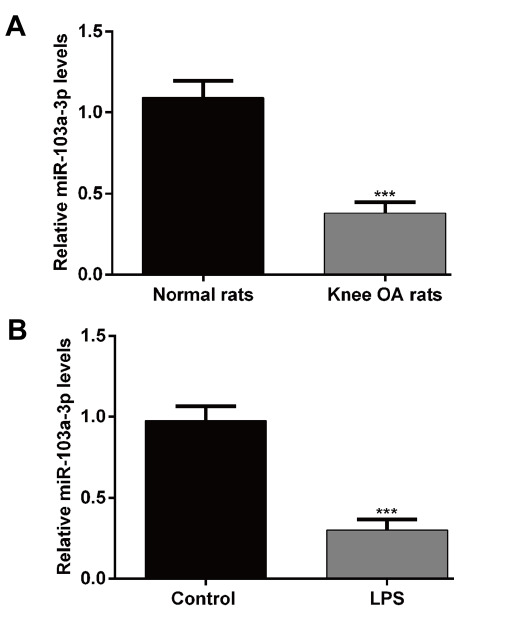
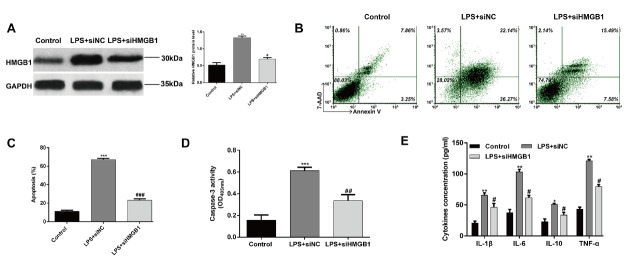
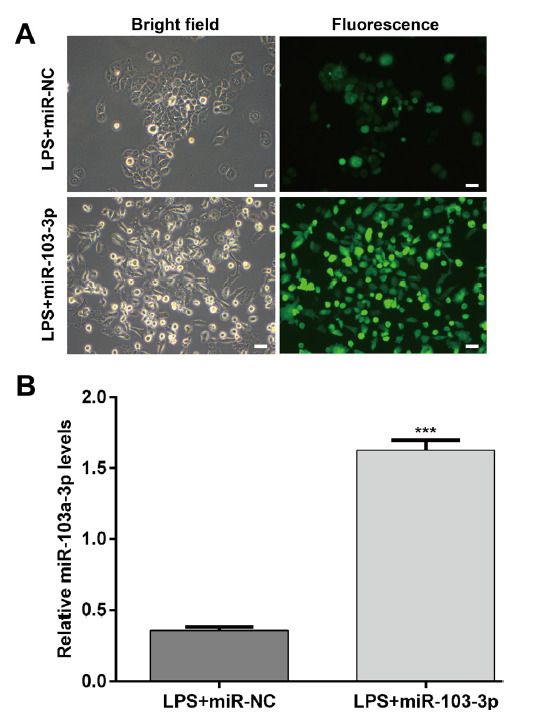
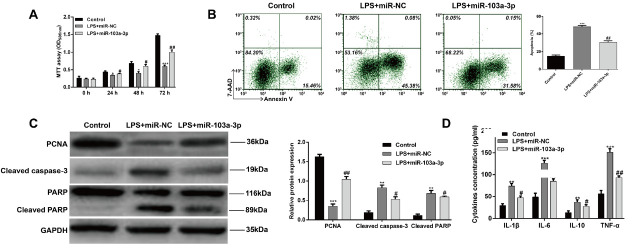
Total 12 experimental OA rat models, together with 12 rats without knee OA lesions were established and cartilage samples were collected. Chondrocytes were treated with LPS . MiR-103a-3p expression was detected in articular cartilage tissues and chondrocytes using quantitative real-time PCR. Knee OA chondrocytes were transfected with miR-103a-3p mimics, and siHMGB1, respectively. Then cellular proliferation, apoptosis, apoptosis related factors and inflammatory cytokines were analyzed by MTT, flow cytometry, western blot, caspase-3 activity and ELISA, respectively. Potential targets of miR-103a-3p were predicted using series of bioinformatics analysis, then confirmed by luciferase reporter assay.
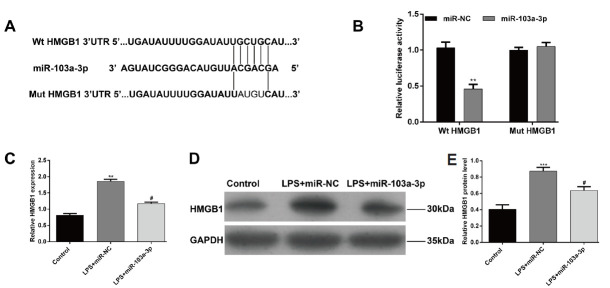
We first found miR-103a-3p was significantly down-regulated in the articular cartilage tissues from experimental OA rats, as well as in chondrocytes treated with LPS . The gain-of-function assay further demonstrated that up-regulation of miR-103a-3p significantly promoted cell proliferation, inhibited apoptosis and inflammation, which was accompanied with elevated expression of PCNA, and reduced expression of caspase-3, PARP, IL-1β, IL-6, IL-10 and TNF-α. Furthermore, high mobility group box 1 (HMGB1), an important inflammatory mediator of OA, was a target of miR-103a-3p. Moreover, knockdown of HMGB1 mimicked the effects of miR-103a-3p on chondrocytes treated with LPS.
Taken together, our study suggests that miR-103a-3p inhibits chondrocyte apoptosis and inflammation in OA, which appears to be an attractive approach to OA treatment.
MiR-103a-3p是一种小的非编码RNA,据报道其参与成骨细胞的增殖和分化,但miR-103a-3p在人类骨关节炎(OA)中的作用仍不清楚。
在本研究中,我们旨在探讨其在OA发病机制中软骨细胞的功能和分子靶点。
总共建立了12个实验性OA大鼠模型,以及12只无膝关节OA损伤的大鼠,并收集软骨样本。软骨细胞用脂多糖(LPS)处理。使用定量实时PCR检测关节软骨组织和软骨细胞中miR-103a-3p的表达。分别用miR-103a-3p模拟物和siHMGB1转染膝关节OA软骨细胞。然后分别通过MTT、流式细胞术、蛋白质免疫印迹法、caspase-3活性和酶联免疫吸附测定(ELISA)分析细胞增殖、凋亡、凋亡相关因子和炎症细胞因子。使用一系列生物信息学分析预测miR-103a-3p的潜在靶点,然后通过荧光素酶报告基因检测进行确认。
我们首先发现,在实验性OA大鼠的关节软骨组织以及用LPS处理的软骨细胞中,miR-103a-3p显著下调。功能获得实验进一步证明,miR-103a-3p的上调显著促进细胞增殖、抑制凋亡和炎症,这伴随着增殖细胞核抗原(PCNA)表达升高,以及半胱天冬酶-3(caspase-3)、聚(ADP-核糖)聚合酶(PARP)、白细胞介素-1β(IL-1β)、白细胞介素-6(IL-6)、白细胞介素-10(IL-10)和肿瘤坏死因子-α(TNF-α)表达降低。此外,高迁移率族蛋白B1(HMGB1),一种OA的重要炎症介质,是miR-103a-3p的一个靶点。此外,敲低HMGB1模拟了miR-103a-3p对用LPS处理的软骨细胞的影响。
综上所述,我们的研究表明,miR-103a-3p在OA中抑制软骨细胞凋亡和炎症,这似乎是一种有吸引力的OA治疗方法。