Department of Rheumatology, Gaochun Branch, Nanjing Drum Tower Hospital, The Affiliated Hospital of Nanjing University Medical School, Nanjing, China.
J Clin Lab Anal. 2021 Jan;35(1):e23573. doi: 10.1002/jcla.23573. Epub 2020 Nov 18.
Autoimmune disease (AID) patients always present with increased risk of psychiatric disorders, and thyroid function or thyroid hormone may play a critical role in the development of anxiety and depression. Thus, this study aimed to assess the free triiodothyronine (FT3), free tetraiodothyronine (FT4), thyroid-stimulating hormone (TSH) levels, and their correlations with anxiety/depression in patients with AID.
Ninety-eight AID patients and 100 health controls (HCs) were recruited. Serum samples were obtained from all the participants to detect FT3, FT4, and TSH levels. Anxiety and depression were determined using the HADS assessment.
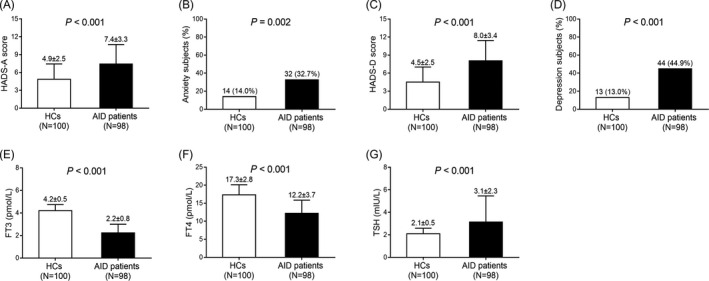
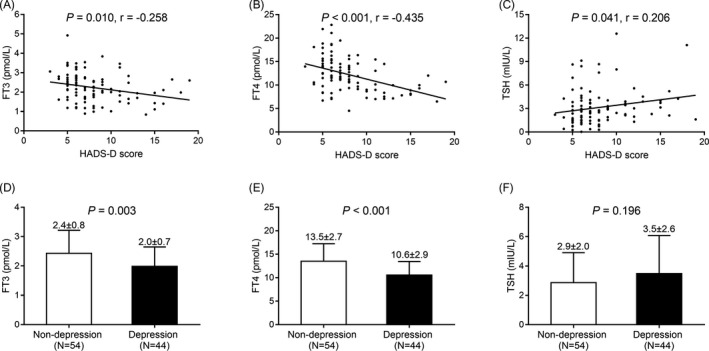
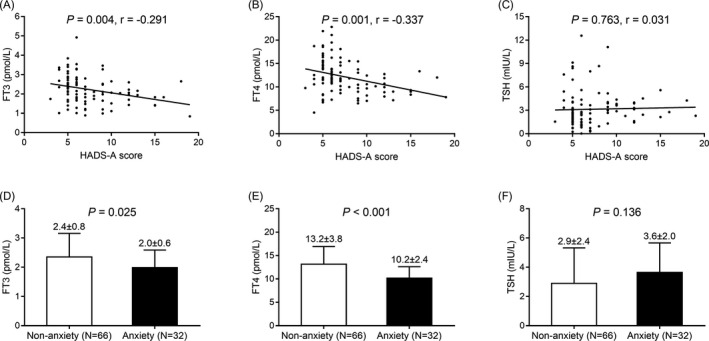
HADS-Anxiety score, anxiety subject percentage, HADS-Depression score, and depression subject proportion were elevated in AID patients compared with HCs. FT3 and FT4 were downregulated while TSH was upregulated in AID patients compared with HCs. In AID patients, FT3 and FT4 negatively correlated with HADS-Anxiety score, and they were downregulated in patients with anxiety compared to patients without anxiety. Meanwhile, FT3 and FT4 were negatively associated while TSH level positively associated with HADS-Depression score. Besides, FT3 and FT4 reduced, but TSH level was of no difference in patients with depression compared to patients without depression. Additionally, increased FT4 independently correlated with both reduced anxiety risk and depression risk.
FT3, FT4, and TSH are dysregulated, and FT4 has the potential to serve as an independent biomarker related to anxiety as well as depression in AID patients. These findings may provide some information on the values of thyroid hormones in facilitating the management of AID patients with anxiety/depression.
自身免疫性疾病(AID)患者总是存在更高的精神疾病风险,甲状腺功能或甲状腺激素可能在焦虑和抑郁的发展中起关键作用。因此,本研究旨在评估 AID 患者游离三碘甲状腺原氨酸(FT3)、游离甲状腺素(FT4)、促甲状腺激素(TSH)水平及其与焦虑/抑郁的相关性。
招募了 98 名 AID 患者和 100 名健康对照者(HCs)。从所有参与者中获取血清样本,以检测 FT3、FT4 和 TSH 水平。采用 HADS 评估焦虑和抑郁。
与 HCs 相比,AID 患者的 HADS-焦虑评分、焦虑患者比例、HADS-抑郁评分和抑郁患者比例升高。与 HCs 相比,AID 患者的 FT3 和 FT4 下调,TSH 上调。在 AID 患者中,FT3 和 FT4 与 HADS-焦虑评分呈负相关,且焦虑患者的 FT3 和 FT4 低于无焦虑患者。同时,FT3 和 FT4 呈负相关,而 TSH 水平与 HADS-抑郁评分呈正相关。此外,与无抑郁患者相比,抑郁患者的 FT3 和 FT4 降低,但 TSH 水平无差异。此外,FT4 升高与焦虑风险和抑郁风险降低独立相关。
FT3、FT4 和 TSH 失调,FT4 可能成为 AID 患者焦虑和抑郁的独立生物标志物。这些发现可能为甲状腺激素在促进 AID 伴焦虑/抑郁患者管理方面的价值提供一些信息。