International Center for Equity in Health, Federal University of Pelotas, Pelotas, Brazil.
Postgraduate Program in Epidemiology, Federal University of Pelotas, Pelotas, Brazil.
J Glob Health. 2020 Dec;10(2):020406. doi: 10.7189/jogh.10.020406.
Every year more than 200 million children under-five years fail to achieve their full developmental potential in low- and middle-income countries (LMICs). Although women´s empowerment has been associated with improved child health and development outcomes, this is a topic little studied in LMICs. We investigated the associations between women´s empowerment and early childhood development among a sample population of 84537 children aged 36-59 months from national health surveys of 26 African countries.
We used data from Demographic and Health Surveys (DHS) and Multiple Indicator Cluster Surveys (MICS) ranging from 2010 to 2018. Four developmental domains were assessed among children using the Early Childhood Development Index: literacy-numeracy, physical, learning and socioemotional. Women's empowerment in attitude to violence, social independence and decision-making was evaluated using the SWPER global, a validated survey-based index. We reported effect sizes for each country and a combined estimate of the association. The study covers all countries with surveys in the region and uses a novel approach for measuring women's empowerment, the SWPER.
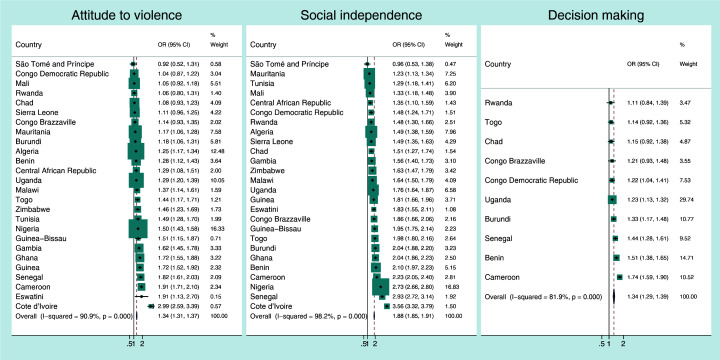
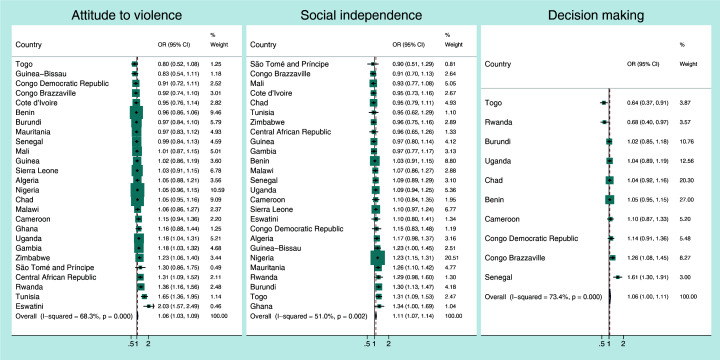
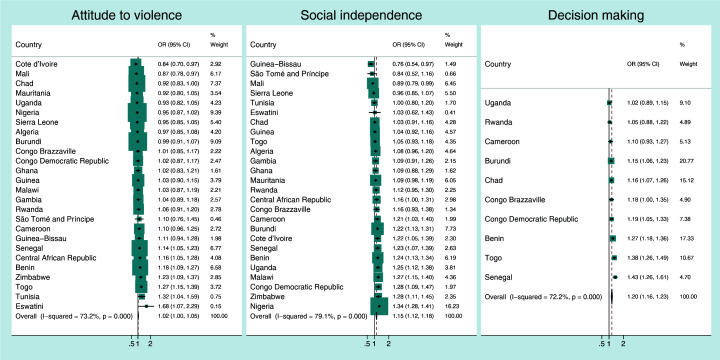
Across all countries, 15.1% of the children were on track in the literacy-numeracy domain, 92.3% in physical, 81.3% in learning and 67.8% in socio-emotional. The odds of a child being on track in literacy-numeracy increased by 34% (odds ratio (OR) = 1.34; 95% confidence interval (CI) = 1.31-1.37), 88% (OR = 1.88; 95% CI = 1.85-1.91) and 34% (OR = 1.34; 95% CI = 1.29-1.39), with a one standard deviation increase in the scores of attitudes to violence, social independence and decision-making domains of empowerment, respectively. No effect of empowerment was observed for the other domains of child development.
Our results show a consistent positive effect of empowerment on the literacy-numeracy domain of child development cross-nationally in Africa and this was particularly evident for the social independence domain of the SWPER. Programs and interventions may also consider addressing the reduction of gender inequalities to improve child development.
每年,有超过 2 亿 5 岁以下儿童未能在中低收入国家(LMICs)充分发挥其发展潜力。尽管妇女赋权与儿童健康和发展结果的改善有关,但这在 LMICs 中是一个研究甚少的话题。我们调查了妇女赋权与 26 个非洲国家的全国健康调查中 84537 名 36-59 个月大的儿童样本人口的早期儿童发展之间的关联。
我们使用了 2010 年至 2018 年期间的人口与健康调查(DHS)和多指标类集调查(MICS)的数据。使用早期儿童发展指数评估儿童在四个发展领域的表现:读写-算数、身体、学习和社会情感。使用 SWPER 全球评估妇女在态度、社会独立和决策方面的赋权情况,这是一个经过验证的基于调查的指数。我们报告了每个国家的效应大小和关联的综合估计值。该研究涵盖了该地区所有有调查的国家,并使用了一种新的测量妇女赋权的方法,即 SWPER。
在所有国家中,有 15.1%的儿童在读写-算数领域表现出色,92.3%的儿童在身体方面表现出色,81.3%的儿童在学习方面表现出色,67.8%的儿童在社会情感方面表现出色。在读写-算数方面表现出色的儿童的几率增加了 34%(优势比(OR)=1.34;95%置信区间(CI)=1.31-1.37),88%(OR=1.88;95% CI=1.85-1.91)和 34%(OR=1.34;95% CI=1.29-1.39),这与态度、社会独立和决策领域的赋权得分每增加一个标准差分别相关。赋权对其他儿童发展领域没有影响。
我们的结果表明,赋权对非洲国家的儿童发展的读写-算数领域具有一致的积极影响,而在 SWPER 的社会独立领域则尤为明显。方案和干预措施也可以考虑解决减少性别不平等问题,以改善儿童发展。