SETI Institute, Mountain View, California, USA.
Space Telescope Science Institute, Baltimore, Maryland, USA.
Astrobiology. 2021 Feb;21(2):219-234. doi: 10.1089/ast.2020.2272. Epub 2020 Nov 19.
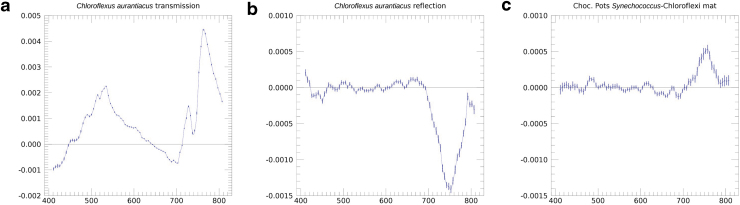
Photosynthesis is an ancient metabolic process that began on early Earth and offers plentiful energy to organisms that can utilize it such that that they achieve global significance. The potential exists for similar processes to operate on habitable exoplanets and result in observable biosignatures. Before the advent of oxygenic photosynthesis, the most primitive phototrophs, anoxygenic phototrophs, dominated surface environments on the planet. Here, we characterize surface polarization biosignatures associated with a diverse sample of anoxygenic phototrophs and cyanobacteria, examining both pure cultures and microbial communities from the natural environment. Polarimetry is a tool that can be used to measure the chiral signature of biomolecules. Chirality is considered a universal, agnostic biosignature that is independent of a planet's biochemistry, receiving considerable interest as a target biosignature for life-detection missions. In contrast to preliminary indications from earlier work, we show that there is a diversity of distinctive circular polarization signatures, including the magnitude of the polarization, associated with the variety of chiral photosynthetic pigments and pigment complexes of anoxygenic and oxygenic phototrophs. We also show that the apparent death and release of pigments from one of the phototrophs is accompanied by an elevation of the reflectance polarization signal by an order of magnitude, which may be significant for remotely detectable environmental signatures. This work and others suggest that circular polarization signals up to ∼1% may occur, significantly stronger than previously anticipated circular polarization levels. We conclude that global surface polarization biosignatures may arise from anoxygenic and oxygenic phototrophs, which have dominated nearly 80% of the history of our rocky, inhabited planet.
光合作用是一种古老的代谢过程,它始于早期的地球,并为能够利用它的生物提供丰富的能量,使其具有全球性的重要意义。类似的过程有可能在可居住的系外行星上运行,并产生可观察的生物特征。在产氧光合作用出现之前,最原始的光养生物——厌氧光养生物——主导着地球上的表面环境。在这里,我们描述了与多种厌氧光养生物和蓝藻相关的表面极化生物特征,同时研究了来自自然环境的纯培养物和微生物群落。偏振测量是一种可用于测量生物分子手性特征的工具。手性被认为是一种普遍的、不可知的生物特征,它独立于行星的生物化学,作为生命探测任务的目标生物特征受到了相当大的关注。与早期工作的初步迹象相反,我们表明,与厌氧和产氧光养生物的各种手性光合色素和色素复合物相关,存在着各种独特的圆偏振特征,包括偏振的幅度。我们还表明,一种光养生物的色素的明显死亡和释放伴随着反射偏振信号的幅度增加一个数量级,这对于远程可检测的环境特征可能是重要的。这项工作和其他工作表明,可能会出现高达约 1%的圆偏振信号,比之前预期的圆偏振水平要强得多。我们的结论是,全球表面极化生物特征可能来自厌氧和产氧光养生物,它们几乎主导了我们这个有生命居住的岩石行星 80%的历史。