Xing Jiazhang, Cheng Yuejuan, Ying Hongyan, Guan Mei, Jia Ning, Bai Chunmei
Department of Medical Oncology, Peking Union Medical College Hospital, Chinese Academy of Medical Sciences, Beijing, China.
Medicine (Baltimore). 2020 Nov 20;99(47):e22811. doi: 10.1097/MD.0000000000022811.
Carotid body tumors (CBTs) are head and neck paragangliomas (PGLs) with a low incidence of distant metastasis. To date, only a few metastatic cases treated with detailed systemic therapy are reported and effective management is still inconclusive. Herein, we reported a metastatic CBT case with systemic therapy and reviewed the reported systemic treatment.
A 56-year-old man noticed multiple painless nodules on the right side of the neck and developed debilitating chest and back pain 7 years after the CBT resection.
Widespread bone and lymph nodes CBT metastases.
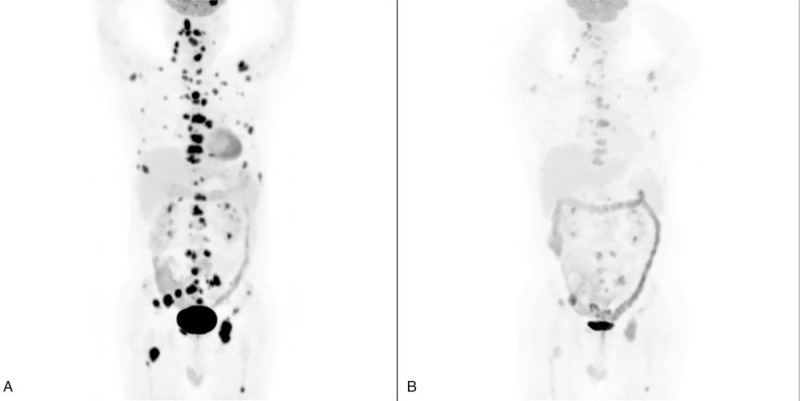
Biopsies of the enlarged lymph nodes confirmed the diagnosis of metastatic CBT and 18F-FDG PET-CT detected multiple right cervical lymph nodes and bone metastases. 24 cycles of cyclophosphamide, vincristine and dacarbazine (CVD) chemotherapy were given since May 2016 to Jul 2018 and dacarbazine maintenance therapy was given in the next 15 months follow-up period.
Partial remission was achieved according to the Response Evaluation in Criteria in Solid Tumors 1.1 criteria. A prominent control in the metastatic lesions were also observed in 18F-FDG PET-CT scan.
Evidence for systemic management of metastatic CBTs is mainly based on studies of PGLs and pheochromocytoma. According to our review on metastatic CBT cases treated with systemic therapy from 1981 to 2018, chemotherapy, especially the CVD regimen, was a common reported management. In SDHB mutated patients, sunitinib and temozolomide could also be considered.
颈动脉体瘤(CBTs)是头颈部副神经节瘤(PGLs),远处转移发生率较低。迄今为止,仅有少数接受详细全身治疗的转移病例报道,有效管理仍无定论。在此,我们报告一例接受全身治疗的转移性CBT病例,并回顾已报道的全身治疗情况。
一名56岁男性在CBT切除术后7年,发现颈部右侧有多个无痛性结节,并出现使人衰弱的胸背部疼痛。
广泛的骨和淋巴结CBT转移。
肿大淋巴结活检确诊为转移性CBT,18F-FDG PET-CT检测到多个右侧颈部淋巴结和骨转移。自2016年5月至2018年7月给予24周期环磷酰胺、长春新碱和达卡巴嗪(CVD)化疗,并在接下来的15个月随访期给予达卡巴嗪维持治疗。
根据实体瘤疗效评价标准1.1标准达到部分缓解。18F-FDG PET-CT扫描也观察到转移病灶有显著控制。
转移性CBT全身管理的证据主要基于对PGLs和嗜铬细胞瘤的研究。根据我们对1981年至2018年接受全身治疗的转移性CBT病例的回顾,化疗,尤其是CVD方案,是常见的报道治疗方法。对于SDHB突变患者,也可考虑使用舒尼替尼和替莫唑胺。