CAS Key Laboratory of Infection and Immunity, Institute of Biophysics, Chinese Academy of Sciences, Beijing 100101, China.
University of Chinese Academy of Sciences, Beijing 100049, China.
Sci Adv. 2020 Nov 20;6(47). doi: 10.1126/sciadv.abd0276. Print 2020 Nov.
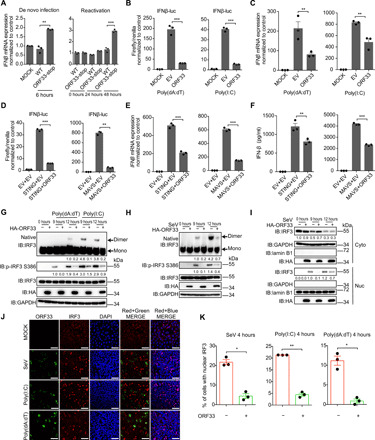
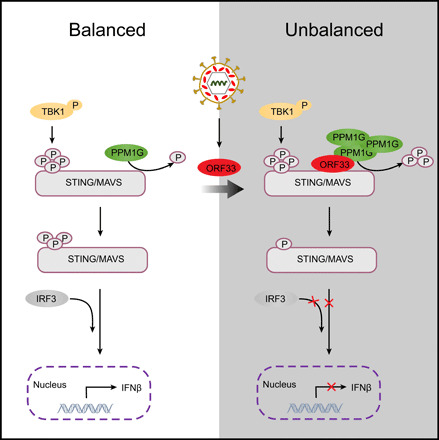
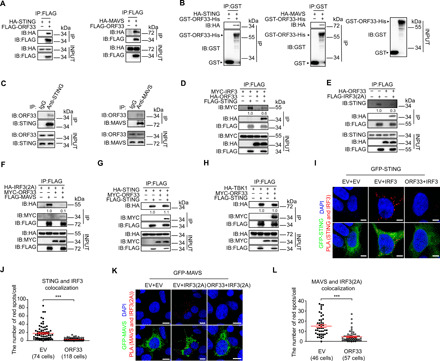
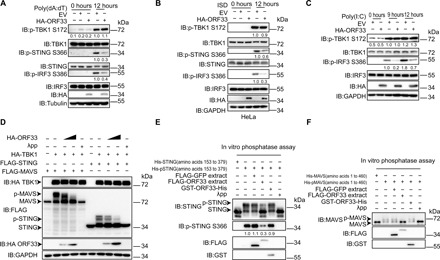
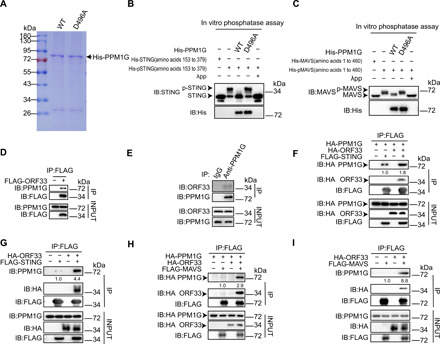
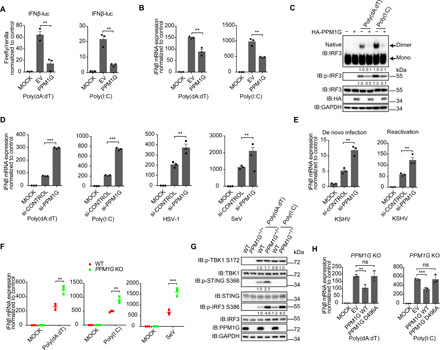
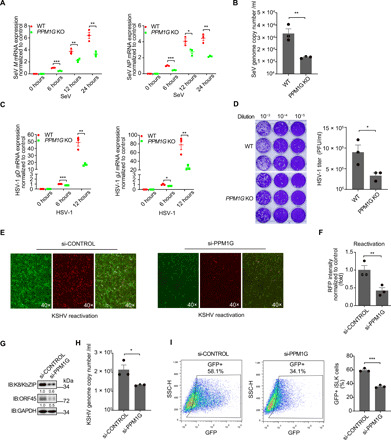
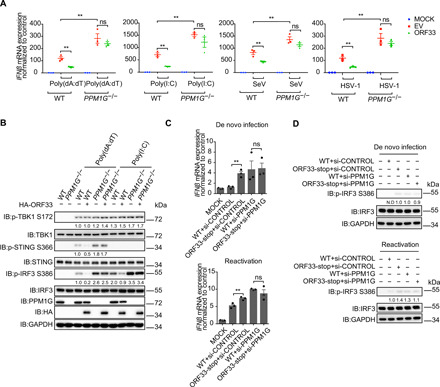
The adaptor proteins, STING and MAVS, are components of critical pathogen-sensing pathways that induce innate immunity. Phosphorylation of either adaptor results in activation of the type I interferon pathway. How this phosphorylation is regulated and how it is manipulated by pathogens remain largely unknown. Here, we identified host protein phosphatase, Mg/Mn dependent 1G (PPM1G) as a negative regulator of innate immune pathways and showed that this host system is hijacked by Kaposi's sarcoma-associated herpesvirus (KSHV). Mechanistically, KSHV tegument protein ORF33 interacts with STING/MAVS and enhances recruitment of PPM1G to dephosphorylate p-STING/p-MAVS for immunosuppression. Inhibition of PPM1G expression improves the antiviral response against both DNA and RNA viruses. Collectively, our study shows that PPM1G restricts both cytosolic DNA- and RNA-sensing pathways to naturally balance the intensity of the antiviral response. Manipulation of PPM1G by KSHV provides an important strategy for immune evasion.
衔接蛋白 STING 和 MAVS 是诱导先天免疫的关键病原体感应途径的组成部分。这两种衔接蛋白的磷酸化会导致 I 型干扰素途径的激活。这种磷酸化如何被调节以及病原体如何操纵它在很大程度上仍然未知。在这里,我们确定了宿主蛋白磷酸酶,Mg/Mn 依赖的 1G(PPM1G)作为先天免疫途径的负调节剂,并表明宿主系统被卡波西肉瘤相关疱疹病毒(KSHV)劫持。从机制上讲,KSHV 被膜蛋白 ORF33 与 STING/MAVS 相互作用,并增强 PPM1G 的募集,以去磷酸化 p-STING/p-MAVS 以进行免疫抑制。抑制 PPM1G 的表达可改善对 DNA 和 RNA 病毒的抗病毒反应。总之,我们的研究表明,PPM1G 限制了胞质 DNA 和 RNA 感应途径,以自然平衡抗病毒反应的强度。KSHV 对 PPM1G 的操纵为免疫逃避提供了一个重要策略。