Illawarra Health and Medical Research Institute, Wollongong, NSW, 2522, Australia.
School of Medicine, University of Wollongong, Wollongong, NSW, 2522, Australia.
Sci Rep. 2020 Nov 20;10(1):20314. doi: 10.1038/s41598-020-76973-8.
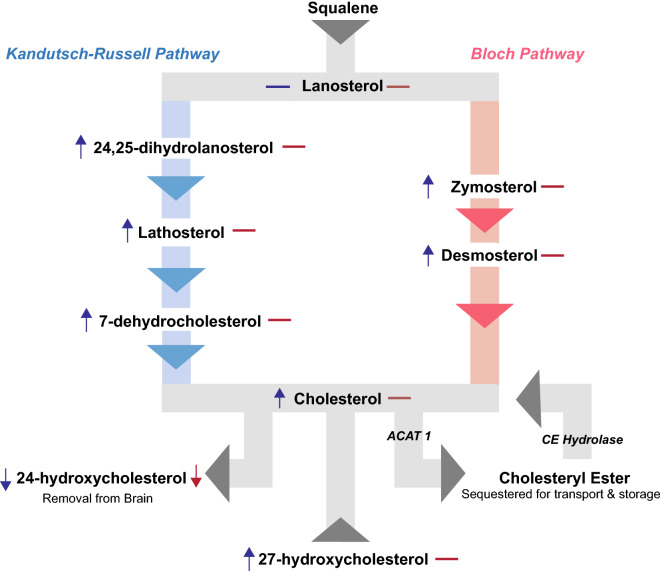
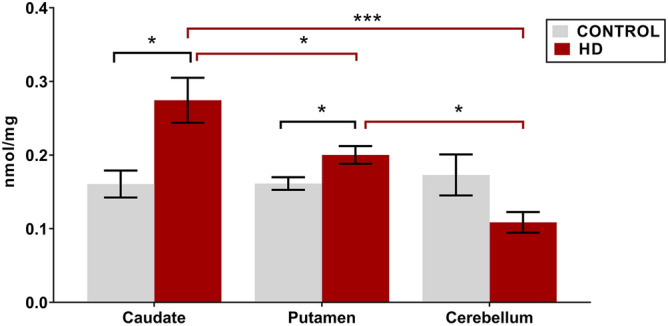
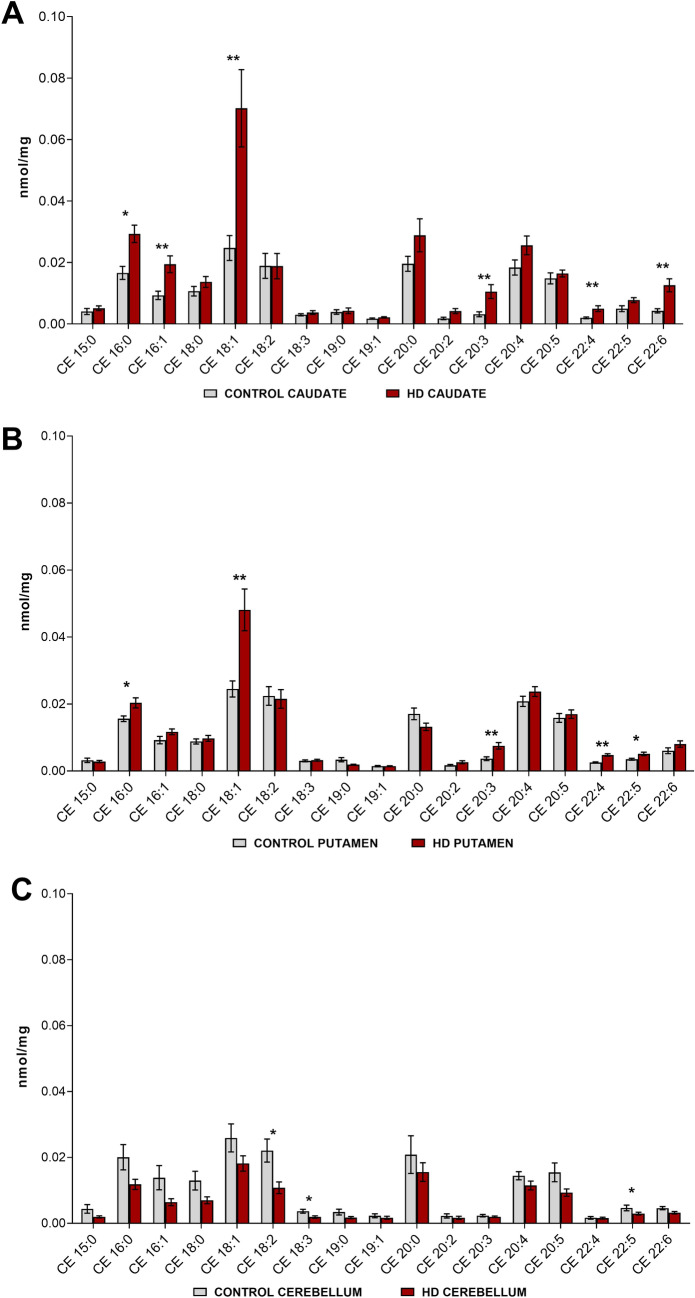
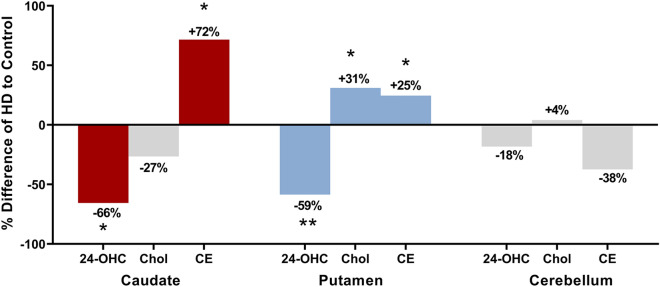
Huntington's disease (HD) is an autosomal dominant neurodegenerative illness caused by a mutation in the huntingtin gene (HTT) and subsequent protein (mhtt), to which the brain shows a region-specific vulnerability. Disturbances in neural cholesterol metabolism are established in HD human, murine and cell studies; however, cholesteryl esters (CE), which store and transport cholesterol in the brain, have not been investigated in human studies. This study aimed to identify region-specific alterations in the concentrations of CE in HD. The Victorian Brain Bank provided post-mortem tissue from 13 HD subjects and 13 age and sex-matched controls. Lipids were extracted from the caudate, putamen and cerebellum, and CE were quantified using targeted mass spectrometry. ACAT 1 protein expression was measured by western blot. CE concentrations were elevated in HD caudate and putamen compared to controls, with the elevation more pronounced in the caudate. No differences in the expression of ACAT1 were identified in the striatum. No remarkable differences in CE were detected in HD cerebellum. The striatal region-specific differences in CE profiles indicate functional subareas of lipid disturbance in HD. The increased CE concentration may have been induced as a compensatory mechanism to reduce cholesterol accumulation.
亨廷顿病(HD)是一种常染色体显性神经退行性疾病,由亨廷顿基因(HTT)和随后的蛋白质(mhtt)突变引起,大脑表现出特定区域的脆弱性。在人类、鼠类和细胞研究中已经证实了神经胆固醇代谢的紊乱;然而,在人类研究中尚未研究脑内胆固醇的储存和运输形式——胆固醇酯(CE)。本研究旨在确定 HD 患者大脑中 CE 浓度的区域特异性变化。维多利亚脑库提供了 13 例 HD 患者和 13 例年龄和性别匹配的对照者死后脑组织。从尾状核、壳核和小脑提取脂质,并使用靶向质谱法定量 CE。通过 Western blot 测量 ACAT1 蛋白表达。与对照组相比,HD 患者的尾状核和壳核中的 CE 浓度升高,而在尾状核中升高更为明显。在纹状体中未发现 ACAT1 表达的差异。在 HD 小脑中未检测到 CE 的明显差异。纹状体区域特异性 CE 谱的差异表明 HD 中存在脂质紊乱的功能亚区。CE 浓度的增加可能是作为减少胆固醇积累的代偿机制而诱导的。