Gentile Sandro, Guarino Giuseppina, Della Corte Teresa, Marino Giampiero, Fusco Alessandra, Corigliano Gerardo, Colarusso Sara, Piscopo Marco, Improta Maria Rosaria, Corigliano Marco, Martedi Emilia, Oliva Domenica, Russo Viviana, Simonetti Rosa, Satta Ersilia, Romano Carmine, Vaia Sebastiano, Strollo Felice
Department of Internal Medicine, Campania University "Luigi Vanvitelli", Naples, Italy.
Diabetes Unit AID Stabia, Nefrocenter Research and Nyx Start-Up, Naples, Italy.
Diabetes Ther. 2021 Jan;12(1):107-119. doi: 10.1007/s13300-020-00954-3. Epub 2020 Nov 21.
The number of older adults with insulin-treated diabetes mellitus (DM) is steadily increasing worldwide. Errors in the insulin injection technique can lead to skin lipohypertrophy (LH), which is the accumulation of fat cells and fibrin in the subcutaneous tissue. While lipohypertrophic lesions/nodules (LHs) due to incorrect insulin injection techniques are very common, they are often flat and hardly visible and thus require thorough deep palpation examination and ultrasonography (US) for detection. Detection is crucial because such lesions may eventually result in poor diabetes control due to their association with unpredictable insulin release patterns. Skin undergoes fundamental structural changes with aging, possibly increasing the risk for LH. We have therefore investigated the effect of age on the prevalence of LHs and on factors potentially associated with such lesions.
A total of 1227 insulin-treated outpatients with type 2 DM (T2DM) referred to our diabetes centers were consecutively enrolled in the study. These patients underwent a thorough clinical and US evaluation of the skin at injection sites, as previously described, with up to 95% concordance betweenthe clinical and US screening techniques. Of these 1227 patients, 718 (59%) had LH (LH+) and 509 (41%) were LH-free (LH-). These patients were then assigned to two age class groups (≤ 65 years and > 65 years), and several clinical features, diabetes complication rates, and injection habits were investigated.
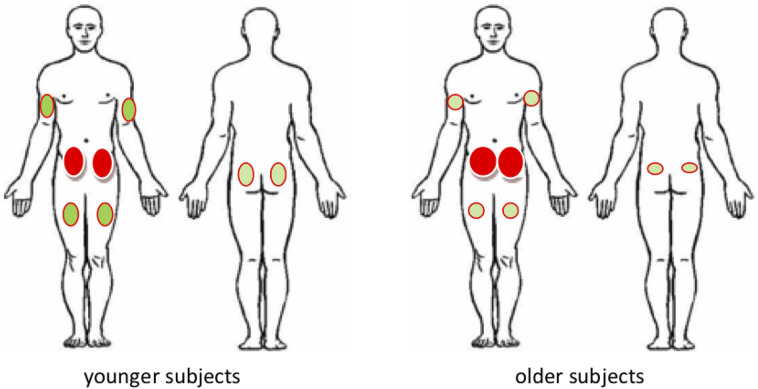
Comparison of the two age subgroups revealed that 396 (48%) and 322 (79%) patients in the younger and older groups, respectively, had LHs (p < 0.001). Compared to the younger subgroup, the older subgroup displayed a higher LH rate in the abdomen (52.9 vs. 38.3%; p < 0.01) and a lower rate in the arms (25.4 vs. 35.8%; p < 0.05), thighs (26.7 vs. 33.4%; p < 0.05), and buttocks (4.9 vs. 26.2%; p < 0.01). In older subjects, the most relevant parameters were: habit of injecting insulin into LH nodules (56 vs. 47% [younger subjects]; p < 0.01), rate of post-injection leakage of insulin from injection site (drop-leaking rate; 47 vs. 39% [younger subjects]; p < 0.05), and rate of painful injections (5 vs. 16% [younger subjects]; p < 0.001). Multivariate analysis showed a stronger association between LH and poor habits, as well as between several clinical parameters, among which the most relevant were hypoglycemic events and glycemic variability.
The higher rate of post-injection drop-leaking and pain-free injections might find an explanation in skin changes typically observed in older adults, including lower thickness, vascularity and elasticity, and a more prominent fibrous texture, all of which negatively affect tissue distensibility. Consequently, in addition to the well-known association between aging skin impaired drug absorption rate, aging skin displays a progressively decreasing ability to accommodate large volumes of insulin-containing fluid.
The strong association between LH rate and hypoglycemic events plus glycemic variability suggests the need (1) to take specific actions to prevent and control the high risk of acute cardiovascular events expected to occur in older subjects in the case of hypoglycemic events, and (2) to identify suitable strategies to fulfill the difficult task of performing effective educational programs specifically targeted to the elderly.
Trial registration number 172-11:12.2019, Scientific and Ethical Committee of Campania University "Luigi Vanvitelli", Naples, Italy).
在全球范围内,接受胰岛素治疗的老年糖尿病患者数量正在稳步增加。胰岛素注射技术错误可导致皮肤脂肪增生(LH),即皮下组织中脂肪细胞和纤维蛋白的堆积。虽然因胰岛素注射技术不正确导致的脂肪增生性病变/结节(LH)非常常见,但它们通常很扁平,几乎不可见,因此需要进行彻底的深部触诊检查和超声检查(US)来检测。检测至关重要,因为此类病变可能最终导致糖尿病控制不佳,原因是它们与不可预测的胰岛素释放模式有关。随着年龄增长,皮肤会发生根本性的结构变化,这可能会增加发生LH的风险。因此,我们研究了年龄对LH患病率以及与此类病变潜在相关因素的影响。
共有1227名转诊至我们糖尿病中心的接受胰岛素治疗的2型糖尿病(T2DM)门诊患者连续纳入本研究。如前所述,这些患者对注射部位皮肤进行了全面的临床和超声评估,临床和超声筛查技术的一致性高达95%。在这1227名患者中,718名(59%)有LH(LH+),509名(41%)无LH(LH-)。然后将这些患者分为两个年龄组(≤65岁和>65岁),并调查了几个临床特征、糖尿病并发症发生率和注射习惯。
两个年龄亚组的比较显示,较年轻组和较年长组分别有396名(48%)和322名(79%)患者有LH(p<0.001)。与较年轻亚组相比,较年长亚组在腹部的LH发生率较高(52.9%对38.3%;p<0.01),而在手臂(25.4%对35.8%;p<0.05)、大腿(26.7%对33.4%;p<0.05)和臀部(4.9%对26.2%;p<0.01)的发生率较低。在老年受试者中,最相关的参数为:将胰岛素注射到LH结节中的习惯(56%对47%[较年轻受试者];p<0.01)、胰岛素从注射部位注射后渗漏率(滴漏率;47%对39%[较年轻受试者];p<0.05)以及疼痛性注射率(5%对16%[较年轻受试者];p<0.001)。多变量分析显示LH与不良习惯以及几个临床参数之间存在更强的关联,其中最相关的是低血糖事件和血糖变异性。
注射后滴漏率较高和无痛注射现象可能可以用老年人典型的皮肤变化来解释,包括厚度、血管分布和弹性降低,以及纤维质地更明显,所有这些都会对组织扩张性产生负面影响。因此,除了众所周知的老化皮肤与药物吸收速率受损之间的关联外,老化皮肤容纳大量含胰岛素液体的能力也在逐渐下降。
LH发生率与低血糖事件及血糖变异性之间的密切关联表明需要:(1)采取具体行动预防和控制老年受试者在发生低血糖事件时预期会发生的急性心血管事件的高风险;(2)确定合适的策略,以完成针对老年人开展有效教育项目这项艰巨任务。
试验注册号172 - 11:12.2019,意大利那不勒斯坎帕尼亚大学“路易吉·万维泰利”科学与伦理委员会)