Traa Amber C, Hoven-Gondrie Miriam L, Diederik Arjen L
Department of Surgery, Gelderse Vallei Hospital, Ede, the Netherlands.
Department of Surgery, Gelderse Vallei Hospital, Ede, the Netherlands.
Int J Surg Case Rep. 2020;77:407-411. doi: 10.1016/j.ijscr.2020.11.033. Epub 2020 Nov 11.
Haemobilia caused by pseudoaneurysms of the right hepatic or cystic artery is rare. Haemobilia classically causes gastro-intestinal hemorrhage, jaundice and upper abdominal pain.
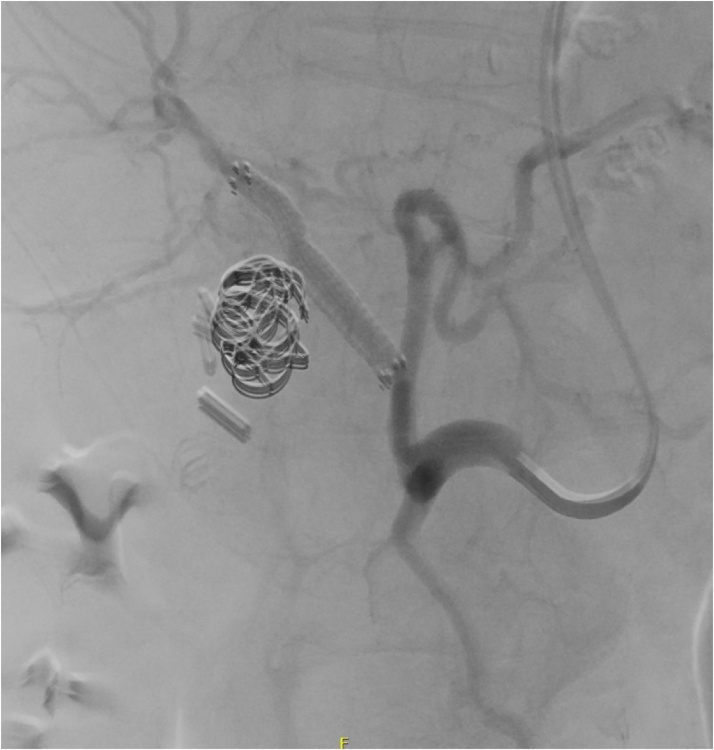
A 76-year old female underwent laparoscopic cholecystectomy because of a severe acute on chronic cholecystitis. A massive arterial bleeding occurred during surgery, which was controlled with hemoclips. Approximately one week after surgery the patient developed severe colic pains and cholestatic liver enzyme alterations. Endo-ultrasound showed normal-width bile ducts, however during a subsequent ERCP haemobilia was observed. On computed tomography a pseudoaneurysm of the right hepatic artery was seen. Selective embolization was initially successful, however, a rebleed was observed two weeks later and a 6 × 50 mm Viabahn stent graft was placed in the right hepatic artery uneventfully. The patient remained free of complaints during 3-years of follow-up.
Pseudoaneurysms of the cystic or hepatic arteries are described to be cholecystectomy or cholecystitis related. The etiology of the pseudoaneurysm in this case can be inflammatory or iatrogenic. Embolization is the golden standard in pseudoaneurysm treatment. Stent graft implantation has not been frequently described as an alternative option to surgery after a failed attempt of embolization.
This case report presents a probable cholecystitis related pseudoaneurysm of the right hepatic artery, which caused haemobilia after cholecystectomy. The pseudoaneurysm was successfully eliminated with a stent graft after embolization had failed. Stent grafts should be considered a minimal invasive and effective alternative after failed embolization of a pseudoaneurysm.
由右肝动脉或胆囊动脉假性动脉瘤引起的胆道出血较为罕见。典型的胆道出血会导致胃肠道出血、黄疸和上腹部疼痛。
一名76岁女性因严重的慢性胆囊炎急性发作接受了腹腔镜胆囊切除术。手术期间发生大量动脉出血,通过血管夹控制住了出血。术后约一周,患者出现严重绞痛和胆汁淤积性肝酶改变。内镜超声显示胆管宽度正常,但在随后的内镜逆行胰胆管造影(ERCP)中观察到胆道出血。计算机断层扫描显示右肝动脉有假性动脉瘤。选择性栓塞最初取得成功,但两周后观察到再次出血,随后在右肝动脉顺利置入了一个6×50毫米的Viabahn覆膜支架。在3年的随访期间,患者无不适症状。
胆囊动脉或肝动脉假性动脉瘤被描述为与胆囊切除术或胆囊炎相关。该病例中假性动脉瘤的病因可能是炎症性或医源性的。栓塞是假性动脉瘤治疗的金标准。在栓塞尝试失败后,覆膜支架植入作为手术的替代选择尚未被频繁报道。
本病例报告展示了一例可能与胆囊炎相关的右肝动脉假性动脉瘤,该假性动脉瘤在胆囊切除术后导致了胆道出血。在栓塞失败后,通过覆膜支架成功消除了假性动脉瘤。对于假性动脉瘤栓塞失败后,覆膜支架应被视为一种微创且有效的替代方法。