Department of Neurosurgery, The University of Texas MD Anderson Cancer Center, 1515 Holcombe Boulevard, Unit 442, Houston, TX 77030, USA; Department of Neurosurgery, Baylor College of Medicine, Houston, TX, USA.
Department of Neurosurgery, The University of Texas MD Anderson Cancer Center, 1515 Holcombe Boulevard, Unit 442, Houston, TX 77030, USA; The Brain Tumor Center, The University of Texas MD Anderson Cancer Center, Houston, TX, USA.
Neurosurg Clin N Am. 2021 Jan;32(1):93-104. doi: 10.1016/j.nec.2020.09.002. Epub 2020 Nov 5.
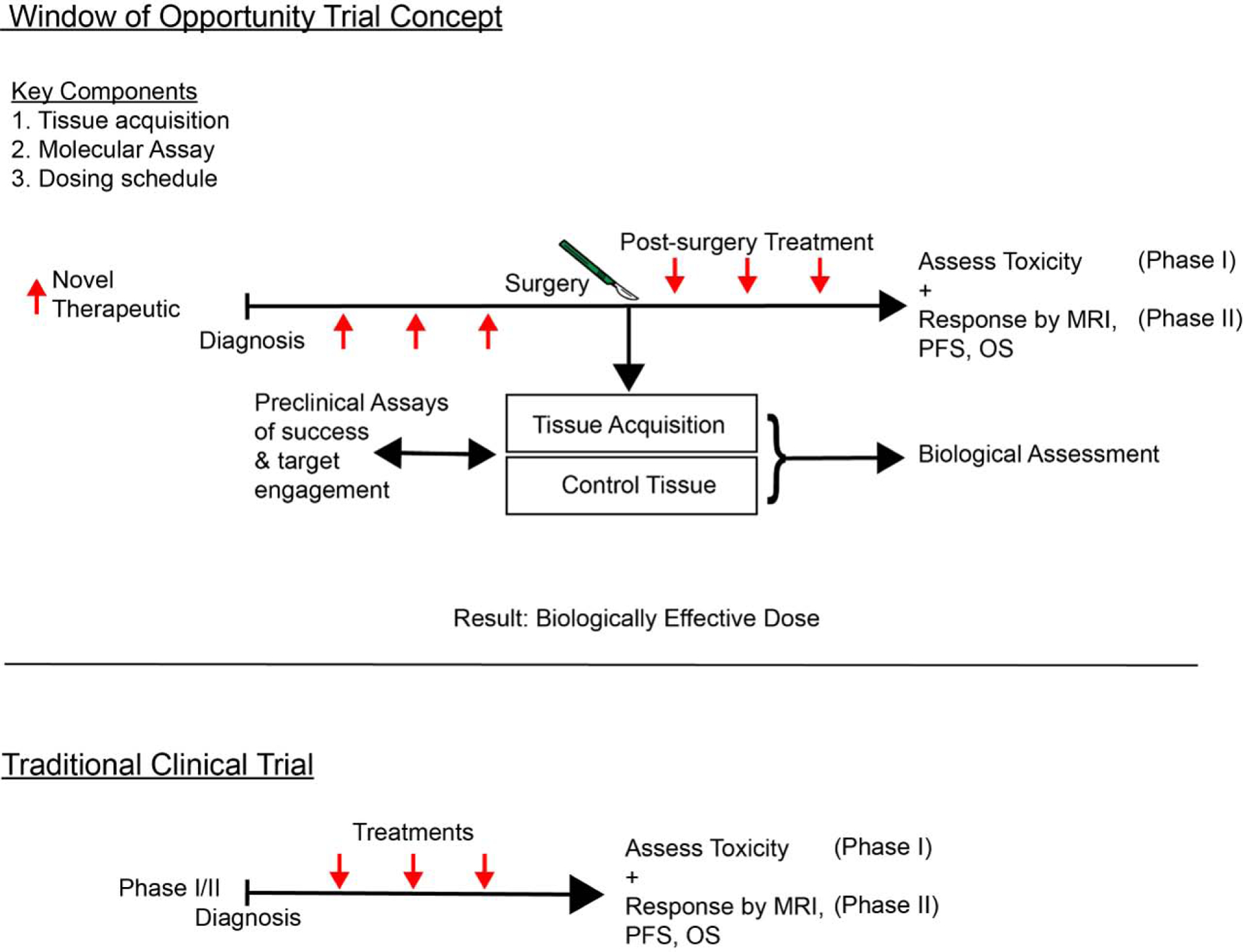
Despite significant improvement in understanding of molecular underpinnings driving glioblastoma, there is minimal improvement in overall survival of patients. This poor outcome is caused in part by traditional designs of early phase clinical trials, which focus on clinical assessments of drug toxicity and response. Window of opportunity trials overcome this shortcoming by assessing drug-induced on-target molecular alterations in post-treatment human tumor specimens. This article provides an overview of window of opportunity trials, including novel designs for incorporating biologic end points into early stage trials in context of brain tumors, and examples of successfully executed window of opportunity trials for glioblastoma.
尽管人们对导致胶质母细胞瘤的分子基础有了显著的认识,但患者的总体生存率几乎没有提高。这种不良结果部分是由于早期临床试验的传统设计造成的,这些设计侧重于药物毒性和反应的临床评估。机会之窗试验通过评估治疗后人类肿瘤标本中药物诱导的靶分子改变来克服这一缺点。本文概述了机会之窗试验,包括将生物学终点纳入脑肿瘤早期试验的新型设计,以及成功实施的胶质母细胞瘤机会之窗试验的例子。