Smolis Adrian, Skarżyński Dariusz
Institute of Environmental Biology, Department of Invertebrate Biology, Evolution and Conservation, University of Wrocław, Przybyszewskiego 65, 51-148 Wrocław, Poland University of Wrocław Wrocław Poland.
Zookeys. 2020 Nov 12;992:105-138. doi: 10.3897/zookeys.992.56921. eCollection 2020.
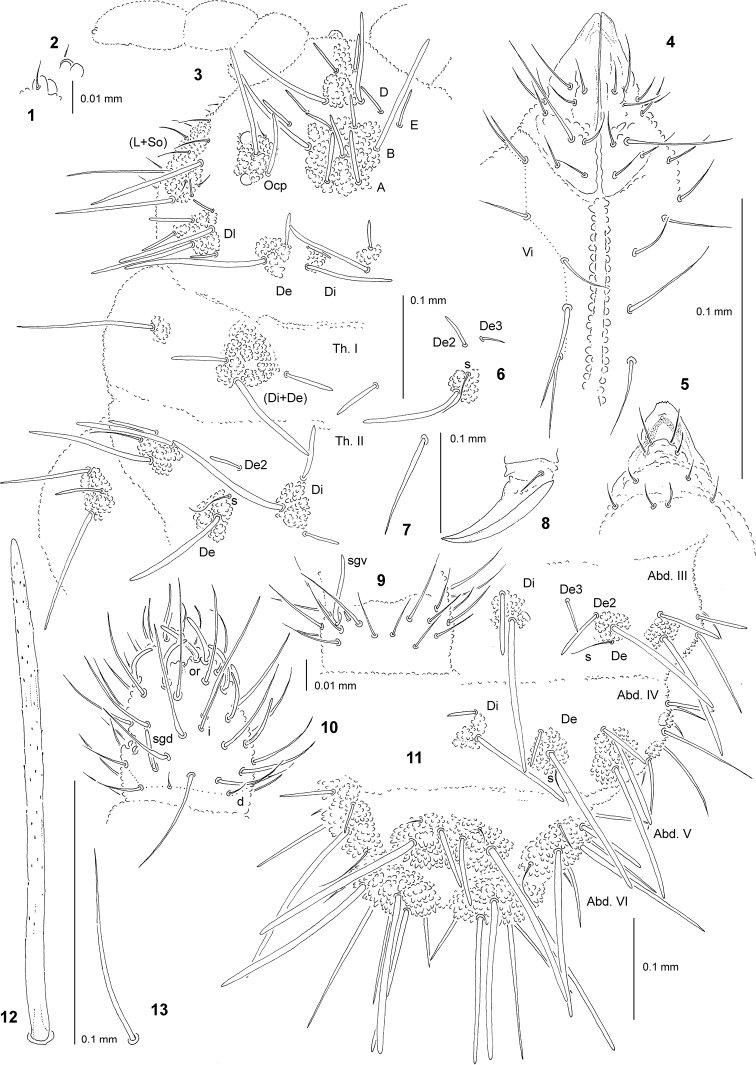
Seven new species of the subfamily Neanurinae from north-western Iran are described and illustrated in detail. differs from the most similar congener, (Axelson, 1905), in chaetotaxic details and the arrangement of tubercles on the dorsal side of the body. can be easily recognised by its wide labrum, the absence of chaetae C on the head and the presence of a toothed claw. is especially distinctive due to the absence of chaetae A and Ocp on the head and the presence of the male ventral organ. is related and most similar to Smolis, Shayanmehr & Yoosefi-Lafooraki, 2018, described recently and known from Mazandran Province in Iran. The new species can be easily distinguished by the following set of features: dark pigmented body, presence of chaetae C and Dl3 on the head, absence of microchaetae on the furca rudimentary, presence of thickened macrochaetae on dorsal side of body and absence of cryptopygy. The main characteristics of include a white body with dark pigmented eyes, the fusion of tubercles Di and De on the first thoracic segment and the presence of the male ventral organ. is superficially similar to Porco, Bedos & Deharveng, 2010, a species known from the Alps and Jura in Europe, but it differs in the body colour and the number of labial chaetae and chaetae (L+So) on the head. , the first member of this enigmatic and intriguing genus known from Iran, is characterised by an unusually elongate ogival labrum and extreme reduction of dorsal chaetotaxy. Furthermore, new records of several other species of the subfamily: Smolis, Falahati & Skarżyński, 2012; Smolis, Falahati & Skarżyński, 2012; ; Smolis, Shayanmehr, Kuznetsova & Yoosefi-Lafooraki, 2017; Smolis, Shayanmehr, Kuznetsova & Yoosefi-Lafooraki, 2017; Smolis, Shayanmehr & Yoosefi-Lafooraki, 2018; (Templeton, 1835) and Cassagnau & Delamare Deboutteville, 1955 are given. The present study is based on the rich material collected by Antoine Senglet and loaned by Peter J. Schwendinger.
本文详细描述并阐释了来自伊朗西北部的7种新的近钩虾亚科物种。[此处缺少具体物种名称]在刚毛序细节以及身体背侧瘤的排列上与最相似的同属物种[此处缺少具体物种名称](阿克塞尔森,1905年)有所不同。[此处缺少具体物种名称]可通过其宽阔的上唇、头部无刚毛C以及有齿爪轻松识别。[此处缺少具体物种名称]特别独特之处在于头部没有刚毛A和Ocp且有雄性腹侧器官。[此处缺少具体物种名称]与[此处缺少具体物种名称]斯莫利斯、沙扬迈尔和尤瑟菲 - 拉福拉基,2018年有关且最为相似,[此处缺少具体物种名称]斯莫利斯、沙扬迈尔和尤瑟菲 - 拉福拉基,2018年是最近描述的,已知分布于伊朗的马赞德兰省。新物种可通过以下一组特征轻松区分:体色深、头部有刚毛C和Dl3、尾叉上无微刚毛、身体背侧有加粗的大刚毛且无隐尾。[此处缺少具体物种名称]的主要特征包括白色身体和深色眼睛、第一胸节上瘤Di和De融合以及有雄性腹侧器官。[此处缺少具体物种名称]表面上与[此处缺少具体物种名称]波尔科、贝多斯和德哈文,2010年相似,[此处缺少具体物种名称]波尔科、贝多斯和德哈文,2010年是一种已知分布于欧洲阿尔卑斯山和汝拉山的物种,但在体色、头部唇刚毛数量以及刚毛(L + So)数量上有所不同。[此处缺少具体物种名称]是伊朗已知的这个神秘且有趣的属的首个成员,其特征是上唇异常细长呈尖卵形且背侧刚毛序极度简化。此外,还给出了近钩虾亚科其他几个物种的新记录:[此处缺少具体物种名称]斯莫利斯、法拉哈蒂和斯卡日ński,2012年;[此处缺少具体物种名称]斯莫利斯、法拉哈蒂和斯卡日ński,2012年;[此处缺少具体物种名称];[此处缺少具体物种名称]斯莫利斯、沙扬迈尔、库兹涅佐娃和尤瑟菲 - 拉福拉基,2017年;[此处缺少具体物种名称]斯莫利斯、沙扬迈尔、库兹涅佐娃和尤瑟菲 - 拉福拉基,2017年;[此处缺少具体物种名称]斯莫利斯、沙扬迈尔和尤瑟菲 - 拉福拉基,2018年;[此处缺少具体物种名称](邓普顿,1835年)以及[此处缺少具体物种名称]卡萨尼奥和德拉马雷·德布特维尔,1955年。本研究基于安托万·森格列收集并由彼得·J·施温丁格借出的丰富材料。