You Jun-Jer, Jong Din, Wiangin Uraiporn
Department of Exercise and Health Sciences, University of Taipei, Taipei, Taiwan.
Department of Digital Design and Information Management, Chung Hwa University of Medical Technology, Tainan City, Taiwan.
Front Psychol. 2020 Nov 5;11:579274. doi: 10.3389/fpsyg.2020.579274. eCollection 2020.
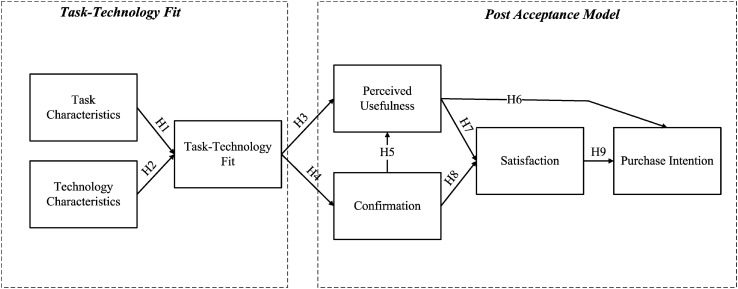
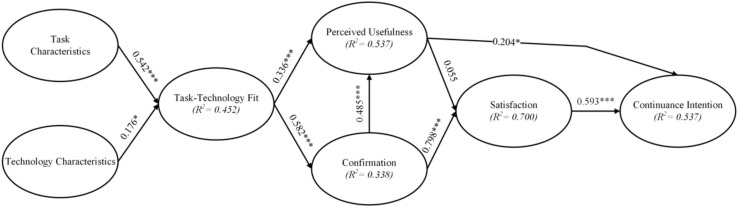
In the past, consumers were mainly informed about organic food by newspapers, magazines, and television advertisements. However, when consumers buy organic products in the market, they cannot get a complete information about the products from the appearance of the various products. In order to overcome this information asymmetry, social media has become an indispensable part of the promotion of organic food by providing a clear distinction between certified organic products and other types of products in the market. The purpose of this study is to demonstrate the antecedents and consequences of the influence of social media on the consumers' selection of organic food, based on the post-acceptance model (PAM) and task-technology fit model. The empirical results indicated task characteristics and technology characteristics had the significant effects on confirmation of the expectations and perceived usefulness through the task-technology fit. Besides, the confirmation of expectations and perceived usefulness also influenced significantly the satisfaction and continuance intention, respectively. Finally, the results presented in this article would contribute to the practical and academic implications and recommendations on the promotion of organic food in the social media platform.
过去,消费者主要通过报纸、杂志和电视广告了解有机食品。然而,当消费者在市场上购买有机产品时,从各种产品的外观上他们无法获得有关产品的完整信息。为了克服这种信息不对称,社交媒体通过明确区分市场上的认证有机产品和其他类型的产品,已成为有机食品推广中不可或缺的一部分。本研究的目的是基于后接受模型(PAM)和任务-技术匹配模型,证明社交媒体对消费者选择有机食品影响的前因和后果。实证结果表明,任务特征和技术特征通过任务-技术匹配对期望确认和感知有用性有显著影响。此外,期望确认和感知有用性也分别对满意度和持续使用意愿有显著影响。最后,本文呈现的结果将有助于在社交媒体平台上推广有机食品的实践和学术意义及建议。