Koehl Lisa, Harp Jordan, Van Pelt Kathryn L, Head Elizabeth, Schmitt Frederick A
Department of Neurology University of Kentucky Lexington Kentucky USA.
Sanders-Brown Center on Aging University of Kentucky Lexington Kentucky USA.
Alzheimers Dement (Amst). 2020 Nov 14;12(1):e12075. doi: 10.1002/dad2.12075. eCollection 2020.
Early detection of dementia symptoms is critical in Down syndrome (DS) but complicated by clinical assessment barriers. The current study aimed to characterize cognitive and behavioral impairment using longitudinal trajectories comparing several measures of cognitive and behavioral functioning.
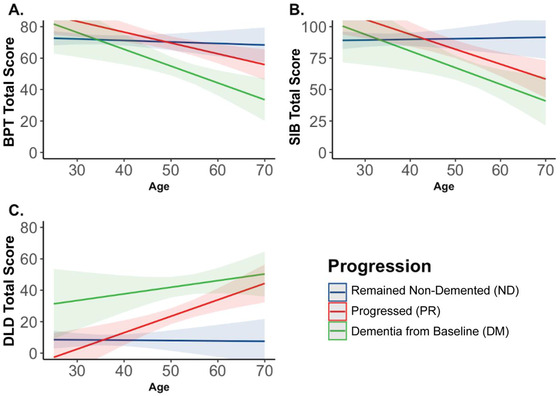
Measures included global cognitive status (Severe Impairment Battery [SIB]), motor praxis (Brief Praxis Test [BPT]), and clinical dementia informant ratings (Dementia Questionnaire for People with Learning Disabilities [DLD]). One-year reliability was assessed using a two-way mixed effect, consistency, single measurement intraclass correlation among non-demented participants. Longitudinal assessment of SIB, BPT, and DLD was completed using linear mixed effect models.
One-year reliability (n = 52; 21 male) was moderate for DLD (0.69 to 0.75) and good for SIB (0.87) and BPT (0.80). Longitudinal analysis (n = 72) revealed significant age by diagnosis interactions for SIB ((2, 115.02) = 6.06, = .003), BPT ((2, 85.59) = 4.56, = .013), and DLD ((2, 103.56) = 4.48, = .014). SIB progression (PR) had a faster decline in performance versus no-dementia (ND) (t(159) = -2.87; = .013). Dementia had a faster decline in BPT performance versus ND (t(112) = -2.46; = .041). PR showed quickly progressing scores compared to ND (t(128) = -2.86; = .014).
Current measures demonstrated moderate to good reliability. Longitudinal analysis revealed that SIB, BPT, and DLD changed with age depending on diagnostic progression; no change rates were dependent on baseline cognition, indicating usefulness across a variety of severity levels in DS.
早期发现痴呆症状在唐氏综合征(DS)中至关重要,但临床评估障碍使其变得复杂。本研究旨在通过比较认知和行为功能的多种测量指标的纵向轨迹来描述认知和行为障碍。
测量指标包括整体认知状态(严重损害量表[SIB])、运动实践能力(简易实践测试[BPT])以及临床痴呆症 informant 评分(学习障碍者痴呆问卷[DLD])。使用双向混合效应、一致性、非痴呆参与者的单次测量组内相关性评估一年的信度。使用线性混合效应模型完成对 SIB、BPT 和 DLD 的纵向评估。
一年的信度(n = 52;21 名男性),DLD 为中等(0.69 至 0.75),SIB 为良好(0.87),BPT 为良好(0.80)。纵向分析(n = 72)显示,SIB((2, 115.02) = 6.06, = .003)、BPT((2, 85.59) = 4.56, = .013)和 DLD((2, 103.56) = 4.48, = .014)在诊断方面存在显著的年龄交互作用。与无痴呆(ND)相比,SIB 进展(PR)的表现下降更快(t(159) = -2.87; = .013)。与 ND 相比,痴呆患者 BPT 表现下降更快(t(112) = -2.46; = .041)。与 ND 相比,PR 显示分数快速进展(t(128) = -2.86; = .014)。
当前测量指标显示出中等至良好的信度。纵向分析表明,SIB、BPT 和 DLD 根据诊断进展随年龄变化;无变化率取决于基线认知,表明在 DS 的各种严重程度水平上均有用。