Pavisic Ivanna M, Nicholas Jennifer M, O'Connor Antoinette, Rice Helen, Lu Kirsty, Fox Nick C, Ryan Natalie S
Department of Neurodegenerative Diseases (I.M.P., J.M.N., A.O., H.R., K.L., N.C.F., N.S.R.), Dementia Research Centre, UCL Queen Square Institute of Neurology, London; UK Dementia Research Institute at University College London (I.M.P., A.O., H.R., N.C.F., N.S.R.); and Department of Medial Statistics (J.M.N.), London School of Hygiene and Tropical Medicine, United Kingdom.
Neurol Genet. 2020 Aug 18;6(5):e507. doi: 10.1212/NXG.0000000000000507. eCollection 2020 Oct.
To use survival modeling to estimate disease duration in autosomal dominant familial Alzheimer disease (ADAD) and ascertain whether factors influencing age at onset also affect survival.
Symptomatic mutation carriers (201 presenilin 1 [] and 55 amyloid precursor protein []) from ADAD families referred to the Dementia Research Centre, between 1987 and 2019, were included. Survival was assessed with respect to age at onset, year of birth, ε4 status, cognitive presentation, and sex using multilevel mixed-effects Weibull survival models. The contribution of mutation and family to variance in age at onset and duration was also assessed.
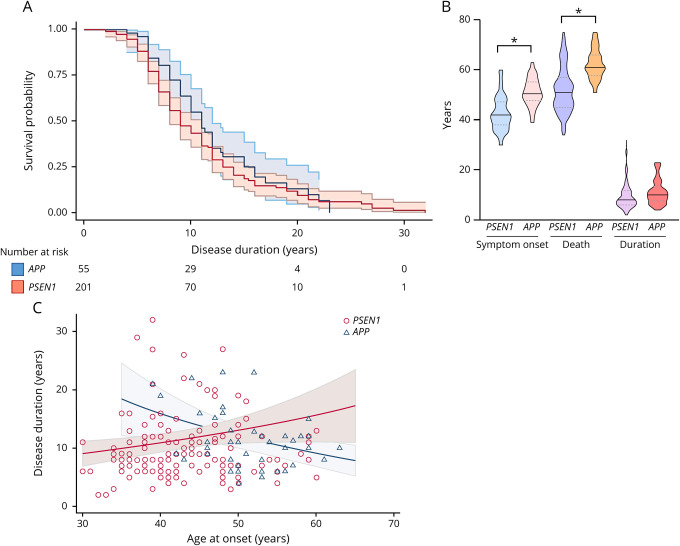
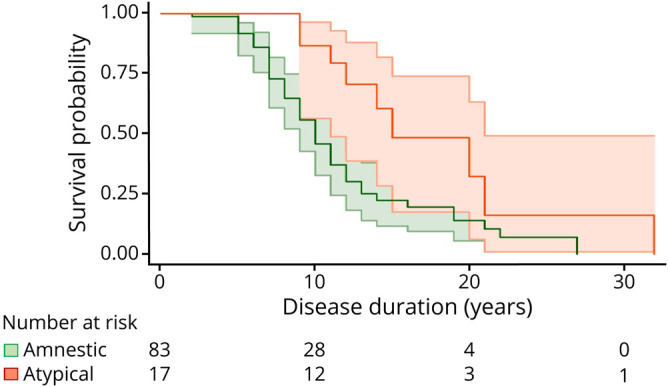
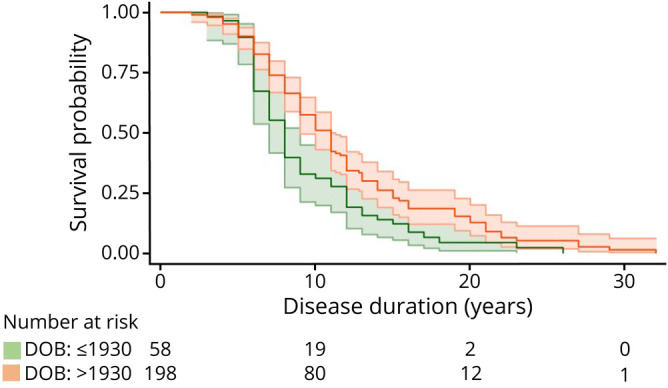
Estimated mean survival was 11.6 (10.4-12.9) years and was similar for and mutations. Sixty-seven percent of the variance in age at onset was explained by mutation and 72% by mutation and family together. In contrast, only 6% of the variance in disease duration was explained by mutation specificity and 18% by family membership. Irrespective of gene, survival appeared longer for successive generations and in individuals with atypical presentations. Older age at onset was associated with longer duration within and shorter duration within mutation carriers. No differences in survival time were found between sexes or between mutations located before or beyond codon 200 within .
Survival is influenced by mutation to a much lesser extent than age at onset. Survival time has increased over time and is longer in atypical presentations. These insights may inform the interpretation of disease-modifying therapy trials in ADAD.
运用生存模型估计常染色体显性遗传家族性阿尔茨海默病(ADAD)的疾病持续时间,并确定影响发病年龄的因素是否也会影响生存情况。
纳入了1987年至2019年间转诊至痴呆症研究中心的ADAD家族中有症状的突变携带者(201例早老素1突变携带者和55例淀粉样前体蛋白突变携带者)。使用多级混合效应威布尔生存模型,根据发病年龄、出生年份、ε4状态、认知表现和性别评估生存情况。还评估了突变和家族对发病年龄和疾病持续时间方差的贡献。
估计平均生存时间为11.6(10.4 - 12.9)年,早老素1突变和淀粉样前体蛋白突变的情况相似。发病年龄方差的67%由突变解释,突变和家族共同解释了72%。相比之下,疾病持续时间方差中只有6%由突变特异性解释,18%由家族成员关系解释。无论基因如何,连续几代人和非典型表现个体的生存时间似乎更长。发病年龄较大与早老素1突变携带者疾病持续时间较长以及淀粉样前体蛋白突变携带者疾病持续时间较短相关。在性别之间或早老素1基因密码子200之前或之后的突变之间未发现生存时间差异。
生存受突变的影响程度远小于发病年龄。生存时间随时间增加,非典型表现个体的生存时间更长。这些见解可能为ADAD中疾病修饰治疗试验的解释提供依据。