Yamakawa Kazuma, Ohbe Hiroyuki, Taniguchi Kohei, Matsui Hiroki, Fushimi Kiyohide, Yasunaga Hideo
Division of Trauma and Surgical Critical Care, Osaka General Medical Center, Osaka, Japan.
Department of Clinical Epidemiology and Health Economics, School of Public Health, The University of Tokyo, Tokyo, Japan.
JMA J. 2020 Oct 15;3(4):313-320. doi: 10.31662/jmaj.2020-0013. Epub 2020 Sep 23.
Existing evidence on the mortality time trends of patients with disseminated intravascular coagulation (DIC) is limited, and whether the mortality trend or quality of care of DIC patients has improved remains unknown. This study aimed to investigate the temporal trend in mortality, patient outcomes, and treatment preferences of several anticoagulants in Japan.
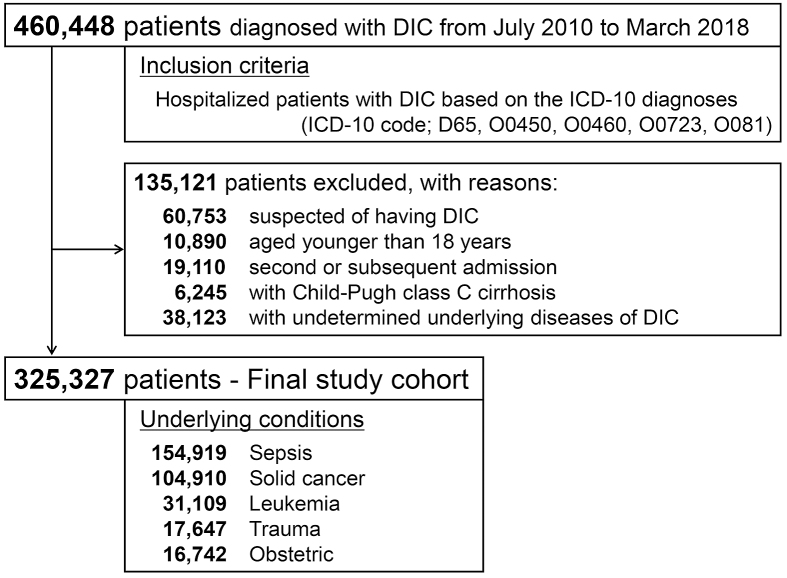
This retrospective observational study used the Japanese Diagnosis Procedure Combination inpatient database, which contains data from more than 1200 acute-care hospitals in Japan. We identified all adult patients that were diagnosed with DIC from July 2010 to March 2018 and sorted them into one of five predefined underlying conditions: sepsis, solid cancer, leukemia, trauma, or obstetric. The data collected as general outcomes were the 28-day mortality and major bleeding events. We also evaluated anticoagulant use for DIC treatment.
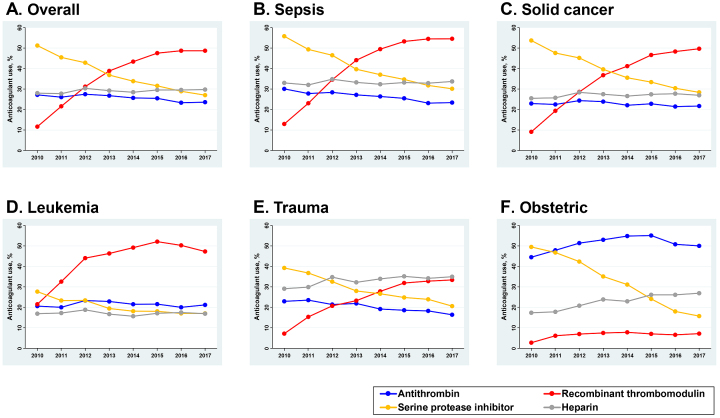
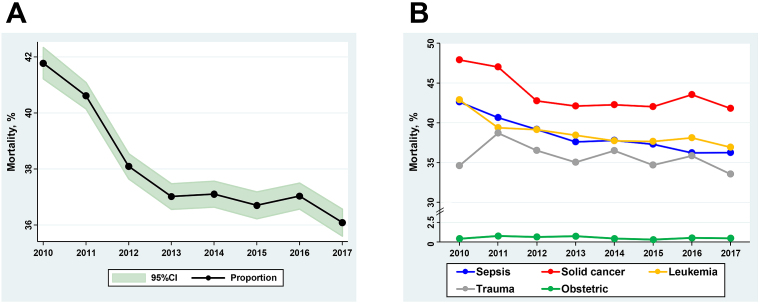
A total of 325,327 DIC patients were included in this study. Regarding the baseline characteristics, an increase in median age, worsened comorbid conditions, and higher illness severity were observed over time. The underlying conditions for DIC were largely unchanged. Over the study period, the 28-day mortality for overall DIC patients decreased from 41.8% (95% CI 41.2%-42.3%) to 36.1% (95% CI 35.6%-36.6%), which is a 14% decrease over the 8-year period ( < 0.001). The downward trend in mortality was more evident in patients with sepsis and leukemia (15% and 14% decreases, respectively), whereas no clinically meaningful change in mortality occurred in trauma and obstetrics patients. Over time, major bleeding events modestly increased, and the length of hospital stay decreased. The temporal trend in the treatment preferences of anticoagulants for DIC patients clearly changed over time.
The overall 28-day mortality for DIC patients clearly decreased from 2010 to 2017. The downward trend in mortality might have resulted from the advances made in the fundamental treatment of underlying diseases and from the changes in anti-DIC strategies.
关于弥散性血管内凝血(DIC)患者死亡率时间趋势的现有证据有限,DIC患者的死亡率趋势或医疗质量是否有所改善仍不清楚。本研究旨在调查日本DIC患者的死亡率、患者预后以及几种抗凝剂治疗偏好的时间趋势。
这项回顾性观察研究使用了日本诊断程序组合住院患者数据库,该数据库包含来自日本1200多家急性护理医院的数据。我们确定了2010年7月至2018年3月期间所有诊断为DIC的成年患者,并将他们分为五个预先定义的基础疾病之一:脓毒症、实体癌、白血病、创伤或产科疾病。收集的一般结果数据为28天死亡率和严重出血事件。我们还评估了用于DIC治疗的抗凝剂使用情况。
本研究共纳入325327例DIC患者。关于基线特征,随着时间的推移,观察到中位年龄增加、合并症恶化以及疾病严重程度升高。DIC的基础疾病基本未变。在研究期间,总体DIC患者的28天死亡率从41.8%(95%CI 41.2%-42.3%)降至36.1%(95%CI 35.6%-36.6%),在8年期间下降了14%(P<0.001)。脓毒症和白血病患者的死亡率下降趋势更为明显(分别下降了15%和14%),而创伤和产科患者的死亡率没有发生具有临床意义的变化。随着时间的推移,严重出血事件略有增加,住院时间缩短。DIC患者抗凝剂治疗偏好的时间趋势随时间明显变化。
2010年至2017年,DIC患者的总体28天死亡率明显下降。死亡率的下降趋势可能是由于基础疾病的基本治疗取得进展以及抗DIC策略的变化。