Sheng Cheng, Zhao Yuemin, Duan Chenlong, Dong Liang, Zhang Panpan
School of Chemical Engineering and Technology, China University of Mining and Technology, Xuzhou 221116, China.
ACS Omega. 2020 Nov 4;5(45):29199-29208. doi: 10.1021/acsomega.0c03967. eCollection 2020 Nov 17.
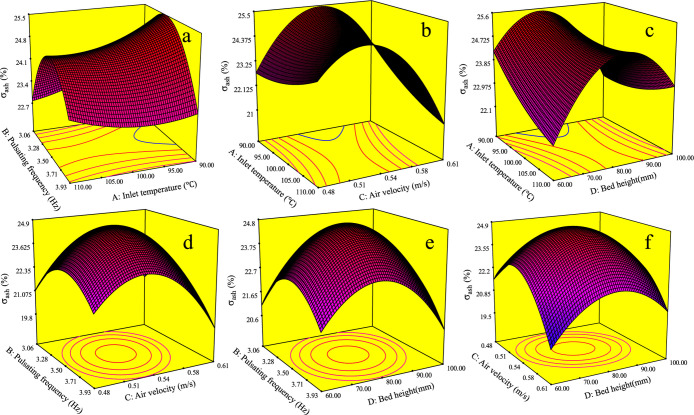
We established a pulsed fluidized bed system to dry and concurrently separate fine lignite (-6 + 3 and -3 + 1 mm lignite). The kinetics and evaporation of lignite moisture were investigated in the pulsed air flow. The variation in the evaporation rate was studied theoretically with respect to temperature, velocity of the pulsed air flow, and pulsed frequency. The rubbing effect between the air and lignite particle probably dominates the evaporation of water. The influence of temperature on the evaporation rate is more significant than that of air velocity by merely considering the effect of air entrainment of the evaporated moisture. Four operational parameters, including inlet temperature, air velocity, pulsating frequency, and bed height, were investigated and optimized through a response surface method to study the interactions between factors and determine the optimal separation conditions. Results indicate that the maximum standard deviation of the ash content of 23.74% was recorded under the optimal condition of the inlet temperature (80 °C), pulsating frequency (3.93 Hz), air velocity (1.09 m/s), and bed height (120 mm) for -6 + 3 mm lignite, and the maximum standard deviation of 24.99% was recorded for -3 + 1 mm lignite under the condition of the inlet temperature (100 °C), pulsating frequency (3.49 Hz), air velocity (0.55 m/s), and bed height (80 mm). The probable error values of separations of -6 + 3 mm lignite and -3 + 1 mm lignite with the pulsed fluidized bed were 0.12-0.16 and 0.10-0.16 g/cm, respectively, which demonstrates that efficient drying and simultaneous separation of lignite can be achieved with the pulsed fluidized bed.
我们建立了一个脉冲流化床系统,用于干燥并同时分离细褐煤(-6 + 3毫米和-3 + 1毫米褐煤)。在脉冲气流中研究了褐煤水分的干燥动力学和蒸发情况。从理论上研究了蒸发速率随温度、脉冲气流速度和脉冲频率的变化。空气与褐煤颗粒之间的摩擦效应可能主导着水分的蒸发。仅考虑蒸发水分的空气夹带效应,温度对蒸发速率的影响比空气速度更为显著。通过响应面法研究了包括入口温度、空气速度、脉动频率和床层高度在内的四个操作参数,并进行了优化,以研究各因素之间的相互作用并确定最佳分离条件。结果表明,对于-6 + 3毫米褐煤,在入口温度(80°C)、脉动频率(3.93赫兹)、空气速度(1.09米/秒)和床层高度(120毫米)的最佳条件下,灰分含量的最大标准偏差为23.74%;对于-3 + 1毫米褐煤,在入口温度(100°C)、脉动频率(3.49赫兹)、空气速度(0.55米/秒)和床层高度(80毫米)的条件下,最大标准偏差为24.99%。脉冲流化床对-6 + 3毫米褐煤和-3 + 1毫米褐煤分离的可能误差值分别为0.12 - 0.16和0.10 - 0.16克/立方厘米,这表明使用脉冲流化床可以实现褐煤的高效干燥和同时分离。