Sorbonne Université, Institut National de la Santé et de la Recherche Médicale (INSERM), Institut Pierre Louis d'Epidémiologie et de Santé Publique, AP-HP. Sorbonne Université, Hôpital Pitié Salpêtrière, Département de Santé Publique, Centre de Pharmacoépidémiologie de l'AP-HP (Cephepi), CIC-1422, F75013, Paris, France.
Sorbonne Université, Institut National de la Santé et de la Recherche Médicale (INSERM), Centre d'investigation clinique-1421, AP-HP. Sorbonne Université, Hôpital Pitié Salpêtrière, Départements de pharmacologie et cardiologie, UNICO-GRECO Cardio-Oncology program, F75013, Paris, France.
BMC Cancer. 2020 Nov 23;20(1):1128. doi: 10.1186/s12885-020-07518-5.
While immune-checkpoint inhibitors (ICIs) have transformed the field of oncology for advanced-stage cancers, they can lead to serious immune toxicities. Several systematic reviews have evaluated the risk of immune-related adverse events (irAEs); however, most have focused on published articles without evaluating trial registries. The objective of this methodological review was to compare the quality of reporting of safety information and in particular, serious irAEs (irSAEs), in both publications and ClinicalTrials.gov for all current FDA-approved ICIs.
PubMed was searched to retrieve all published phase III randomized controlled trials (RCTs) evaluating ICIs. For each eligible trial, we searched for corresponding registration on ClinicalTrials.gov and extracted relevant safety data from both the publication and results posted on registry. We then compared the quality of reporting and the value of safety data between both sources.
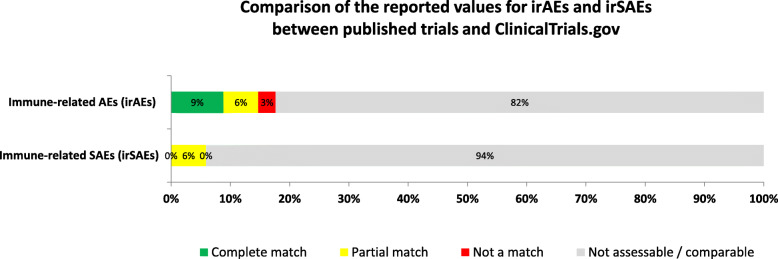
Of 42 eligible published trials, 34 had results posted on ClinicalTrials.gov . Considerable variability was noted in the reporting of safety in both sources. SAEs were reported for all trial results in ClinicalTrials.gov compared to 23.5% of publications. An overall incidence for irAEs and irSAEs was reported in 58.8 and 8.8% of publications respectively, compared to 11.8 and 5.9% in registry results. Comparing the value of specific irSAEs was not possible between the two sources in 32/34 trials either due to different reporting formats (61.8%) or data not being reported in one or both sources (32.4%). From the 2 studies with compatible irSAE format, only 1 had matching data in both sources.
The reporting of irAEs / irSAEs varies considerably in publications and registries, which outlines the importance of standardizing the terminologies and methodologies for reporting safety information relevant to ICIs.
免疫检查点抑制剂 (ICIs) 已改变了晚期癌症的肿瘤学领域,但它们会导致严重的免疫毒性。有几项系统评价评估了免疫相关不良事件 (irAEs) 的风险;然而,大多数都集中在已发表的文章上,而没有评估试验注册。本方法学综述的目的是比较在所有当前 FDA 批准的 ICI 中,出版物和 ClinicalTrials.gov 中安全信息,特别是严重 irAEs (irSAEs) 的报告质量。
检索 PubMed 以检索所有评估 ICI 的已发表的 III 期随机对照试验 (RCT)。对于每个合格的试验,我们在 ClinicalTrials.gov 上搜索了相应的注册信息,并从出版物和注册结果中提取了相关的安全性数据。然后,我们比较了两者来源的报告质量和安全性数据的价值。
在 42 项合格的已发表试验中,有 34 项试验结果在 ClinicalTrials.gov 上发布。在两个来源中,安全性报告都存在相当大的差异。在 ClinicalTrials.gov 上,所有试验结果均报告了 SAE,而出版物中仅报告了 23.5%。出版物中分别报告了 irAEs 和 irSAEs 的总体发生率为 58.8%和 8.8%,而注册结果中分别为 11.8%和 5.9%。在 34 项试验中,由于报告格式不同(61.8%)或一个或两个来源未报告数据(32.4%),有 32/34 项试验无法比较两种来源中特定 irSAE 的价值。在 2 项具有兼容 irSAE 格式的研究中,只有 1 项在两个来源中具有匹配数据。
出版物和注册处的 irAEs / irSAEs 报告差异很大,这突显了标准化与 ICI 相关的安全信息报告术语和方法的重要性。