Itrat Annie, Jagadheesan Karuppiah, Danivas Vijay, Lakra Vinay
North West Area Mental Health Service and The University of Melbourne, Melbourne, Australia.
Indian J Psychiatry. 2020 Sep;62(Suppl 3):S454-S458. doi: 10.4103/psychiatry.IndianJPsychiatry_852_20. Epub 2020 Sep 28.
Given the paucity of research on how COVID-19 pandemic-associated lockdowns have affected the access to inpatient treatment, the present study was carried out.
This study aims to describe (1) the characteristics of patients who accessed inpatient treatment, (2) the length of inpatient stay and readmissions, and (3) the quality and safety of care as indicated by the type of admission (voluntary/compulsory) and seclusion use during the lockdown period.
For this comparative database study conducted at North West Area Mental Health Service, the study group included patients who had an admission between March 16, 2020 (starting of social distancing measures in Victoria) and May 12, 2020 (when easing [Stage 1] of social restrictions started). The control group included patients admitted between March 16, 2019, and May 12, 2019. The hospital databases were sources of information.
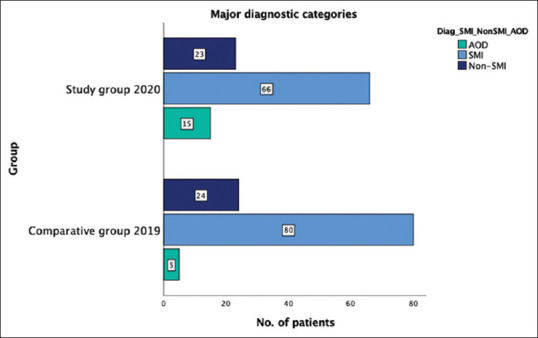
The study and control groups included 104 and 109 patients, respectively. Compared to the control group, the study group had significantly more patients with separated relationship status, a lower number of severe mental illnesses (SMIs), a higher number of substance use disorders, and lower readmissions. A subanalysis within the lockdown period showed more voluntary admissions in the initial phase whereas more compulsory admissions in the later phase at trend significance.
Patients with a separated relationship status and a substance use disorder sought inpatient treatment more than others. Aside from exploring the reasons for these findings, it is also important to investigate why SMIs and readmissions decreased during the lockdown period through further studies.
鉴于关于新冠疫情相关封锁措施如何影响住院治疗可及性的研究匮乏,开展了本研究。
本研究旨在描述(1)接受住院治疗患者的特征,(2)住院时长和再入院情况,以及(3)封锁期间根据入院类型(自愿/强制)和隔离使用情况所体现的护理质量和安全性。
在西北区精神卫生服务中心进行的这项比较性数据库研究中,研究组包括在2020年3月16日(维多利亚州开始实施社交距离措施时)至2020年5月12日(社交限制开始放宽[第一阶段]时)期间入院的患者。对照组包括在2019年3月16日至2019年5月12日期间入院的患者。医院数据库为信息来源。
研究组和对照组分别包括104例和109例患者。与对照组相比,研究组中处于分居关系状态的患者显著更多,严重精神疾病(SMI)患者数量更少,物质使用障碍患者数量更多,且再入院率更低。封锁期间的亚分析显示,初期自愿入院患者更多,而后期强制入院患者更多,具有趋势显著性。
处于分居关系状态且患有物质使用障碍的患者比其他人更倾向于寻求住院治疗。除了探究这些发现的原因外,通过进一步研究调查封锁期间SMI患者数量和再入院率下降的原因也很重要。